



Budapest Ferenc Liszt International Airport attracted 19.6 million passengers in 2025, representing a 12% annual increase in passenger traffic, according to the operator Budapest Airport.
Budapest attracted 4.7 million guest nights in H1 2026, with foreign visitors representing 85% of this, CBRE calculates. By 2030, Oxford Economics believes the number of international travelers could increase by a further 48% over the 2026 baseline.
Against this backdrop, the historic center of Budapest has seen several high-end hotel redevelopment and renovation projects undertaken. The mid- to high-level strata is also attracting developers and leading hotel brands, says Marius Gomola, managing partner at Horwath HTL Hungary.
Reflecting robust demand, the Budapest hotel market pipeline remains strong, with 1,850 rooms expected to be delivered in 2026, according to CBRE. The capital city has dominated development, while activity has faded in the countryside regions.
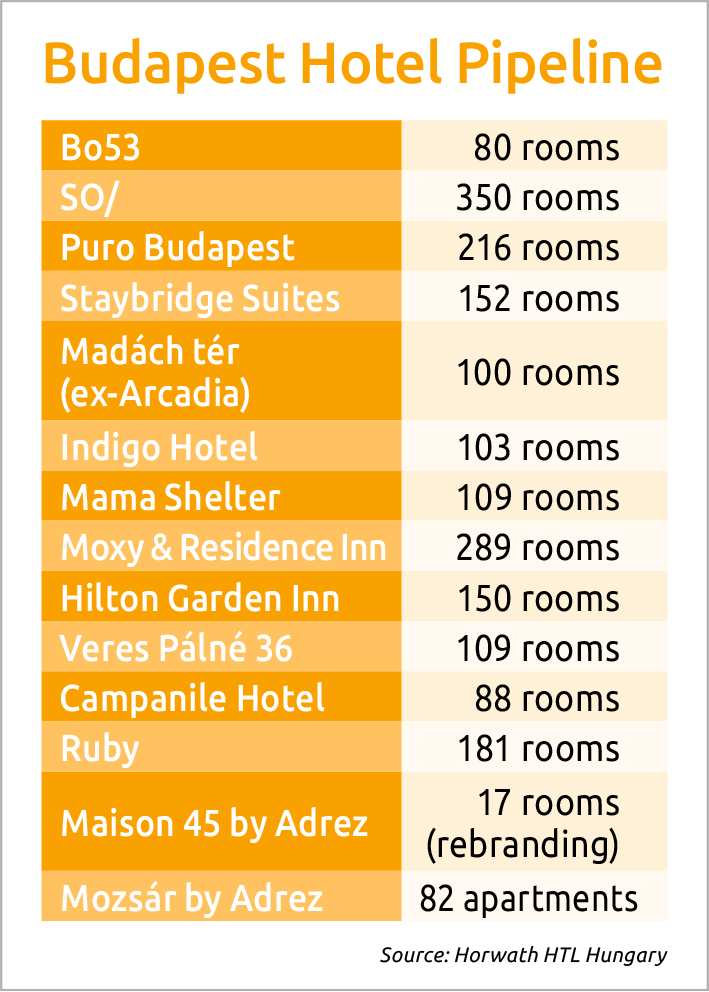
The Budapest pipeline for 2026 and 2027 is put at 14 hotel properties, with 2,026 rooms (excluding those that have already opened prior to the date of this article), according to Horwath HTL Hungary.
“More than 70% are upscale and over 20% are upper upscale, which would suggest that Budapest does not need midscale category hotels. This could not be further from the truth, and would be a very misleading conclusion. The high cost of land and construction pushes all developments to higher positioning for the business case to work,” explains Gomola.
With regard to development models, Mihály Schrancz, CEO and founding partner at Realis WAM, sees examples of both owner-operation models and lease arrangements.
“We expect continued strengthening across the hotel market over the next year, supported by further growth in inbound tourism, alongside increases in both ADR and RevPAR performance indicators,” he says.
“Traditional investors typically do not possess in-house real estate development capabilities and therefore tend to focus primarily on acquiring completed hotel assets rather than participating in development risk. The strategic question then becomes operational structure: whether to pursue owner-operation models or lease arrangements with professional operators,” he adds.
On design, CBRE says, “Distinctive architecture, rooftop bars, panoramic locations, and unique design features are increasingly viewed as tools for enhancing competitiveness and pricing power in an increasingly crowded marketplace.”
A notable trend in Budapest, as in Prague (both have UNESCO-protected world heritage sites), is the renovation and redevelopment of historic buildings, giving them new use-value while preserving the classical feel of the city center.
“The best performing hotels are in these interesting, historic buildings. The redevelopment of historic buildings offers a unique branding opportunity and capitalizes on Budapest’s rich cultural heritage, appealing to all levels of tourism demand,” comments Péter Takács, a partner at Newmark VLK Hungary and a hotel expert.
“However, such projects often face regulatory hurdles and higher renovation costs due to their preservation requirements. Undoubtedly, there is a lack of development sites in Budapest city center, with very few remaining. Given that tourism primarily occurs in the city center, the only viable option for the future will be to convert older, historical buildings,” he argues.
One notable heritage redevelopment in central Budapest involves Forestay Group and Recorde Asset Management’s collaboration on the redevelopment of Váci Utca Center at Váci utca 81. The former office building is being transformed into a dual-brand Marriott hospitality development comprising a 217-room Moxy hotel and a 72-suite Residence Inn by Marriott, for a combined total of 289 rooms and suites.
The developer was also involved in the Moxy Budapest Downtown, a separate hotel on Kazinczy utca, which opened in May with 281 guest rooms. Forestay says the Kazinczy Street Moxy is the first Hungarian hotel to receive full BREEAM certification at the “Excellent” level.
The SO/, Mama Shelter, Ruby and Julius Menl, proven lifestyle hotel brands that are entering the market, are a great step forward, according to Gomola. The opening of Adrez and the eventual entry of Numa, both with a digital focus combining living with hotel products, will make the Budapest hotel scene more versatile. The rebranding of the Matild Palace Luxury Collection by Marriott to the Matild Palace and The Ritz-Carlton Budapest will be the capital’s most high-profile rebranding when the scheduled interior redesign is completed, he adds.

ESG is playing an increasingly decisive role in hotel construction and development, in the view of Attila Radvánszki, another partner at Horwath HTL Hungary.
“Due to the growing demand for sustainability and social responsibility, these factors have also come to the fore in the hotel industry. Large financial investors, such as pension funds and insurance companies, are gradually increasing their investments in hotels,” he says.
“These investors place significant importance on sustainability when selecting and managing properties. Similarly, major private equity firms have begun to assess the environmental performance of their hotel assets, particularly in terms of progress toward carbon neutrality. However, it remains uncertain how these firms will handle properties that fail to meet sustainability standards,” Radvánszki cautions.
“In the design and construction of hotels, there is seen as an increasing emphasis on energy efficiency, water saving, and the use of renewable energy sources. Hotels that prioritize sustainability can reduce their operating costs by up to 20%, mostly energy costs,” he notes.
According to Schrancz of Realis WAM, it is interesting to observe the performance of five-star hotels.
“Although these assets have been delivered to exceptionally high architectural and interior design standards, achieving sustainable profitability has proven more challenging than initially expected. Nevertheless, these projects contribute significantly to the overall quality and international image of the city, and I remain confident that they will ultimately establish their position within the market,” he concludes.
This article was first published in the Budapest Business Journal print issue of October 19, 2026.


