

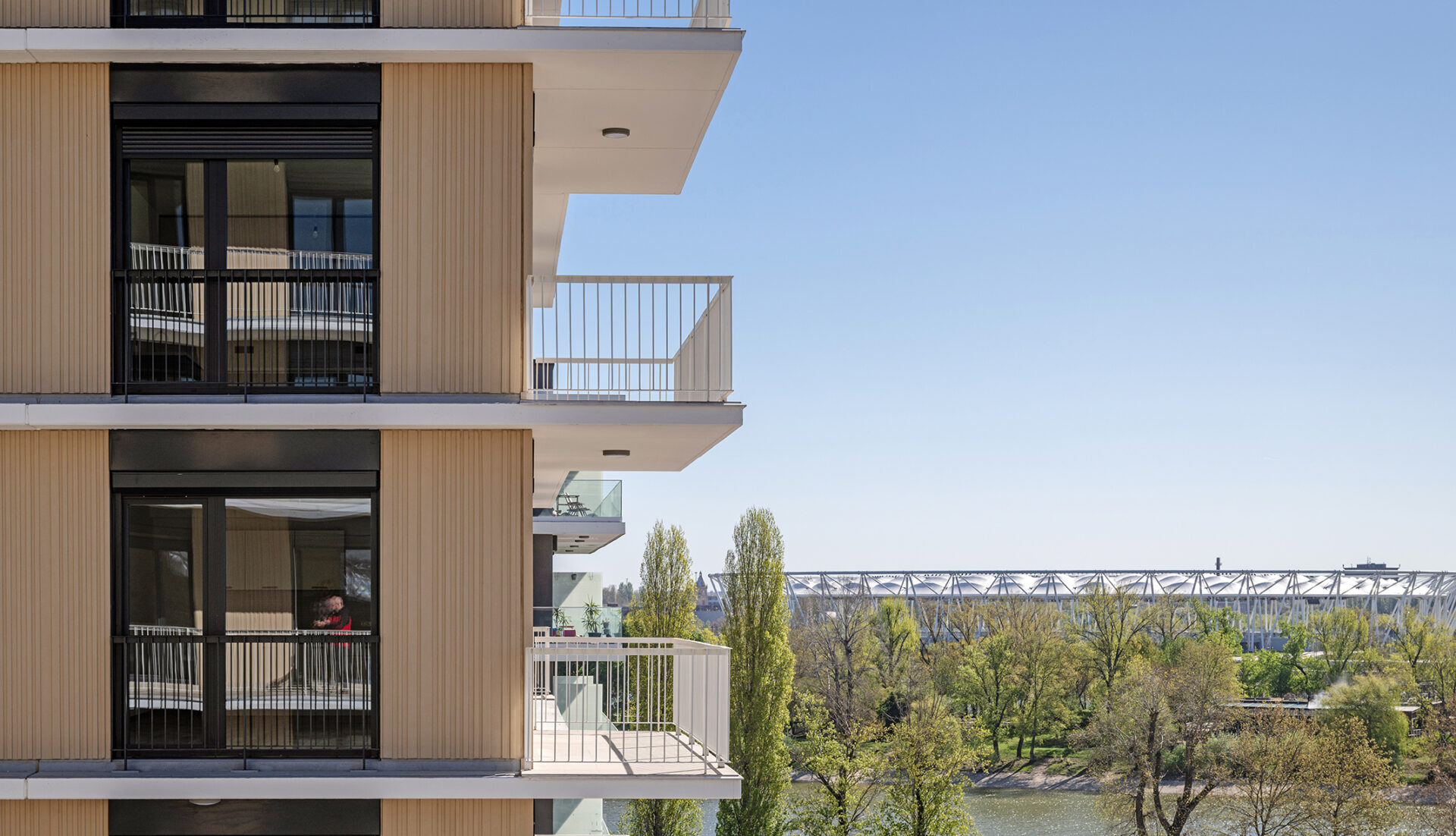

Growing urbanization and more sophisticated lifestyle and ESG-related requirements are putting pressure on developers, architects and asset operators to deliver higher-quality developments. Further, the rental and student accommodation markets are growing, with the private rental sector seen as a promising sub-sector for long-term investment.
Wider concerns remain about the pace of residential unit delivery and the growing housing affordability gap. The government is under pressure to increase the supply of affordable quality housing and the availability of mortgages, a common theme across major cities in Europe.
Hungary needs an estimated 25,000 new apartments per year to keep pace with demand. Géza Germán, deputy CEO of Óbuda Group, does not see this as realistic in the near term.
“The 2025 level is still far from the annual target of 25,000 units, even if the increase in permits signals some improvement. Housing output is driven not just by regulatory objectives, but also by capacity, financing, land availability, permitting processes, and viable product offerings,” he notes.
“Residential construction appears to have gained some momentum: according to data from the Hungarian Central Statistical Office, more than 6,200 new homes were completed in the first half of 2026, approximately 22% more than in the same period a year earlier,” Germán says.
Reflecting growing residential demand in Hungary, several commercial real estate developers have multi-apartment projects under way.
“Most successful residential developments provide a strong retail and service environment either within the project or in the vicinity. ‘15-minute cities,’ where residents can access most daily necessities (work, shopping, education, healthcare, and leisure) within a 15-minute walk or bike ride are very popular among city dwellers,” comments Tibor Tatár, deputy CEO at Wing Development.
“If part of this concept can be reproduced on a smaller scale within mixed-use developments, it will meet strong market demand. This approach is reflected in our Greenway project on Váci út in District XIII, where the residential component has already been launched,” he says.
A good development today must be climate-conscious, accounting for shading, cross-ventilation, usable outdoor spaces, proximity to services, and pedestrian-friendly urban connections. The internal quality is equally critical: flexible, functional floor plans, sufficient storage, low energy demand, good acoustics, cycling infrastructure, and genuinely usable shared areas all make a real difference.
“I prefer to start by looking at the neighborhood as a whole,” outlines Germán. “A downtown site and a suburban site require different design responses. Density, functions and services will differ, as will the transport system, the surrounding environment and the lifestyles of future residents,” he adds.
Marco Nobel, founder and CEO of the student and flex living operator Fuse, stresses commute time rather than transit in the abstract. The threshold is under 20 minutes to faculties, he says.
“For a premium product that should be within walking distance. For a more affordable product, public transport is fine as long as it stays within 20 minutes. Budapest has five or six well-defined areas where most of the faculties are concentrated, and we evaluate a property position against those rather than against the city center,” Nobel says.
As with other market sectors, a growing number of new developments feature improved energy efficiency and use renewables. However, third-party green certifications such as BREEAM and LEED are not yet widely used in residential projects. The motivation for long-term ESG-compliant buildings remains an open question when so many residential development models are sold to individual buyers.
“For build-to-sell, there is very little motivation beyond complying with building and construction codes. The pressure simply is not there,” argues Nobel. “Build-to-rent is different, and the motivation is usually attached to the funding. If an institutional investor requires ESG compliance, it becomes very important very quickly,” he notes.
“Where the operator fits in is worth separating out. Once a building is designed and completed, we have limited influence on the environmental side, because that was settled at the design stage. We have a great deal of influence on the social and governance side, and both carry real weight in the overall score. So ‘E’ is largely a development-stage decision, and ‘S’ and ‘G’ are an operating one,” Nobel says.
“The single most important thing is that the operator is involved from the design stage. Come in after completion and you inherit decisions that cannot be undone, and most of the chances to optimize the building have already gone. Sustainability in a residential scheme is really decided twice: once by the developer at design stage, and then again, every year afterwards by whoever runs it. Almost all of the attention goes to the first decision. We are the counterparty to the second one, across 17 locations in Budapest for more than a dozen separate owners,” he adds.
With thousands of new units being delivered across Budapest and other Hungarian cities, there is a unique window of opportunity to embed health-promoting features from the design stage, rather than retrofitting them later at greater cost, according to Regina Kurucz, managing director of Rewell Consulting and a WELL assessor.
“Standards like the WELL Building Standard provide a science-backed framework to guide developers in creating spaces that actively support residents’ physical and mental health. I am, therefore, happy that there is now a multi-apartment residential building in Hungary registered for WELL Residence certification, the BAM Living Kispest,” she says.
On the challenges facing the residential sector, Óbuda’s Germán argues that predictability should be the priority. “We need stable rules and a common understanding of them: the developer, the authorities and the design team should have the same interpretation of the constraints of the site, the required studies and the consultations that will influence the permitting process. Only then can a reliable project schedule be developed,” he says.
“For larger or more complex developments, we organize structured»consultations with the project stakeholders at an early stage. Municipalities, relevant authorities, and utility providers can share their most useful input while the design can still be meaningfully adjusted. Early consultation does not, of course, constitute preliminary approval, but it can prevent a great deal of unnecessary redesign later,” he says.
Tibor Nagygyörgy, CEO of Biggeorge Property, is one of the leading residential developers in Budapest. He agrees with Germán about predictability. “What is needed is a comprehensive housing strategy,” he says. “This should include faster, more predictable permitting; incentives for build-to-rent and institutional residential investment; support for brownfield redevelopment; infrastructure-linked zoning; and a stable VAT framework for new homes. Equally important is improving construction-sector productivity and addressing labor shortages.”
This article was first published in the Budapest Business Journal print issue of October 19, 2026.
Producing journalism that is worthy of the name is a costly business. For over 30 years, the publishers, editors and reporters of the Budapest Business Journal have striven to bring you business news that works, information that you can trust, that is factual, accurate and presented without fear or favor.Newspaper organizations across the globe have struggled to find a business model that allows them to continue to excel, without compromising their ability to perform. Most recently, some have experimented with the idea of involving their most important stakeholders, their readers.
We would like to offer that same opportunity to our readers. We would like to invite you to help us deliver the quality business journalism you require. Hit our Support the BBJ button and you can choose the how much and how often you send us your contributions.


