

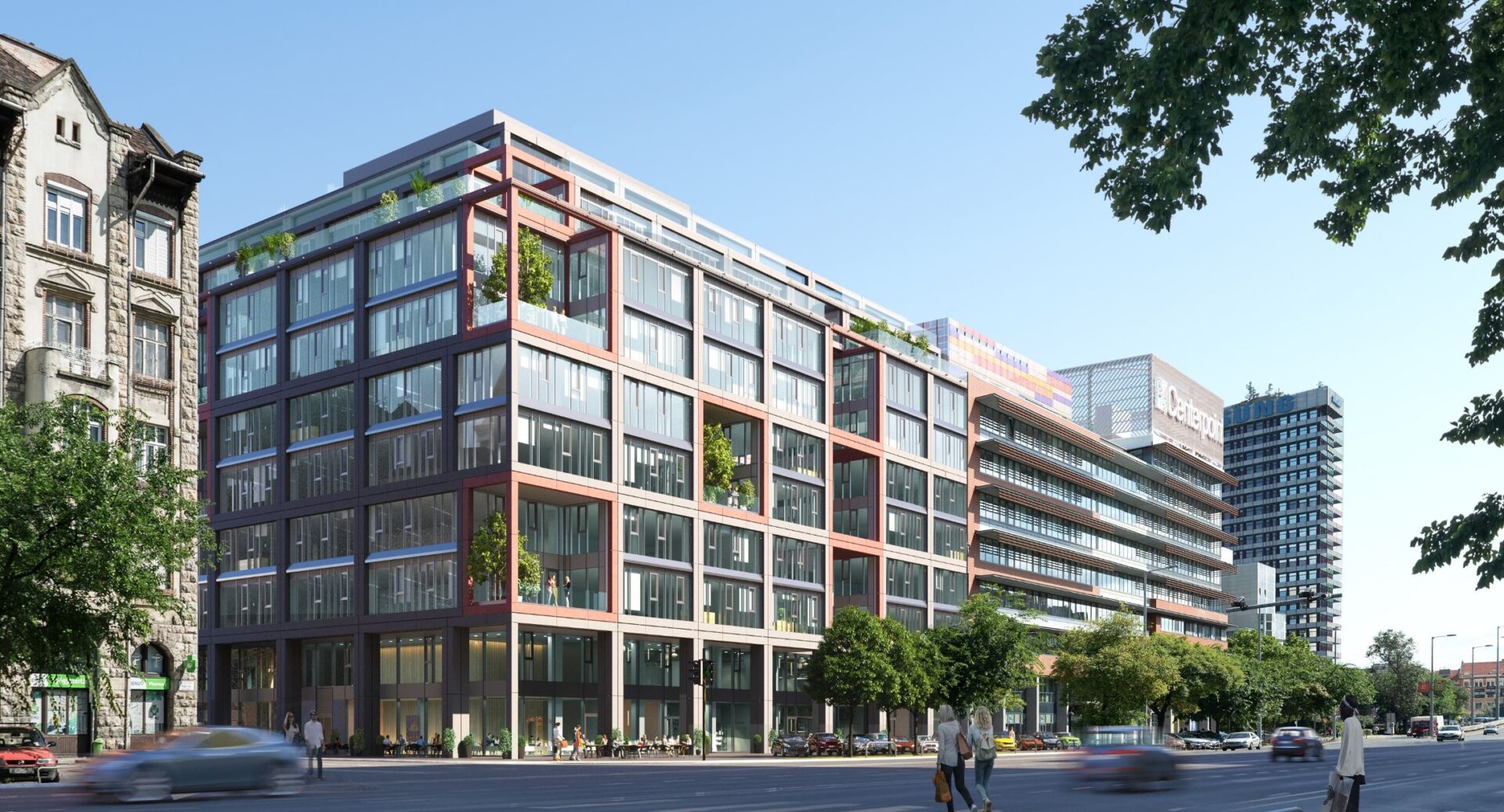

A small pool of Hungarian and regional developers are pursuing cautious development strategies against a background of high construction costs, a challenging financial environment, and uncertainty over the future of office demand. Analysts say only the best-designed, most ESG-compliant, sustainable, and centrally located developments will succeed in an increasingly demanding office market. This is also creating a gulf between newer and older assets.
“A clear two-tier market is emerging, with strong occupier demand focused on modern, ESG-compliant buildings, while older, non-compliant stock is experiencing increasing vacancy and downward pressure on rents,” says Valter Kalaus, managing partner of Newmark VLK Hungary.
Aurelia Luca speaks for Skanska, where she is executive vice-president for operations in Hungary and Romania. She believes the firm is on the right side of that divide. “We are confident in the long-term demand for well-located, high-quality and adaptable offices in Budapest, but we do not expect demand to be distributed evenly across the market,” she says.
“Occupiers are scrutinizing energy performance, operating efficiency, flexibility and workplace quality more closely, while investors are also looking at the long-term relevance and resilience of the asset,” Luca comments.
Consultancy Cushman & Wakefield has traced 17 office projects due to be delivered by 2027, only three of which are speculative. Overall vacancy stands at above 12%, though it is expected to fall as new supply dries up. Total Budapest office stock approaches 4.5 million sqm, according to the Budapest Research Forum (CBRE, Colliers, Cushman & Wakefield, Eston International, iO Partners, and Robertson Hungary).
CBRE has traced 480,000 sqm of office space under construction in Budapest, of which 80% is already pre-let. A key market feature is the number of public-sector occupiers looking to move into new offices following a drive from the previous government. The Zugló City Center project, for example, with about 150,000 sqm, could represent 45% of this year’s office delivery. Districts XIII, XI, and XIV are the most popular Budapest office locations.
The first half of 2026 confirmed the underlying resilience of office markets across the Central and Eastern European region. Beyond these headline figures, the market is charting a clear course, with new supply subdued and construction only gradually recovering. Rents are trending upward across the region, according to JLL and iO Partners.
“CEE office markets are entering a new phase of tightening supply: resilient occupier demand, falling vacancy and limited new development are strengthening landlords’ positions and driving rental growth, particularly for high-quality, newly built assets,” comments Péter Würsching, head of leasing for office and industrial at iO Partners Hungary.
However, the paradox of the Budapest office market is that, despite demand for quality space, tenants tend to stay where they are because of budget concerns. As a result, renewals are dominating market activity rather than new contracts.
CBRE agrees that pre-lease availability is limited and that relocation and fit-out costs are leading occupiers to renew existing leases rather relocate. In the first half of 2026, leasing renewals represented 53% of total leasing activity. Given elevated construction costs and persistent financing challenges, large-scale, speculative developments are expected to remain limited. Instead, the consultancy says BTS projects and location-driven boutique developments, typically below 5,000 sqm, are likely to play a growing role.
In the second quarter, lease renewals accounted for 62% of total demand, compared with just 27% for new leases. This suggests that occupiers remain active but are prioritizing cost optimization and existing commitments over expansion or relocation, adds Valter Kalaus, managing partner of Newmark VLK Hungary.
“Against this backdrop, developers continue to be much more selective, requiring a meaningful level of pre-leasing prior to launching a new development, which is keeping speculative supply limited in the near term, with 119,000 sqm under construction. At the same time, there is still uncertainty around the future evolution of vacancy and its impact of government-related offices and changes in the amount of space occupied by such organizations,” argues Kata Mazsaroff, managing partner at Colliers Hungary.
In a rare speculative office development, GTC has received the occupancy permit for Centerpoint 3, the latest phase of the Centerpoint office complex located in the Váci Corridor. The new building offers 36,600 sqm of modern office, retail, and service space, developed to LEED “Gold” certification standards. The completion marks the final phase of the overall project, which now comprises more than 77,000 sqm of office, retail and leisure space.
In a top-of-market speculative office transaction, Skanska has sold the 22,000 sqm second phase of its H2Offices complex to Erste Open-Ended Real Estate Investment Fund, represented by Erste Alapkezelő. This is the second phase of the 67,000 sqm total development in the Váci Corridor and marks the fund’s sixth office building acquisition from Skanska in Hungary.
“The sale of H2Offices Phase II, fully leased to a long-term tenant, reflects the strength of the project and continued investor demand for high-quality, sustainable offices in Budapest,” says Katarzyna Zawodna-Bijoch, president and CEO at Skanska’s commercial development business unit in CEE. The project is targeting LEED “Platinum,” WELL “Platinum,” and Access4You “Gold” certifications, reflecting its focus on energy performance, accessibility, and user well-being, according to Skanska.
“Looking ahead, I expect even greater emphasis on measurable results and transparent reporting throughout the lifecycle of a building. The industry is moving from talking about sustainability ambitions to demonstrating performance in practice,” adds Skanska’s Luca.
Questions about the Budapest office market center on whether low delivery and falling vacancy will drive rental increases and when new development projects will start. One element appears certain: only high-quality, well-located projects will succeed in the current office market.
“The most competitive developments will be those capable of combining ESG performance, operational efficiency, occupier experience, and future flexibility within a stable and predictable investment framework,” concludes Kalaus.
This article was first published in the Budapest Business Journal print issue of October 19, 2026.
Producing journalism that is worthy of the name is a costly business. For over 30 years, the publishers, editors and reporters of the Budapest Business Journal have striven to bring you business news that works, information that you can trust, that is factual, accurate and presented without fear or favor.Newspaper organizations across the globe have struggled to find a business model that allows them to continue to excel, without compromising their ability to perform. Most recently, some have experimented with the idea of involving their most important stakeholders, their readers.
We would like to offer that same opportunity to our readers. We would like to invite you to help us deliver the quality business journalism you require. Hit our Support the BBJ button and you can choose the how much and how often you send us your contributions.


