



The conference also aimed at aligning the initiative with the United Nations’ Sustainable Development Goals and positioning sustainability as a priority in education, research, innovation and campus operations.
ELTE says its Sustainability Flagship Program, formally introduced on Jan. 23, marks a shift in which sustainability will play a determining role not only in academic content but also in how the institution manages its campuses and builds community.
The program is one of three closely connected ELTE flagship initiatives. The Sustainability Development Goals University Center sits alongside the Knowledge Center for AI and Disruptive Technologies and the Student-centered Digital Skills and Competence Development Center, launched in December 2025.
The Budapest university says the flagship structure is intended to provide a single strategic and planning framework for modernization efforts that can strengthen its social responsibility and international competitiveness.
In his opening address, Lénárd Darázs, the rector of ELTE, said sustainability is one of the most complex strategic initiatives and a potential “breakout point” for the institution. He emphasized that the approach requires an institution-wide mindset and actions that are measurable and capable of feedback.
ELTE intends to align its activities with the UN’s SDG framework to make them transparent and comparable. The stated goal is a resilient, future-proof university environment, with sustainability reflected in teaching, research and ELTE’s broader public engagement.
The objective is to embed sustainability at a systemic level across the university’s operations. ELTE says this includes teaching, research, innovation, campus development, community building and the provision of equal opportunities. By setting a single strategic frame, the university aims to link initiatives that might otherwise remain fragmented and to support coordinated planning and implementation through to 2030.
Conference presentations approached sustainability from governmental, university and international perspectives and discussed both domestic and global contexts. State Secretary for the Circular Economy and Climate Policy Csaba Gondola of the Ministry of Energy described sustainability as a defining global megatrend in which the green and digital transitions are occurring simultaneously.
He argued that it should be treated not as a choice but as an unavoidable necessity. Gondola said universities are key actors in knowledge-based adaptation, helping societies respond to rapid change through research, education and practical solutions.
He argued that environmental aims must be paired with economic and social sustainability to deliver an “orderly transition” that communities can actually support.
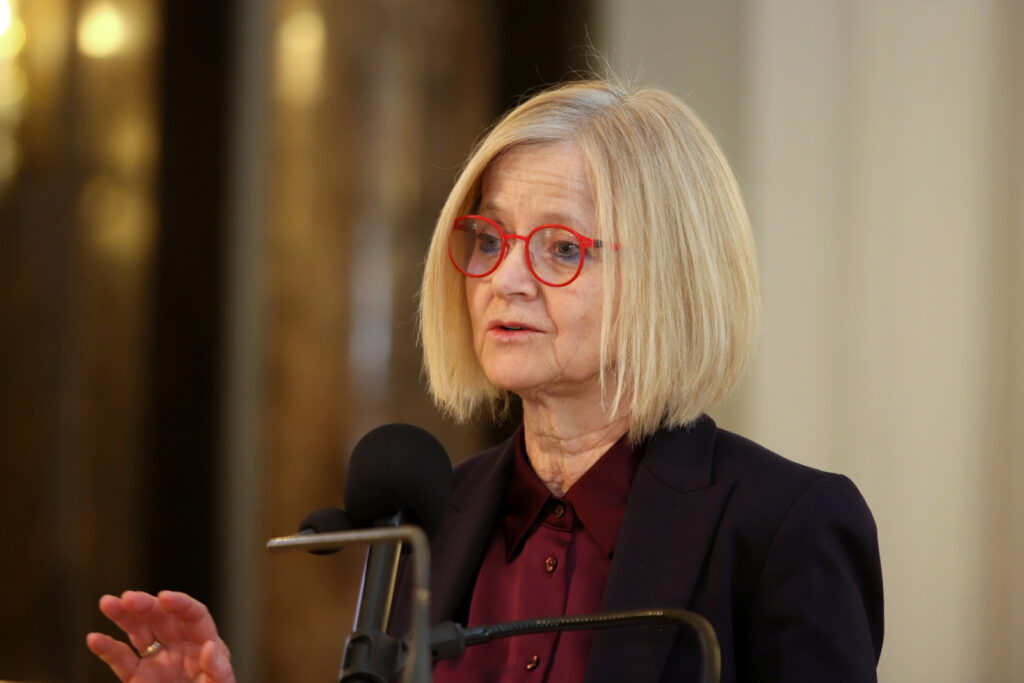
Judit Mádlné Szőnyi, ELTE’s general vice rector and coordinator of the program, presented the framework’s foundations and future vision. She said sustainability is an integral part of ELTE’s quality development plan to 2030. The program, she added, is built on three main directions: implementing the flagship project itself; developing core activities from an SDG perspective; and applying equal opportunities and inclusion as horizontal principles across the institution.
A core message of the launch was that ELTE is treating sustainability not as an add-on but as an area where the university already has a measurable baseline. Mádlné Szőnyi outlined an analysis, described as internationally novel, that used artificial intelligence to map ELTE’s education and research activity.
The results suggest that ELTE’s sustainability footprint is already extensive: more than 76% of its research portfolio, covering 375 projects, is linked to sustainability goals. The university also reported that 62% of taught courses have sustainability relevance, and that sustainability-related activity is visible in ELTE’s “third mission” work as well, including knowledge transfer and community-oriented programs.
ELTE highlighted its strengths in research and teaching innovation, citing ELTE-led national projects such as TinLab and DOKK (see separate box). It also noted that knowledge transfer linked to development efforts is strengthening, particularly in technology, the circular economy and climate, and referenced efforts to ensure research results have a wider impact.
Beyond research and teaching, sustainability was also presented as a factor in campus development and operations, including energy and building renovations, accessibility improvements, and awareness-raising community programs.
ELTE says the Sustainability Flagship Program is a way to provide a clearer vision, operating framework, structural focus and development directions for sustainability-related development in the coming years, supported by monitoring, data and institution-wide coordination.
The international dimension was highlighted through the Charm-EU university alliance. Ferenc Takó, head of the Charm-EU office, said the alliance supports ELTE’s sustainability goals through shared teaching innovation and sustainability-focused educational elements, including modules, micro-credentials, and winter and summer universities. He also pointed to the development of mobility and virtual collaboration models designed to support joint work across institutions and teams.
Looking ahead to the 2030 development cycle, ELTE says sustainability is intended to become a foundation of institutional operation and culture, supported by a unified data system and measurable targets, while delivering performance that stands out, even in international comparison.
The National Laboratory for Social Innovation (Társadalmi Innovációs Nemzeti Laboratórium or TinLab) was established in the fall of 2020 to implement innovations that contribute to society’s well-being and foster new social partnerships and cooperations. Among the consortium partners are the universities of Miskolc (representing Northern Hungary) and Pannonia (Transdanubia).
The Digital Education Development Competence Center (Digitális Oktatásfejlesztési Kompetencia Központ or Dokk) aims to ensure the digital-technological and methodological development of higher education, providing methodologies and digital frameworks that institutions can apply directly, as well as tailored content that best supports effective competence development. Among the consortium partners is Gábor Dénes University.
This article was first published in the Budapest Business Journal print issue of February 13, 2026.


