



In line with changing market demands, Wing says it will reposition the site for mixed-use purposes: according to the current concept, alongside the existing office space, more than 500 apartments as well as retail and service functions could be included in the development, which is close to Hungária körút in District VIII.
Wing sees the project as simultaneously expanding its Budapest office portfolio with a modern “A” class office building and creating the opportunity for a larger-scale, multi-phase urban development.
The developer plans to convert the structurally complete building to create more than 200 homes in the first residential development phase, with subsequent phases bringing the total number of apartments to over 500. The homes from the first residential development phase, expected to launch next year, could be completed as early as 2028.
“One of the most important elements of the development concept is the coordination of the various functions. Wing’s goal is to create a more active urban environment, offering more services and green spaces, on a site that currently remains partially underutilized,” says the new owner.
“The value of a transaction like this does not simply lie in acquiring an existing property or development site, but in the opportunity to rethink a well-situated urban location in line with today’s needs,” adds Tibor Tatár, head of residential and office developments at Wing Hungary.
The acquisition is consistent with Wing’s long-term investment strategy, which focuses on high-quality assets in prime locations capable of delivering stable returns, according to the company. As such, Olympia represents another landmark addition to Wing’s Budapest portfolio, which has recently expanded to include Capital Square, the Greenway project, and the development site at 39 Váci út, the future KPMG headquarters.
Wing’s legal advisor was Oppenheim Law Firm, while iO Partners and CMS Hungary represented Atenor. K&H Bank is providing financing for the acquisition of the existing office building forming part of the complex, with legal support from Baker McKenzie Budapest.
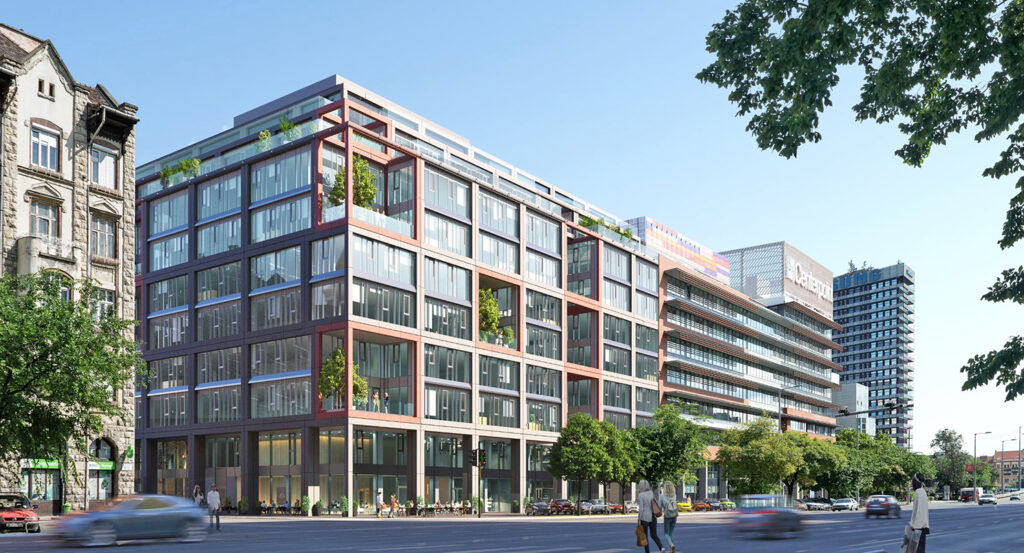
GTC has received the occupancy permit for Centerpoint 3, the latest phase of its office complex located in the Váci Corridor. With this milestone, the company says it has completed one of the largest new office developments delivered in the Hungarian capital in recent years.
Centerpoint 3 offers a total of 36,600 sqm of modern office, retail and service space. Developed to achieve LEED “Gold” certification, the building includes landscaped terraces and an internal garden.
“Receiving the occupancy permit for Centerpoint 3 further strengthens GTC’s position among the leading asset managers in Hungary,” says Botond Rencz, CEO of GTC Group. “We have delivered a building that meets the highest standards of sustainability and workplace quality. The project attracted tenant interest even before construction was completed, confirming both the appeal of its location and the quality of the space on offer,” he adds.
Centerpoint 3 will soon become the new headquarters of Uniqa Hungary, which has leased more than 6,000 sqm of office space in the building. The company is expected to relocate later this year. Discussions with additional occupiers are currently underway, according to GTC.
The completion marks the final phase of the Centerpoint complex, which now comprises more than 77,000 sqm of office, retail, and leisure space in District XIII. GTC’s portfolio in Hungary comprises office and retail properties with a total gross leasable area of nearly 240,000 sqm.
Across all its markets, the company has developed 82 office buildings and shopping centers totaling 1.4 million sqm. GTC currently manages a portfolio of 43 properties offering 723,000 sqm of leasable space in major cities across Belgrade, Bucharest, Poland, Sofia, and Zagreb, as well as Budapest.
The low speculative office pipeline in Budapest is widely predicted to result in a reduced supply of modern, quality, well-located contiguous office space that meets tenant demands, ESG expectations and EU Taxonomy regulations, despite rising overall vacancy rates.
This mismatch is also creating a gulf between quality, ESG-compliant space and older, non-compliant offices in terms of commercial viability and the possibility of an exit strategy for owners.
Cushman & Wakefield has traced 17 office projects due to deliver by 2027, with only three being developed on a speculative basis. Overall vacancy stands at 12%, although this is expected to fall as new supply dries up. Total Budapest office stock stands at approaching 4.5 million sqm according to the Budapest Research Forum, consisting of CBRE, Colliers, Cushman & Wakefield, Eston International, iO Partners, and Robertson Hungary.
This is far from a uniquely Hungarian trait, however. The lack of modern, well-located ESG-compliant speculative office development is a common theme across Central and Eastern European capitals. The total area of modern office space in Prague reached approximately 3.95 million sqm at the end of the second quarter of 2026. During the period under review, only one office project was completed, the extensive renovation of the Danube House building in Prague’s Karlín district, according to Colliers.
The supply of high-quality office space in Prague remains limited, and the vacancy rate stands at 5.8%: the lowest level since 2020. Across Prague, approximately 310,000 sqm of office space is currently under construction, of which about 58% has already been pre-leased. However, a significant portion of this volume consists of projects being developed directly for future owners or anchor tenants.
This article was first published in the Budapest Business Journal print issue of September 4, 2026.


