

Listen to the audio version of this article (generated by AI).
Listen to the audio version of this article (generated by AI).

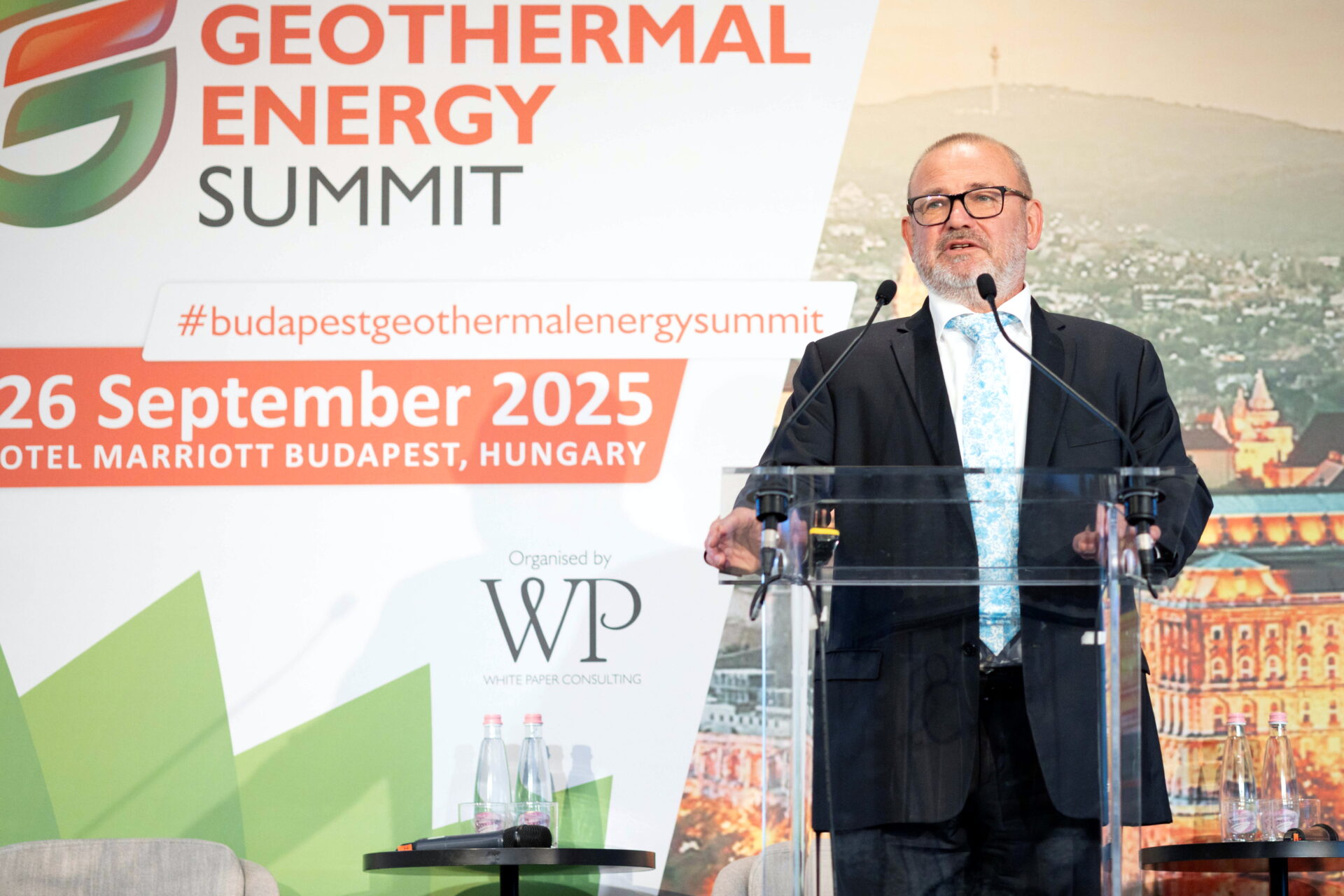
Hungary, its neighbors in the Carpathian Basin and several other European Union countries have excellent potential to expand the use of geothermal energy for heating and power generation, numerous speakers attested during summit sessions at the Budapest Marriott Hotel.
“As you may know, in Hungary, similar to many Central European countries, there are district heating systems. Roughly 670,000 flats [use] district heating, and 10% already use geothermal [sources], but our intention is to double this number, and we are on track,” Hungary’s Minister of Energy Csaba Lantos declared in his keynote presentation.
Such progress would form the backbone of the country’s target to replace one million cubic meters of natural gas, that is roughly 12% of current consumption, within the next decade, he said.
To enable these plans, Hungary announced a new regulatory regime in 2023 designed to attract investors and clear the way for rapid development. Measures include a “drilling-risk reduction program,” whereby a successful exploration will receive a 10% subsidy upon completion, while an unsuccessful venture will receive a 50% compensation payment (with a cap) on the drilling costs. These policies are beginning to yield results.
“We are very proud that more than 100 drilling research permits have been requested, and more than a dozen extractions have already happened,” Lantos said, citing geothermal projects at the MTK Sports Park in Budapest, MOL’s refinery at Százhalombatta and the Lego factory in Nyíregyháza.
Speaking for Europe, Miklós Antics, president of the European Geothermal Energy Council (EGEC), the industry’s leading lobby group, was arguably even more ambitious.
Proclaiming geothermal energy as “potentially the largest and presently the most misunderstood source of energy in the world today,” he said EGEC’s target was to move “from megawatts today to gigawatts, so as to provide 75%of district heating and cooling from geothermal resources, 65% for agrifoods, 15% of electricity production and 10% for critical raw materials.”
This was no Utopian vision, Antics asserted, as there are 193 geothermal power plant projects under investigation, along with “more than 500” geothermal district heating plants currently being planned. “It’s getting to be tremendous activity,” he enthused.
However, the EGEC president cautioned that geothermal projects “do not happen with the click of fingers,” and that commissioning “may take three to five years, or even more.” Indeed, as the summit progressed, it became increasingly clear that the technical, legal, commercial and even social issues surfacing in the dash to exploit geothermal potential have been and are causing setbacks.
Take, for example, the case of Hungarian state electricity company MVM’s first push into geothermal waters. A year ago, at the previous Geothermal Summit, Csaba Kiss, deputy CEO, declared that the state-owned electricity company was targeting 100 MW of geothermal generating capacity by 2035. However, MVM’s projects were to be purely for generation purposes, as the company seemingly had no desire to complicate matters by dabbling in heat production.
Twelve months later, plans had changed: while the 100 MW target remains, Kiss quietly changed emphasis at the latest summit, noting the need to generate both power and heat to justify geothermal investments.
He also repeatedly stressed the uncertainties in his presentation, citing, among other factors, the need “to drill 3,000 or 3,500 meters deep, which is very costly and very risky,” along with the necessity “to find fluid with a temperature of at least 100°C.”
Tímea Ladi, head of geothermal and new energies at Hungary’s MOL Group, also underlined the need to manage risks carefully in geothermal exploration to achieve commercial success.
Asked whether MOL, with its long history of drilling for oil and gas, could transfer the knowledge to geothermal, she responded: “I think it’s definitely a match made in heaven, because we know geological risk; it’s our daily bread to work with geological risk.”
She added, with perhaps a whiff of Schadenfreude vis-a-vis the difficulties encountered by MVM: “I don’t want to repeat the financial analysis, because that was also our [conclusion], that power generation has to go hand-in-hand with heat sales because [only] this team of services can provide a decent return on the risks taken in geothermal exploration and drilling.”
While a Polish speaker at the summit spoke of the difficulties in finding investors willing to fund district heating projects where profits are legally capped at 6%, Horia Ban, president of the Romanian Geoexchange Society, bewailed the typical time required to obtain the necessary permits.
“It can take two years to gather the authorization for drilling, [that is], if you get it!” he lamented. Even Germany, a country renowned for its administrative efficiency, has hit roadblocks.
“The problem is the municipalities, they are not competent, and if they start to drill, they go on a learning curve and then […] that’s it. So the learning curve dies and it’s not transferred to the next developer,” Inga Moeck, board member at Bundesverband Geothermie, noted among a list of issues.
“About delays: The geological drilling uncertainty and brine quality uncertainty, these can go both ways. The results could be worse or better than expected. [But] the third, the schedule: I’ve never seen a project executed in a shorter period than expected; it’s always longer. And that’s a challenge, especially for private investors, who have a very determined project period because of their payback requirements, and hence their budget periods. Sometimes, it’s very difficult to re-allocate a budget from one period to another.”
Gábor Molnár, managing director, Arctic Green Engineering Services, Hungary
“We all know in this room that sometimes there is a shortage of equipment in Europe, because the equipment very often is to be found in projects in Asia. So, I’m wondering why not a regional kind of common purchasing of the cleanest equipment, which is, of course, the most expensive, but by sharing the burden and purchasing jointly, we can actually have the cleanest drilling equipment out there, and it can rotate between the countries, based on integrated schedules. Why not, right?”
Suzana Carp, co-founder, CleanTech for CEE
“Denmark is a great example for district heating. […] The district heating in the cities is generally integrated systems, so not fragmented, and even though they don’t have [as] high [geothermal water] temperatures as in Hungary, they push geothermal and biomass, and you can enter the district heating market if you are the cheapest. You can sign a contract for, I don’t know, 25 or 50 years; there is no regulation that says this is going to be the tariff for next year, so it gives flexibility. I»would highlight Denmark in this case.”
Tamás Pazsiczky, partner with consultancy EY-Parthenon, Hungary
This article was first published in the Budapest Business Journal print issue of October 3, 2025.
Producing journalism that is worthy of the name is a costly business. For over 30 years, the publishers, editors and reporters of the Budapest Business Journal have striven to bring you business news that works, information that you can trust, that is factual, accurate and presented without fear or favor.Newspaper organizations across the globe have struggled to find a business model that allows them to continue to excel, without compromising their ability to perform. Most recently, some have experimented with the idea of involving their most important stakeholders, their readers.
We would like to offer that same opportunity to our readers. We would like to invite you to help us deliver the quality business journalism you require. Hit our Support the BBJ button and you can choose the how much and how often you send us your contributions.


