



The European publication, “Switch to Inclusive Design 2.0,” states that accessibility today encompasses much more than physical access. It also shows how we can work together responsibly and effectively to achieve it, says contributing developer Skanska.
“A space might be physically reachable but still difficult to use: too bright, too loud, too overwhelming,” the report, created by the Polish Integracja Foundation, in collaboration with several partners, including Skanska, emphasizes. It stresses how complex sensory experiences shape spatial perception.
“Elements like noise levels, lighting, materials, and colors can impact how welcoming a space feels, just as much as a staircase or doorway width,” the report finds. It highlights, “Around 15-20% of users are affected by such environmental stimuli on a daily basis, yet their needs are rarely addressed during planning,” it argues.
“Some leading international companies like Skanska are already demonstrating what real inclusivity looks like in practice. Their office developments have received the Building Without Barriers certification, which confirms that these environments are not just accessible, but livable for all,” comments Aurelia Luca, executive vice president of Skanska’s Commercial Development Business Unit in Hungary and Romania.
“At Skanska, we believe that truly inclusive design begins with a deep understanding of the diverse people who engage with our spaces; not only our tenants but also visitors and the broader community. This principle is at the heart of everything we do across Hungary, exemplified by our H2Offices project in Budapest,” she adds.
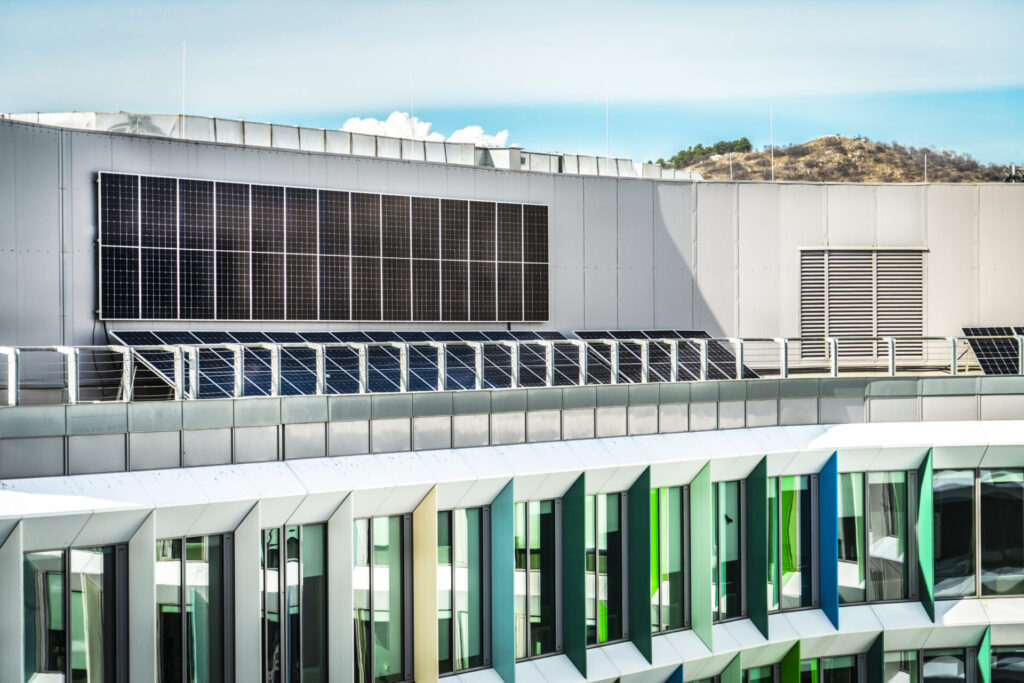
Nearly 150 solar panels with a total capacity of 81.76 kWp have been installed on the roof of phase one of the Budapest One office building. The green energy generated by the system further reduces the building’s emissions while also lowering energy costs for its tenants, according to its developer, Futureal.
The 146 solar panels collectively generate 80,000 kWh of energy annually, reducing the building’s carbon dioxide equivalent emissions by nearly 18 tons each year. Their installation means Budapest One’s energy performance certificate rating has improved from “CC” to “BB.” The green energy generated by the system could result in annual savings of several million forints, which will proportionally reduce tenants’ energy costs.
“From the very beginning, our goal with Budapest One was to create a human-centered, sustainable building that meets even the most demanding expectations of our tenants,” says Gábor Radványi, chief architect and head of sustainability at Futureal.
The 66,000 sqm Budapest One complex has achieved “Gold” Access4You certification for its outstanding accessibility and meets the top “Platinum” WELL rating. In addition, the development has achieved a BREEAM “Excellent” rating.
A new customs yard was inaugurated on Aug. 28 in Vác (35 km north of Budapest by road), according to state news agency MTI. The facility, built through an investment exceeding HUF 500 million, will serve the capital, northern Pest County, and Nógrád County, according to State Secretary Bence Rétvári of the Ministry of Interior, who spoke at the opening ceremony. He added that the full cost was borne by a company that had previously developed one of Hungary’s largest smart warehouses in Vác. Rétvári also noted that recent railway infrastructure improvements have enabled container trains from China to reach the region in 26 days.
Hungary’s luxury real estate market has cooled as wealthy buyers hold back ahead of next year’s elections, according to property broker Duna House, telex.hu reports. The number of transactions decreased by 4% in July compared to June and was down 18% from the same period a year earlier. Fewer foreign buyers are active, leaving domestic clients doing most of the purchasing, primarily for personal use. Duna House noted that luxury in Hungary means more than high prices, with unique locations, premium construction and amenities such as panoramic views, smart-home systems, pools and multi-car garages defining the segment. Despite the slowdown, demand remains steady for truly unique, top-tier properties, with prices varying widely: hundreds of millions of forints in the countryside versus billions in popular parts of Buda. After booming during the pandemic, the market has turned cautious, with fewer in-person viewings and longer decision-making times. Investment-driven purchases have declined due to weaker returns, while Hungarian investors increasingly look abroad, with destinations like Portugal and Dubai offering more attractive opportunities, albeit with higher risks.
This article was first published in the Budapest Business Journal print issue of September 5, 2025.


