



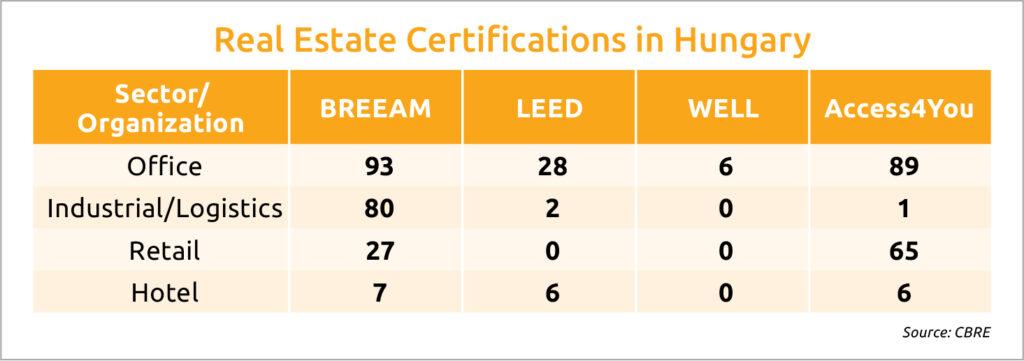
BREEAM is clearly the most popular third-party accreditation option in Hungary and the broader region, followed by LEED. Regarding interiors and accreditation relating to health and well-being, WELL, Access4You and others are also increasingly popular options.
“ESG certification schemes maintain rigorous standards to ensure the objectivity and independence of sustainability assessments,” comments Nándor Kovács, strategy director at Óbuda Group.
“For example, BREEAM requires a clear separation between the assessor and the design and consulting teams, with certification processes subject to strict methodological rules and third-party verification,” he notes.
“All schemes rely on an auditable trail of evidence and apply consistent quality management practices. The early engagement of consultants leads to better performance outcomes, allowing sustainability strategies to be embedded from the earliest stages of design and development,” Kovács adds.
The number of BREEAM accreditations has increased in recent years. The sustainability advisory Greenbors Consulting has traced 26 BREEAM certifications in Hungary for the first quarter of the year, while 88 were recorded across the whole of 2024.
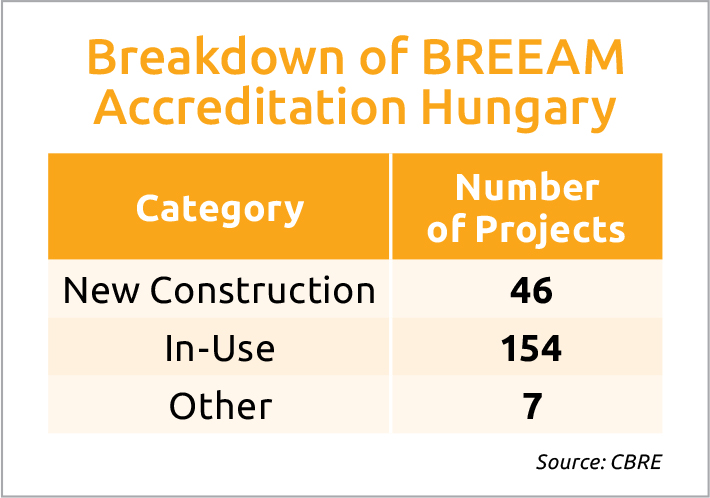
Far more were recorded in the BREEAM “In-Use” category compared to “New Construction.” These statistics include commercial office, retail, and logistics buildings, but no residential projects. Theoretically, residential buildings can also be certified, but there are few current examples.
“It’s unlikely that all offices will be required to be accredited, but there is a growing trend toward stricter sustainability regulations and market demand for green buildings,” says Zsombor Barta, founding partner of Greenbors Consulting.
“Over time, accreditation may become more common or even mandatory in certain regions or sectors as governments and organizations push for improved environmental performance and transparency,” he believes.
CBRE has recorded 93 BREEAM-certified office projects, 80 industrial and logistics developments, 27 retail and seven hotel accreditations as of the first quarter of the year, reflecting the move beyond the office sector.
BREEAM has become the preferred green building certification scheme in Hungary and across Central Europe for several compelling reasons, according to Barta. First and foremost, its flexibility and adaptability to local market conditions set it apart.
Unlike other international systems, BREEAM allows documentation and evidence to be submitted in local languages, free of charge for “In-Use” certifications, or with a modest fee in the case of “New Construction.” This makes the process far more accessible and efficient for regional stakeholders. Another major strength lies in BREEAM’s well-established framework for certifying existing buildings through its “In-Use” category.
LEED is primarily used by stakeholders with strong North American ties or by companies that have a global policy to employ the system. Its use in Central Europe is still relatively limited compared to BREEAM, although there are notable exceptions; Skanska, for example, uses LEED for all its developments across Europe.
Developers and owners face distinct challenges when opting for “New Construction” versus “In-Use” certifications.
“For ‘New Construction,’ the main hurdles include upfront design and planning to meet strict sustainability standards, integrating new technologies, managing higher initial costs, and coordinating multiple stakeholders early on,” Barta explains.
“In contrast, ‘In-Use’ certifications focus on existing buildings, where challenges revolve around accurately measuring and improving ongoing performance, retrofitting newer systems, engaging occupants, and balancing operational costs with sustainability goals,” he continues.
“Overall, ‘New Construction’ requires proactive planning and investment, while ‘In-Use’ demands continuous management and adaptation,” Barta says.
The higher number of BREEAM “In-Use” certifications compared to “New Construction” across the Central European region can be attributed to several factors.
“The ‘In-Use’ scheme is significantly more flexible and advantageous than similar offerings from other certification bodies, making it an attractive option for asset and portfolio owners,” Barta argues.
A key driver behind this trend is the strategic repositioning and upgrading of existing commercial properties. Owners are increasingly focusing on future-proofing their assets (whether through renovations, functional changes, or operational improvements) to meet evolving market expectations.
“This helps make properties more appealing to tenants, investors, and other stakeholders. At the same time, the Hungarian commercial real estate market is currently seeing relatively few new construction projects. This naturally shifts the emphasis toward maximizing the value and sustainability of existing buildings, further contributing to the popularity of the BREEAM ‘In-Use’ certification,” Barta adds.
Anna Bencze, head of sustainability at HelloParks, argues that it is unimaginable for a new industrial or logistics building to be on the rental market without such certifications.
“This is the case today with ESG, with demand continuing to grow and requirements becoming increasingly specific and stringent. On the other hand, the regulatory environment is also addressing the issue in a targeted manner,” she says.
“As things stand, from 2030 onwards, only so-called Zero Emission Buildings will be allowed to be built in the EU, which, among other things, excludes the use of fossil fuels on site. In my opinion, the regulatory environment is increasingly moving in the right direction, but at a slow pace,” Bencze adds.
As specialized “human-centric” accreditation systems have emerged, Cushman & Wakefield research indicates that nearly 50% of Budapest’s office market is already Access4you certified, with the Váci út Corridor leading at 64%.
Accessibility also correlates with building age; post-2020 developments tend to be the most inclusive, showing that such design is becoming an industry norm. CBRE has traced 89 office Access4you accreditations, 65 from retail and six hotels as of Q1 2025.
“A new trend has begun; alongside larger, more time-consuming and expensive building certifications, smaller ratings have emerged that make sustainable ratings accessible to a wider audience,” explains Regina Kurucz, managing director of Rewell Consulting.
“These smaller ratings focus on a specific aspect of a building, such as the WELL Health-Safety Rating for healthy building operations, the WELL Equity Rating for equal opportunities, Access4you for accessible and barrier-free solutions, ActiveScore for active transportation and amenities, and ModeScore for connectivity between buildings,” she notes.
According to international benchmarks, green buildings have on average 2-10% higher investment costs, but this green premium can pay off in as little as 3-5 years due to 25-50% lower energy and operational expenses. Sustainable buildings depreciate more slowly, providing more stable long-term returns, concludes Barta.
This article was first published in the Budapest Business Journal print issue of September 5, 2025.


