



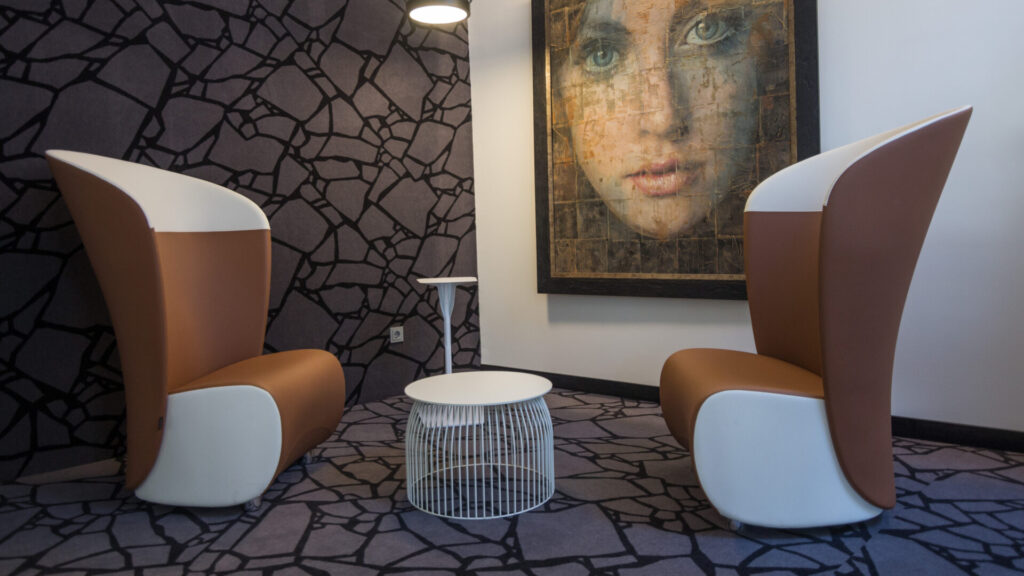
The ambiance of the venue matches the interview topic. The leafy Buda neighborhood offers a much-desired workplace lift with a cocktail of fresh air, little noise and sun-lit spaces. Europa Design has been a trendsetter in the local office furniture business for three decades, and founder Ottó Feuertag makes sure everything at the HQ is designed to promote that message.
“You need to consider a bunch of factors when it comes to office furniture because it all impacts us,” he explains to the Budapest Business Journal. Special padding absorbs sound waves and prevents echoes; colors partly contribute to that purpose, too, while also positively impacting colleagues’ moods and mental well-being. Feuertag notes that several other aspects must also be factored into interior design.
“Light, thermal comfort and access to water all matter; so do things that influence mental health,” he says. Nor should we forget ergonomics as a basis of physical well-being. Unsurprisingly, the push of a button can adjust the height of Feuertag’s desk, and his laptop is also fixed to a movable arm that allows the user to find the right angle.
These considerations are all part of the so-called Well Certification System, which assesses, evaluates and finally certifies the physical and mental impacts of the built environment on people. It encompasses all the traditional and forward-looking areas of the working environment, from ergonomics and interior design to robotically controlled engineering solutions.
Feuertag has been the ultimate representative of that program in this country since 2018, and as such, his mission is to encourage this human-centric approach to take root and become widespread across the nation. A board member and co-founder of the Well-being Association, he carries the flag by planning and completing tailor-made projects to align any workplace with the program’s priorities.
“In line with WHO and OECD recommendations, we consider it of the utmost importance that more companies in Hungary pay attention to the protection and development of their corporate well-being strategy, equally distributed as physical, mental, social and financial well-being.
This requires a thoroughly considered well-being strategy, with the sort of well-designed and high-quality programs that can only be achieved if organizations have skilled experts who not only have enthusiasm and dedication but also the proper knowledge of the subject.
Accordingly, the association organizes well-being ambassador and mentor training that enables businesses to have qualified on-site personnel to oversee and execute their own program and involve additional outside experts if necessary.
“We are talking about expertise that can come in handy in everyday operations,” Feuertag says. For instance, if you want to keep your workforce healthy by ordering fruit once or twice a week or involving services like office massage, yoga, or workshops on well-being topics, you need to be able to judge whether the produce or service is worth the price and whether its quality is consistent enough. If suppliers don’t comply with quality requirements or try to overcharge the company, new partners need to be sought. “This demands constant monitoring.”
The impact of noise exposure, lack of natural light, poor nutrition, and non-ergonomic chairs (to name but a few negative items on a well-being expert’s list) add up. Ideally, when a company is planning to move into a new facility, a detailed plan should be drawn up to check all the boxes to support a new office culture and style of hybrid work. A similar audit is recommended for existing operations. Relevant factors should be assessed and altered based on the expert opinion.
“Everything can be measured, and data can then be examined against the well-being index. Sadly, oftentimes companies are reluctant to carry out even relatively small investments although their multiplicator effect can’t be emphasized enough,” the Europa Design founder adds.
Most importantly, the company management should be made aware of how and to what extent the different aspects of well-being can improve staff’s everyday lives and, hence, overall productivity. Feuertag insists that this applies to BSCs in particular. Many don’t realize that around 75% of total operational costs are HR-related, against which all the rest, from rent to utilities to insurance and more, pale in volume and significance.
“Staff well-being can make or break the success of a company; therefore, I never understand when some executive starts moaning about the costs of related investments. The well-being framework exists for a reason, and it has been proven by hard data how much benefit different elements thereof contribute to talent retainment and productivity.” Not to mention that the value of high well-being index companies might be 153% higher, according to S&P statistics.
Feuertag is further convinced that the issue needs to be handled at the right level, which he says is not the case most of the time.
“Employee well-being is still disregarded or treated as a minor HR issue. Instead, it should be dealt with at the highest management level as it directly affects the company’s most valuable asset, its staff. Executives should make it a strategic part of their business plans, and HR professionals should, therefore, get a seat at that table to make management understand its importance. Only this leads to long-term business success,” Feuertag says.
When asked whether companies are beginning to sign up en masse to get Well-certified, given the importance of the above, the expert smiles.
“I believe this was a rhetorical question. There’s room for improvement when it comes to awareness; let’s put it that way. But that’s what we are also working on, to raise awareness, because it’s in the best interest of all stakeholders to embrace the values represented by the Well Certification,” he concludes.
This article was first published in the Budapest Business Journal print issue of February 7, 2025.


