



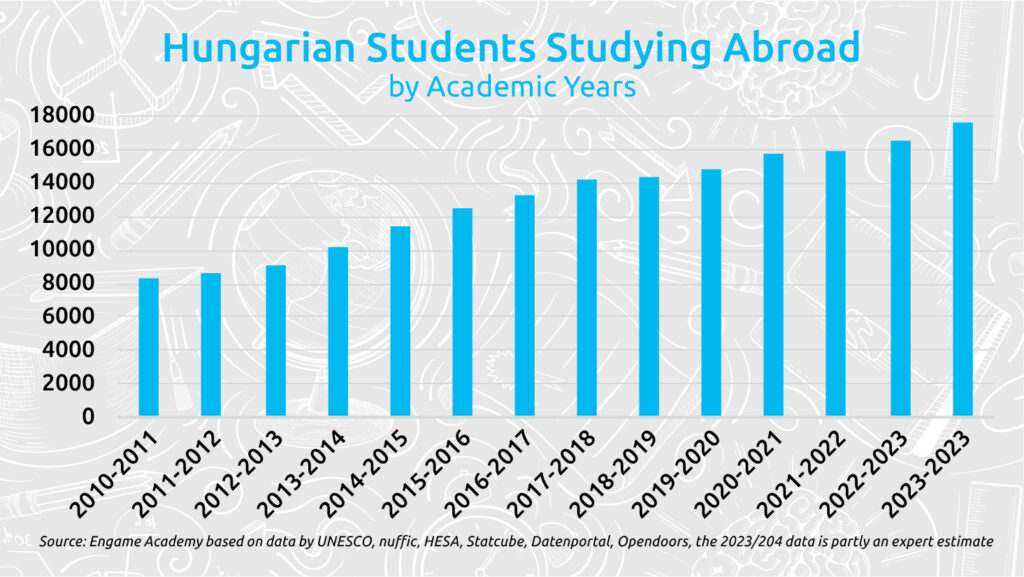
Hungarian youngsters continue to pursue opportunities to study abroad in ever larger quantities. The number has doubled since 2010, hitting the 17,500 mark in the current academic year. Even that figure doesn’t reflect reality in full, as registration of international students is not compulsory in every country.
The unbroken enthusiasm has much to do with the fact that Hungary’s highest-ranked higher education institutions are in the 600-800 range globally at best. Medical university Semmelweis is the only exception; even it “only” ranks in the top 300 worldwide.
The shift in financial conditions offers another explanation for the trend. When the number of government-funded university spots was dramatically slashed in 2013, it gave another push to the study abroad movement.
Even with that new reality in place, enrolment at prestigious Dutch universities isn’t necessarily more expensive than studying in the home country. The old saying “Go west, young man!” is being taken to heart by an increasing number of Hungarian youths, male and female.
The Netherlands has also been gaining in popularity since Brexit. The latter event restructured the landscape for EU students, who were often traditionally oriented toward the United Kingdom. The appeal of Dutch tertiary education lies in its extensive English-language programs, which cover a broad range of fields and are known for their modern teaching methods, practical approaches, and global outlook.
This availability of English-language programs is unmatched among non-native English-speaking countries, making it a top alternative to U.K. universities. Dutch universities also offer relatively affordable tuition rates, typically around EUR 2,500 per year, significantly lower than those in the United Kingdom or the United States.
“For the first time ever, more Hungarians study in the Netherlands than in pre-Brexit era Britain,” Rita Nádas, an educational leader at Engame Academy, highlighted as she presented recent research.
Today, there are nearly as many Hungarian students at Dutch universities as at German. However, things might become more complicated in the future as local student associations have initiated requests at the government level to cut back on English-language degree courses.
“This has to do with the fact that the Dutch are used to having interaction-based education, and overcrowded lectures undermine that principle,” Nádas explained.
All in all, Hungarians’ top country preferences haven’t changed. Austria still tops the charts, followed by Germany. Both offer tuition-free education, are relatively affordable and are close to the homeland. English-language offerings in German universities are gradually expanding. Both countries also provide excellent pathways for graduates to integrate into their respective labor markets.
Among the top five destinations are Denmark and the United Kingdom as well. The Danish higher education system lures applicants with its tuition-fee scheme. Although certain restrictions in terms of programs taught in English have been introduced, the fierce labor shortage the economy faces may be a pull in the opposite direction. Either way, British colleges are losing ground for understandable reasons.
“After Brexit, EU students are charged international fees that can easily exceed the GBP 30,000 mark as opposed to the GBP 10,000 U.K. fee,” Nádas says. “Attractive student loans are no longer available, and full scholarships don’t really exist at the undergraduate level.”
Not surprisingly, a mere 320 students applied to U.K. universities from Hungary this year, and the number of students at British higher education institutions is down to just over 1,100.
Apart from the Netherlands, Ireland is another beneficiary of the post-Brexit landscape. “You can nicely pair courses which Hungarians should find attractive,” Nádas points out. Affordable tuition is another plus, and the EUR 3,000 administration fee usually doesn’t apply to Hungarians due to income-based financial support. There’s a catch, though.
“The Irish convert foreign high school diplomas at a devalued rate, which means foreign applicants are disadvantaged compared to locals, hence need to deliver much better results,” Nádas warns.
Cross-border educational adventures are not necessarily the privilege of the wealthy. If students work in the Netherlands, the government matches their salary, which should enable them to make ends meet. Receiving professional guidance at home, which can be a critical component to gaining admission abroad, is not beyond reach, either.
The Engame Academy offers supplementary education to Hungarian high school students, with particular regard to preparing them to study abroad, and is accessible for youngsters with modest means too.
“We have helped 2,000-plus students enter the university of their dreams since our establishment in 2010, many of whom profited from our scholarship scheme,” CEO Ágota Bíró says.
Engame’s four-year program focuses on career guidance, life skills, and language development by covering a wide range of topics, one-on-one mentoring and field trips in different economic sectors. Their crown jewel is a 14 month university admission preparatory course.
“Spoilt for choice, students do need personalized guidance in this maze of admission rules,” Bíró added.
The statistics speak for themselves. This year, Engame’s 78 graduates had a 99% acceptance rate, the bulk of them landing at foreign universities. In line with current trends, destination No. 1 was the Netherlands, with 30% of Engame alums enrolling there.
“It’s so much more than calculating admission scores when it comes to applications. We help students find what fires them up and where they find the course most suitable to their needs,” Bíró explains.
“This could even be in Hungary. The bottom line is that they can make informed decisions about where and what to study, and thus gain the university education that will equip them to become confident, purposeful adults,” she concludes.
This article was first published in the Budapest Business Journal print issue of November 29, 2024.


