


Stagnating economies, high inflation and unemployment, even in the most developed countries, have led to many families sliding closer to poverty. For similar reasons, restaurants in Hungary are struggling, and the Hungarian government recently introduced a HUF 100 billion support program to improve the competitiveness and raise salaries in the sector. Even with a low turnover in restaurants, there is surplus food wasted, not only in hospitality but even more so in households.
While food waste is often perceived as a recent problem, it has been a concern for centuries. Before the industrial revolution, preserving food was difficult and relied mostly on salt and the lower temperatures in cellars, with the waste fed to the animals.
The advent of industry and technological innovation led to more efficient agriculture and mass production. The development of canned food and refrigeration technologies made food more affordable and easier to distribute. It became cheaper and more easily accessible, leading to greater consumption and more waste. Food was no longer a vital asset to be stored and shared carefully within the family.
According to data published last year by the UN Food and Agriculture Organization (FAO), about 19% of food, or one billion tonnes, is wasted globally every year. This is alarming not only because masses worldwide face food insecurity and hunger, but also because it contributes to greenhouse gas emissions and strains natural resources.
In the EU, about 60 million tonnes of food are wasted every year, amounting to more than 100 kg per inhabitant on average across the bloc. Most does not come from restaurants and food services, which actually account for only about 12% of food waste. Retail and food distribution generate even less, at 8%, or 10 kg per inhabitant.
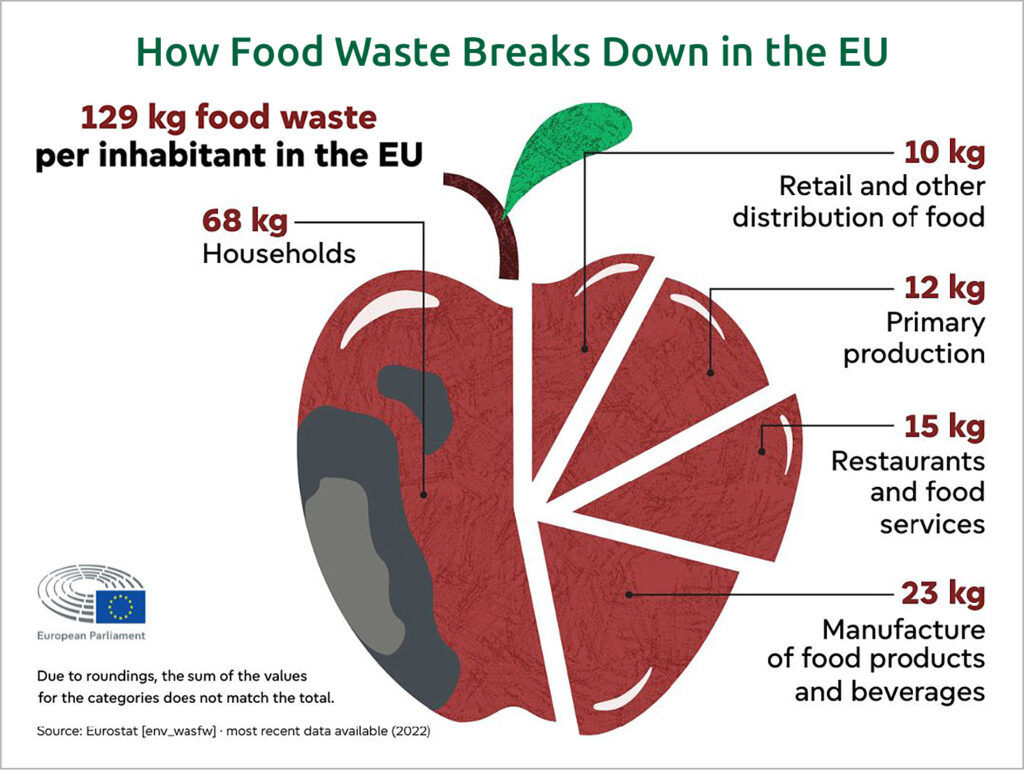
The main culprits in generating food waste in the EU are households (53%), while the processing and manufacturing sector accounts for 18%. Regarding specific countries, in 2022 (the last year for which full datais available), the average EU figure was 129 kg per inhabitant. Interestingly, there is no connection between food waste and a country’s economic development. Most food waste is generated by Denmark (254 kg), Greece (196 kg), Romania (181 kg), and Belgium (151 kg), closely followed by Ireland, France, Italy and Austria.
Hungary is among the most disciplined populations in terms of food waste, with the six least wasteful states being Spain (65 kg per inhabitant), Slovakia (71), Croatia (72), Hungary (84), Bulgaria (95), and the Czech Republic (101).
The EU has been developing increasingly ambitious policy measures to combat food waste. In 2025, the European Parliament adopted legislation requiring member states to cut food waste by specified percentages by 2030: for example, a 30% reduction for retail and household waste compared to recent baseline years.
Hungary began addressing food waste long before the measures adopted by the EP. In 2016, the Hungarian National Food Chain Safety Office (Nébih) initiated a “Maradék nélkül” (“Wasteless”) program, based on similar campaigns in the United Kingdom and the Netherlands. The Hungarian initiative led to significant declines in household food waste, estimated at 35% over eight years.
Another, more recent program has connected the Hungarian Food Bank Association (Magyar Élelmiszerbank Egyesület) and the Wolt food courier network. The partnership was created to ensure that surplus, high-quality food reaches the people who need it most rather than going to waste.
Since its launch last year, it has enabled 1,615 dedicated “food rescue” deliveries, through which 51,600 surplus meals were saved from being wasted and redistributed to people in need. The initiative has continuously expanded in scale, involving multiple restaurant partners and reaching a wide network of beneficiary organizations.
The solution is simple: Wolt Drive, a last-mile delivery solution any webshop can plug into, even if they’re not otherwise part of the Wolt service. It gives Hungarian businesses access to Wolt’s courier network for fast, tracked, on-demand, or scheduled deliveries, directly from their own website or app. Customers order on the merchant’s site, while Wolt only handles the delivery, and both the merchant and the customer can track the courier live on a map.
This cooperation connects restaurants, logistics, and social organizations through a streamlined, city-scale solution. Participating restaurants notify the Hungarian Food Bank when surplus food remains at the end of the day. The MEE coordinates the collection and identifies the most suitable recipient organizations, such as homeless shelters, family support centers, and social institutions.
Wolt couriers collect the surplus food directly from the restaurants and deliver it to the designated locations. Deliveries are carried out by bike or car, depending on volume and distance, using Wolt’s existing urban logistics infrastructure. Orsolya Hartyányi, managing director of Wolt Hungary, explained the reasoning for partnering with the Hungarian Food Bank.
“We believe that the technology and infrastructure we use every day in urban logistics can serve not only our customers, but also help us support our communities together. This collaboration is a perfect example of how restaurants and people in need can be connected in a way that ensures not a single portion of food goes to waste,” she says.
While it is not expressed explicitly, the goals of the partnership align with European Union priorities.
• It reduces food waste by rescuing fresh, ready-to-eat meals.
• It strengthens local communities by supporting vulnerable groups through trusted social organizations.
• It leverages existing technology and logistics for social good, without creating parallel systems.
• It demonstrates how corporate infrastructure can be mobilized for scalable ESG impact.
This article was first published in the Budapest Business Journal print issue of January 30, 2026.


