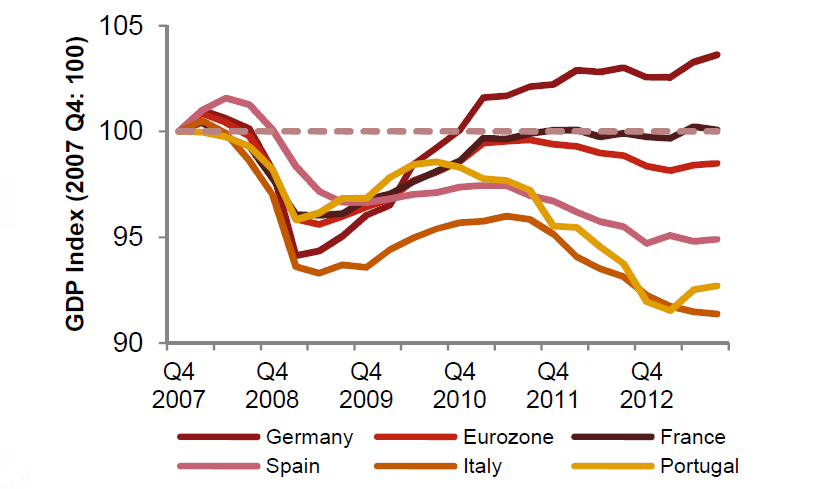
PwC found that, while significant gains in growth may be observed among the Gulf economies and the “Emerging Seven” (E7) nations (Brazil, Russia, India, China, Indonesia, Mexico, Turkey), that “even some positive news [came] out of the Eurozone”: According to PwC, “Q3 GDP data showed the bloc grew by 0.1% quarter-on-quarter, implying it is no longer dragging down global GDP.”
The analysis did note divergence between the more stable and “peripheral” economies within the Zone, however, with the latter still looking at “a long way to go to reach their pre-crisis GDP levels.”
PwC, which has maintained a view of a weak but gradual recovery for Eurozone economies in 2013, noted the nicely positive news of growth in Portugal and Spain, whose GDPs rose 0.2% and 0.1% q.o.q., respectively. On the minus side, while Germany has enjoyed 4% *growth* since the fourth quarter of 2007 (a boundary established by PwC to define “economic crisis”), Spain’s GDP is a whopping 5% below its level of the same period.
The current projection by PwC for 2014 has overall Eurozone GDP increasing by 0.9%, higher than the 0.7% prescribed to rejuvenate the bloc’s economies by 2015. The analysis points out, however, with the projections in place, the peripheral Italy would have to see average GDP growth of 4.1% over the next two years to regain pre-crisis levels.
Producing journalism that is worthy of the name is a costly business. For over 30 years, the publishers, editors and reporters of the Budapest Business Journal have striven to bring you business news that works, information that you can trust, that is factual, accurate and presented without fear or favor.Newspaper organizations across the globe have struggled to find a business model that allows them to continue to excel, without compromising their ability to perform. Most recently, some have experimented with the idea of involving their most important stakeholders, their readers.
We would like to offer that same opportunity to our readers. We would like to invite you to help us deliver the quality business journalism you require. Hit our Support the BBJ button and you can choose the how much and how often you send us your contributions.