



“I don’t want to talk about the economy because it’s awful,” retorted a young man in his early 20s, the first approached. Kornel, a 75-year-old retired agricultural engineer, was more forthcoming.
“From our point of view, as pensioners, inflation is higher. Maybe it is 5.5% in general, except I don’t buy ski gear every day because I don’t take trips abroad, but basic food inflation is very high. Sadly, I can see it [going] up and up,” he said.
Two others in their late 20s expressed gloom about the economy’s future, while a follow-up check on the Central Statistical Office’s data largely vindicated the retiree’s observations.
True, the official figure for average annual food inflation in January was “just” 6%, but within this, some basic products, such as flour, had soared by 43.2%, while milk and eggs jumped by 25% and 23.8%, respectively.
The numbers certainly surprised analysts, whose predictions for the month, according to an earlier Portfolio survey, had averaged a mere 4.9%. The reality, which followed a 4.6% rise in the consumer price index in December, meant a sharp deviation from the central bank’s 3% target, a figure briefly achieved in September last year.
It also gave weight to Minister for National Economy Márton Nagy’s words one day previously that the government might re-introduce price caps on staple food items to reduce the burden on the public. Meanwhile, analysts quickly revised their targets for the remainder of this year.
Zoltán Török, Senior Analyst at Raiffeisen Bank, told the Budapest Business Journal his estimate for average inflation had risen from “a little above 4% to around 5%.” In addition, he no longer expects any cuts in the base rate during 2025.
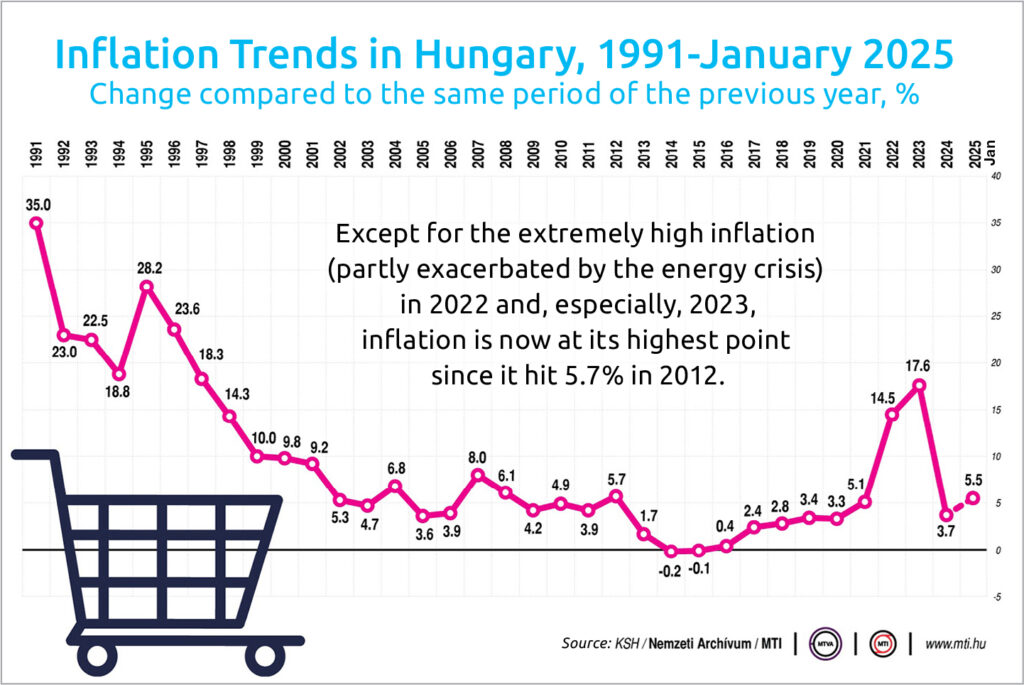
The January inflation figure also increases the risk of a budget deficit overrun. Török had already expressed “immense doubts” that the target deficit of 3.7% of GDP could be hit after the December inflation figures.
“The inflation upside surprise makes it even more difficult to meet the target this year; I think the deficit will be only marginally lower than it was in 2024 [at a preliminary estimate of 4.8% of GDP],” he said.
In near-perfect step with his Raiffeisen colleague, Péter Virovácz, senior analyst at ING Bank, raised his inflation prognosis for 2025 to 5.1%, noting in addition that it “poses a downside risk” to both this year’s economic growth, which he puts at a “moderate” 2%, and consumption outlooks, estimated in a range of 4-5%, and itself a key element of the expected increase in growth.
However, as the proverb goes, every cloud has a silver lining; in the case of January’s CPI number, this proved true regarding the foreign exchange markets, with the Hungarian currency appreciating a little against both the euro and U.S. dollar since players, including Török and Virovácz, reasoned the central bank would no longer be in a position to cut interest rates later this year.
The appreciation continued over the next week as markets factored in hopes of an end to the Ukraine conflict. The forint, which was trading around HUF 404.7 to the common currency early on Feb. 11, gained almost 1% to HUF 400.8 as this issue of the BBJ was being prepared for press a week later.
Yet, for all the recent strengthening of the forint (it has gained some 2.5% against the euro since the new year), both analysts consulted were predicting a value of around HUF 420 for the currency come the year-end.
“Based on the recent upbeat market sentiment that a peace deal could be reached in Ukraine, [emerging markets’ currencies], including [the] HUF, are stronger. But I don’t think this strength will remain with us for a long time,” Virovácz told the BBJ.
However, illustrating the uncertainties, he stressed that “an actual peace in Ukraine” could change this story, should it transpire.
Tuesday, Feb. 11, was not a good news day for the Hungarian Government: In addition to the unexpectedly high inflation rate announced by the statistical office, Transparency International released its annual “Corruption Perspective Index,” which rated Hungary as the most corrupt country in the European Union for the third consecutive year.
Moreover, the anti-corruption NGO’s 2024 report, published by its Berlin headquarters, revealed that Hungary had achieved 41 points on a scale from 0 (most corrupt) to 100 (least corrupt) in 2024. It was thus one point lower compared to its 2023 score in the global rankings, slipping from 76th to joint 82nd place, equal to countries such as Burkina Faso, South Africa and Cuba.
As TI’s Hungary office wrote in its executive summary of the report: “In 2012, Hungary was ranked 46th with 55 points, which means that in the last 12 years, Hungary has slipped 36 places and 14 points in the world corruption ranking.”
This performance means Hungary’s score has fallen the most among EU Member States in that period, overtaking Greece and Italy, which have fallen 13 and 12 points, respectively.
EUR 1 bln ‘Loss’
But what has all this got to do with the economy? Quite a lot, in TI’s assessment. First, there has been a direct impact in the form of EU funding cuts. As József Péter Martin, TI Hungary’s executive director, stated to domestic news outlets when releasing the report, “For the first time ever in the history of the EU, Hungary, because of systemic corruption and rule of law problems, irrevocably lost EUR 1 billion in cohesion policy funding in 2024.”
Worse still, the country is also at risk of losing EUR 10.4 billion, its share of the EU’s post-COVID-19 Recovery and Resilience Facility, unless it fulfills all 27 “super milestones” established by the European Commission as prerequisites for accessing this money.
Then there is what Martin termed the “vicious circle” of indirect effects caused by the debilitating impact of corruption on economic performance, which itself leads to more corruption, as documented by Nobel prize-winning economist Daron Acemoglu.
In Martin’s assessment, recent social and economic indicators, including health, education and productivity measurements, “clearly indicate that the Orbán regime has entered a vicious circle since the COVID-19 pandemic, with corruption undermining economic performance,” he said.
In response to the TI report, the Government Information Center wrote: “It has now become clear: [U.S. financier George] Soros and the [U.S.] Democrats jointly fund a network to fabricate lies about their opponents. Transparency International is also a member of this network, financed from rolling dollars. In addition, they also lie about Hungary, according to orders,” ATV reported.
This article was first published in the Budapest Business Journal print issue of February 21, 2025.


