



These two providers in Hungary now offer an alternative for conscious long-term savers using exchange-traded funds or ETFs.
“Einfacher geht’s nicht” (“It couldn’t be simpler,”) Dietmar Deffner says repeatedly in Germany’s most popular business podcast whenever he talks about ETF savings plans. His constant emphasis is that investing regularly and starting early in life will secure your wealth. The key to success is buying low-cost ETFs, which are ideal for building diversified portfolios and putting investments on autopilot.
Hungary has lagged in adopting structured ETF savings plans, leaving local investors to listen to Deffner’s low-cost ideas with envy. That has changed with K&H Értékpapír (Securities) and Revolut recently launching ETF investment programs.
Hungarian society is notoriously risk-averse, with around just 2% of households investing in the stock market. In Germany, that figure is closer to 20; in the United States, it is more than 60%.
The appetite to invest in the capital markets has been held back in Hungary partly because of harsh brokerage costs. The low-cost advantage of ETFs was offset by disproportionate service provider fees that limited the ability to regularly save in stock-exchange-traded products for those with moderate amounts to invest.
Enter the two newly introduced investment plans, and a whole new horizon holds the promise of growing a nest egg for all.
The launch of these products couldn’t come at a better time. Government-issued inflation-linked bonds have dominated household investments in recent years, offering double-digit returns. However, with yields now declining, many investors are seeking alternative avenues for long-term wealth accumulation.
K&H Értékpapír’s solution went live in January 2024 with 50 ETFs to choose from. The product has become popular, as reflected by an 8% boost in the total number of customers.
“We see ETF investing becoming increasingly popular among Hungarian investors,” says István Horváth, head of K&H Értékpapír, a member of K&H Group. “Our service allows clients to build diversified portfolios with significant cost advantages over actively managed funds.”
A key selling point of K&H Értékpapír’s plan is its cost structure. Unlike more traditional ETF purchases that incur a minimum transaction fee (typically EUR 6.99), K&H Értékpapír pools customer orders, allowing it to waive this fee.
Instead, it applies a 0.6% commission per transaction, a rate slightly higher than competitors like Erste, for example, at 0.35%. However, Horváth argues that the program’s convenience and the ability to purchase fractional shares justify the pricing. K&H Értékpapír’s Hungarian-language customer support and tax reporting integration further differentiate it from foreign fintech competitors.
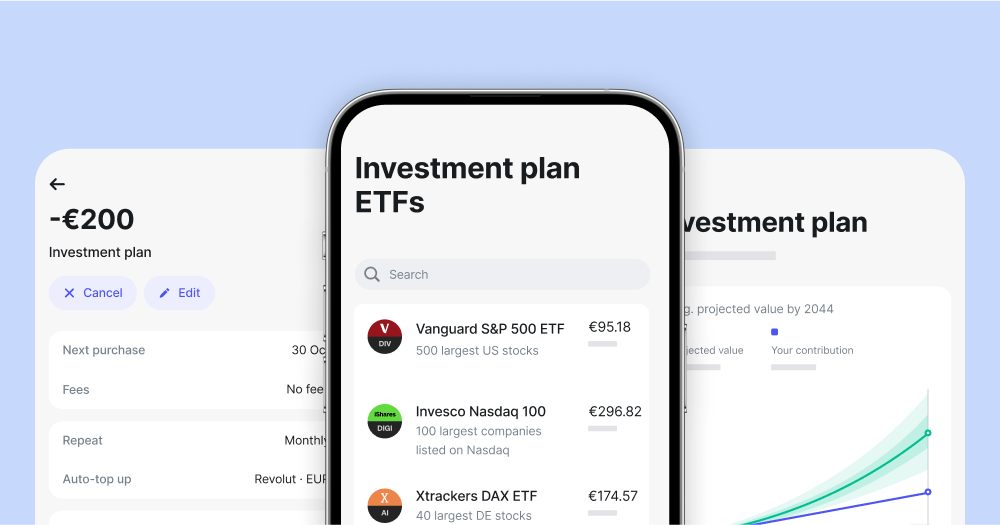
In contrast to a bank-led approach, Revolut’s ETF savings plan operates under an ultra-low-cost model.
“Our goal is to make investing easy, accessible, and affordable for everyone,” says Rolandas Juteika, head of wealth and trading for the European Economic Area at Revolut. “We do not charge commission fees for recurring ETF purchases, nor do we impose custody fees. Our revenue model allows us to maintain this structure without hidden costs.”
Revolut’s offering enables users to start investing from just EUR 1, with access to 300 ETFs. Couple this expansive selection with zero commissions, and it represents a significant advantage for cost-conscious investors. “Lowering the barrier to entry is crucial,” Juteika adds.
As stated in a 2023 study, “The ETF Savings Plan Market in Continental Europe,” by extraETF, 7.6 million ETF investment plans with an annual savings volume of EUR 15 billion were executed every month in continental Europe alone by the end of 2023.
“In Hungary, as in the rest of Europe, we see a shift toward long-term, passive investing. With our ETF plan, we expect to accelerate this trend,” Juteika notes.
Looking ahead, Revolut is also considering adding Hungary’s Tax-Advantaged Savings Account (TBSz) to its investment platform. “TBSz is part of our roadmap,” Juteika confirms. “Aligning with local tax regulations will enhance our appeal to Hungarian investors, making our platform even more competitive.”
Playing the TBSz card could be a game-changer for Revolut. The uniquely Hungarian scheme offers tax-free investment for a five-year period, an ideal setup for long-term savings like ETF investment plans. Add the ultra-low-cost feature, and competitors may have a hard time keeping up.
Both companies acknowledge the importance of financial literacy in driving adoption. K&H Értékpapír focuses on investor education through local content and support, including making available a video series that explains the importance of investments in an easy-to-understand fashion. Revolut, in turn, integrates learning modules within its app, helping users navigate the investing landscape globally.
As competition intensifies, both players will likely refine their offerings to attract Hungary’s growing base of retail investors. ETF investing in Hungary is finally stepping into the modern era, a long overdue turn of events that should draw more people than ever to start saving regularly and at reasonable prices at last.
This article was first published in the Budapest Business Journal print issue of March 7, 2025.


