



The Hungarian Banking Association initiative, extended to a month this year, showcases the sector’s commitment to corporate social responsibility and saving lives, has the support of the Hungarian National Bank (MNB) as a longstanding partner.
It aims to encourage bank employees to donate blood and promote the importance of this life-saving practice on a sector-wide level. The collective efforts of these employees are expected to contribute to the production of thousands of blood products essential for medical treatments and emergency care across the country.
This year, the event has expanded significantly into the Bank Blood Donor Month, from Oct. 8 to Nov. 8, with donation drives across 20 banking locations.
The participation of MNB executives and staff further elevates the initiative, underscoring the collaboration’s importance across the banking sector.
The technical coordination of the program is handled by the National Blood Supply Service (OVSz) and the Hungarian Red Cross, which ensure smooth operations and handle the logistics of blood donation drives. Apart from 18 sites in the capital, blood donations will also take place at regional bank offices in Nyíregyháza (232 km northeast of Budapest by road) and Békéscsaba (209 km southeast).
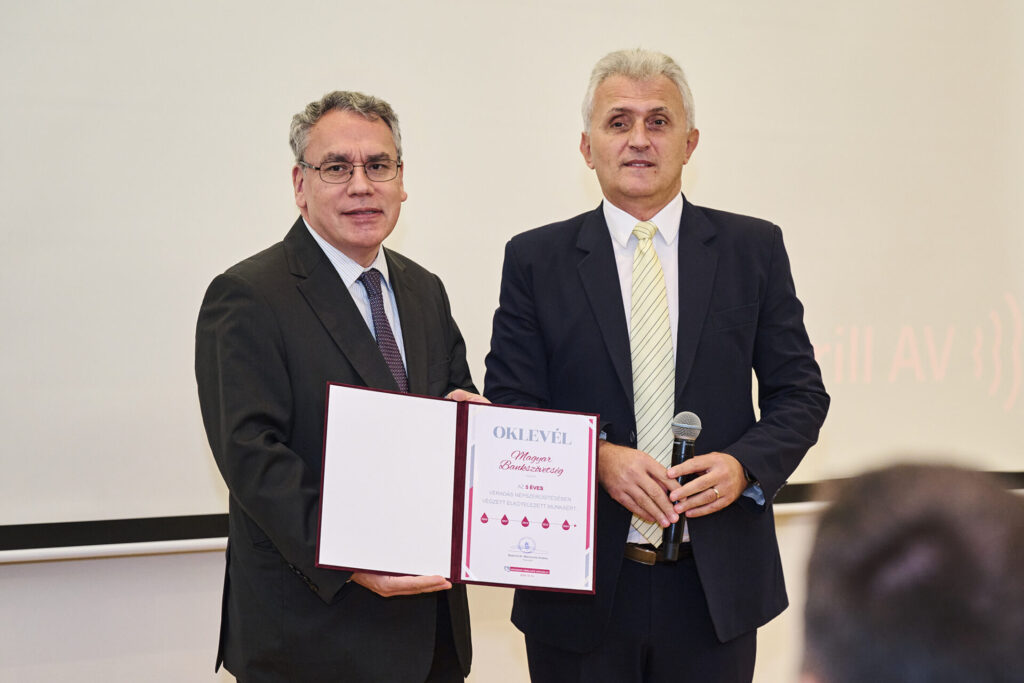
At the launch event hosted by UniCredit Bank, Deputy Governor of the Hungarian National Bank Csaba Kandrács emphasized the importance of the effort.
“Over the past year, the MNB has organized 10 blood donation events, with our colleagues participating more than 1,100 times, a nearly 10% increase from the previous year. These donations have directly contributed to the recovery of more than 3,000 of our fellow citizens, clearly demonstrating the immense power of collective action toward a shared goal,” he said.
Speaking at the event, Deputy Governor Virág Barnabás urged everyone to contribute regularly if possible.
“By donating blood multiple times a year, we are not only helping our fellow citizens recover but also reinforcing the importance of societal solidarity and mutual support. I extend my heartfelt thanks to all blood donors and hope that more people will follow the example set by the banking community,” he said.
Nagy Sándor, the deputy director of the National Blood Supply Service, expressed gratitude for the banking sector’s support of donation initiatives, noting the growing participation and the increasing number of volunteers. The program’s impact is steadily expanding, with the banking sector demonstrating its commitment to corporate social responsibility through active engagement in life-saving efforts.
As part of the program’s fifth anniversary, the National Blood Supply Service presented the Hungarian Banking Association with a certificate of recognition, honoring its outstanding organizational efforts. Radován Jelasity, chairman and CEO of Erste Bank, president of the association and a regular donor with more than 50 donations to his name, expressed his gratitude.
“I am proud of those who support others through blood donation, and I remain hopeful that the banking community’s example will inspire many more to get involved,” he said.
Kovács Levente, secretary-general of the banking association, emphasized the importance of extending the duration of the event to a month this year, recognizing the ongoing need for a reliable blood supply.
The Hungarian banking sector’s commitment to addressing this national need was formalized in 2020 with the launch of the “Good Deed Bank” initiative, a CSR program aimed at uniting member banks with various socially beneficial activities.
Alongside the high street banks, several high-ranking officials from the Ministry of Finance and the MNB joined forces in the program’s initial phase. Through initiatives such as educational programs, charitable donations, and support for cultural, social, and sports organizations, banks have demonstrated their dedication to fostering a more equitable society.
The program places particular emphasis on activities that enable bank employees to showcase their collective efforts, whether through helping to replenish blood supplies or promoting the spread of essential digital literacy skills.
By fostering a culture of giving and emphasizing the critical importance of voluntary blood donations, for example, the banking community sets a powerful example of how businesses can play a pivotal role in addressing societal challenges.
The Bank Blood Donor Week aims to assist the nation’s blood supply by encouraging bank executives and employees to contribute directly. Ensuring a safe and reliable blood supply in Hungary requires approximately 500,000 units of blood annually, which means the participation of around 500,000 voluntary donors. Daily, 1,600-1,800 donations are necessary, with a single unit of blood having the potential to help three or four patients.
The banking community’s involvement in the Blood Donor Week initiative has grown significantly each year, indicating that the program has achieved multiple objectives. First, it has successfully engaged an increasing number of participants during a critical period when the OVSz most needs to replenish blood stocks. Second, it inspires societal solidarity, encouraging others to participate in helping those in need.
With this year’s initiative expanded to a month, the sector’s collective efforts will have an even more significant impact, potentially saving thousands of lives nationwide. With the support of bank employees and volunteers across the country, the banking sector is proving that its role extends beyond financial services, encompassing the broader well-being of society.
This article was first published in the Budapest Business Journal print issue of October 18, 2024.


