

Listen to the audio version of this article (generated by AI).
Listen to the audio version of this article (generated by AI).

Any frustrated shoppers waiting in line at Hungary’s supermarkets to return cans and bottles while assistants strive to restore the machines that are key to the process back to working order may take comfort: their patience is contributing to an environmentally friendly operation with a turnover of up to HUF 750 million a day. And it’s the envy of the recycling universe.
At least, these are two conclusions implied by an early September press release from Mohu, the company that owns the equipment that, when fully functioning, gobbles up empty beverage containers, be they glass, aluminum or plastic, at an impressive rate.
According to Mohu, in 18 months, it has processed three billion spent containers, equating to 200 returns per second nationwide, with a daily record of 15 million sorted, squashed, and sent off on one day this summer.
In total, it also means the company has “paid HUF 120 bln for redeemable vouchers, which may have resulted in significant additional income” for the hosting stores.
All this, with an 80% redemption rate cited, presumably meaning four in five containers are returned for processing, the performance “far exceeds” both Mohu’s expectations and international experience to date, the release states (though it fails to supply any supporting evidence of the latter claim).
As for the future, Mohu says it is keen to broaden its network, currently at some 5,000 locations, primarily in small settlements and shops, as well as creating independent return points utilizing entrepreneurs.
To support this expansion, the Mohu release concludes with news that the company has raised the handling fee “much higher […] as an incentive for smaller shops and voluntary partners from September.”
So far, so good, it would appear for Hungarian recycling, the environment, Mohu and all concerned. But for Tamás Kozák, head of the Hungarian Retailers’ Association (OKSz), Mohu’s press release contained some bitter irony, as much for what it did not say as for what it did.
It is true, for example, that Mohu has significantly raised the return fee paid to small shops and entrepreneurs who host DRS machines.
As part of a package of fee adjustments, retailers with a floor space of less than 200 square meters have seen their reward for a returning container raised from HUF 7.5 to HUF 11.5 per item, a 53% increase from Sep. 1.
However, the Mohu release failed to include any reference to the fee paid to larger retailers with space above 400 square meters, which have seen the handling fee cut by HUF 4, from HUF 7.5 to HUF 3.5, in the same adjustment announcement.
News of the cut was met with dismay by Kozák and the larger, mostly foreign-owned retailers, whom he represents. In a response released on Aug. 1, OKSz said the fee changes would add HUF 6.5 bln in additional costs to its members, who are already hosting and operating the DRS machines at a loss.
Answering inquiries for this story, Kozák told the Budapest Business Journal that the Mohu fee change had been implemented as announced, with “no negotiations; Mohu dictated it.”
Indeed, from the very beginning, when Mohu began its 35-year concession as the monopoly operator on the DRS system in mid-2024, there have been no handling fee negotiations with the retailers, according to Kozák.
From their side, a financial study undertaken by OKSz members concluded that covering their operating costs (principally for staff employed to empty and dispose of the waste bins, plus the daily cleaning and the electricity demand by the DRS machines) would require a handling fee of HUF 10 per container.
The study, which was confirmed by the Hungarian consultancy Andersen Adótanácsadó as a reasonable assessment of costs, was forwarded to Mohu but was seemingly ignored, according to Kozák.
(Mohu stated in its press release that the recycling volume is such that “partners across the country have to empty an average of 50 vending machines per minute,” though this number also includes machines operated by smaller shops.)
The latest cut, Kozák said, applied to the larger retailers who together account for by far the bulk, between 70-80% of the total items recycled through the DRS system.
“Mohu is a subsidiary of [listed energy company] MOL, and they want to optimize profits […] but these [fee] changes do not make sense. The small retailers only process around 10%, maximum 20% of the [total recycling],” he added.
The OKSz retailers, however, are in a bind: by selling beverages, they are, by law, required to host the DRS machines to recycle the empties. Mohu, in practice, unilaterally sets the fees, Kozák said, despite the law requiring some kind of independent cost assessment mechanism to determine those fees, which Mohu is obliged to pay.
This mechanism “just doesn’t work,” Kozák says. Quizzed about other deficiencies alleged in Hungarian media reports, he claimed that Mohu had failed to fulfill its obligation to “deep clean” the DRS machines once a year in “more than 50% of cases.” But there is, it seems, some hope for progress in the current impasse.
“We are hoping for a solution for these problems with the new management of Mohu,” Kozák says, referring to recent changes at the top of the recycling monopoly.
Editor’s Note: The BBJ asked Mohu’s communications department for comments for this story, but no response had been received by our print deadline. We intend to return to the story once we get their input.
According to a European Commission directive, all EU member states have to implement a deposit return system (DRS) on drinks’ containers as part of the EU circular economy goals. Mohu, a Hungarian acronym for the recycling firm, which is a subsidiary of state-owned oil and gas company MOL, controversially received a 35-year monopoly concession to manage and handle this task.
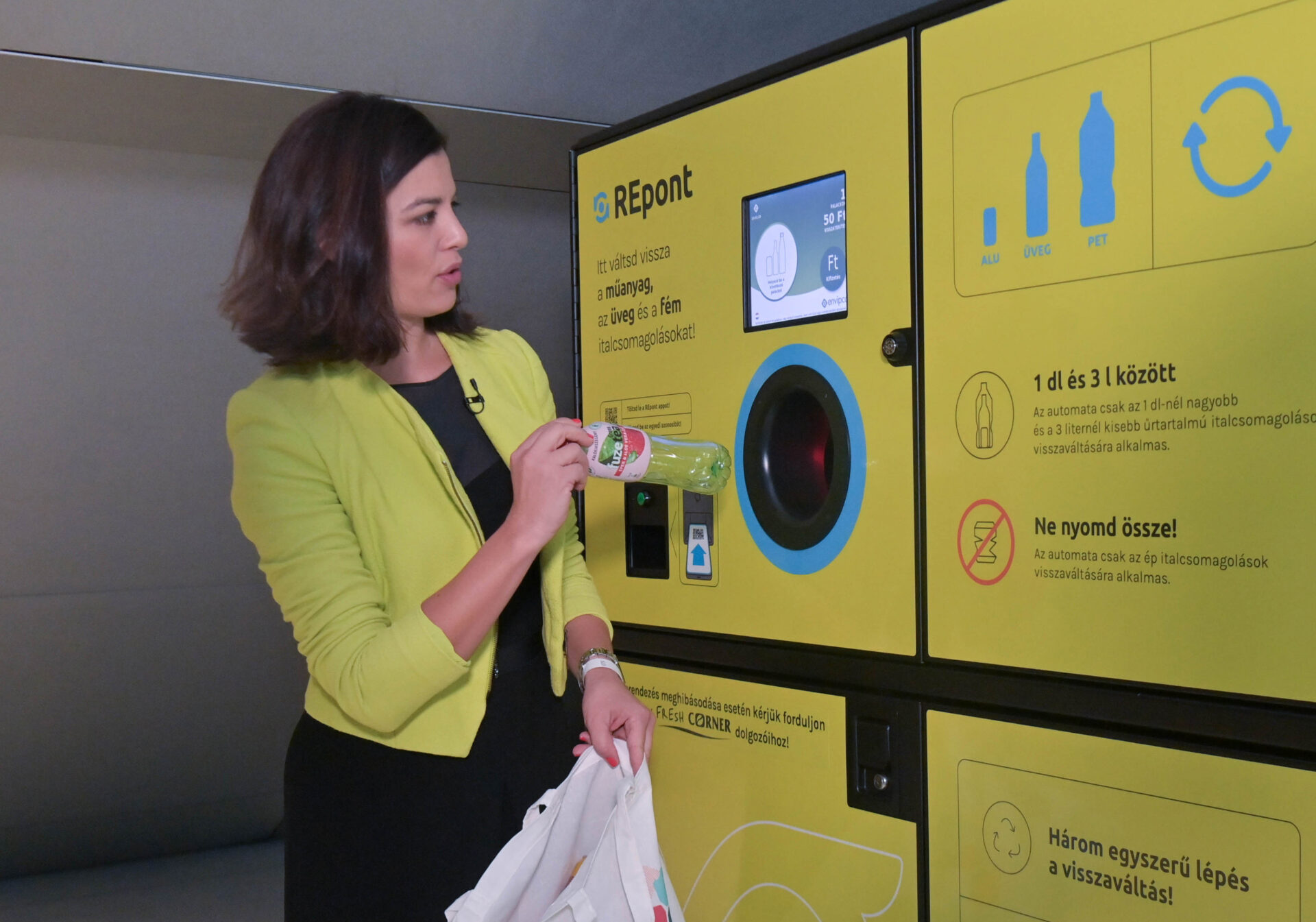
The Hungarian system, which suffered development delays, began operation in July 2024. Shoppers now pay a HUF 50 deposit on beverage containers, which are marked with a special “50” symbol. The deposit is reclaimed by returning the can or bottle via the Mohu machines located at so-called REpont units, housed in supermarkets and stores.
The machine automatically checks the container has a deposit symbol and then sorts the aluminum, plastic or glass waste into individual bins. Once the containers have been collected, the shopper can opt to receive a paper slip detailing the amount to use at the cashier, have the amount automatically transferred to their bank account, or choose to donate it to charity.
This article was first published in the Budapest Business Journal print issue of September 19, 2025.
Producing journalism that is worthy of the name is a costly business. For over 30 years, the publishers, editors and reporters of the Budapest Business Journal have striven to bring you business news that works, information that you can trust, that is factual, accurate and presented without fear or favor.Newspaper organizations across the globe have struggled to find a business model that allows them to continue to excel, without compromising their ability to perform. Most recently, some have experimented with the idea of involving their most important stakeholders, their readers.
We would like to offer that same opportunity to our readers. We would like to invite you to help us deliver the quality business journalism you require. Hit our Support the BBJ button and you can choose the how much and how often you send us your contributions.


