



“A strong fourth quarter (EUR 4.7 billion) pushed the [2025] volume above the five-year average by 14%. However, deals slipping into 2026 resulted in some markets in lower-than-expected volumes,” comments Gábor Borbély, head of research for CEE & Hungary at CBRE.
Hungary achieved EUR 610 million in investment volume last year, representing a 100% annual rise in activity, although a significant volume gap remains with Poland and the Czech Republic, which are established as the leading investment markets in the CEE region.
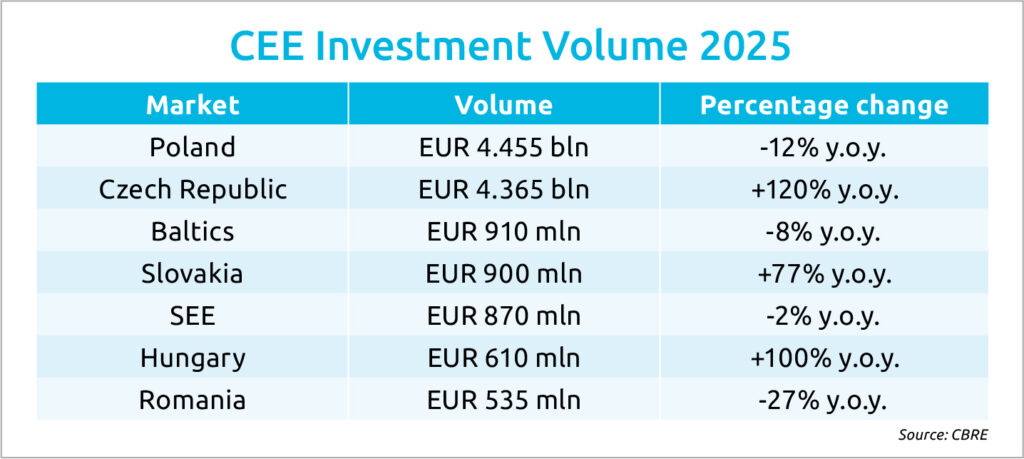
According to the latest insights from Colliers, CEE marked a decisive turning point in 2025, moving from hesitation to execution as investment volumes surged to EUR 11.6 billion across the region’s six core markets (Bulgaria, Czech Republic, Hungary, Poland, Romania, and Slovakia), recording a 31% year-on-year increase. Looking ahead, Colliers forecasts a moderate uplift in investment volumes in 2026.
“Following the EUR 881 mln recorded for Hungary in 2025, total investment volume in 2026 could trend somewhat higher; however, visibility remains limited as the closing rate of transactions currently in progress is still uncertain. In addition, the outcome of the upcoming elections is a relevant factor for some investors and may influence both timing and capital allocation decisions,” says Balázs Zelles-Görgey, head of capital markets at Colliers Hungary.
Avison Young, meanwhile, recorded EUR 12 bln in CEE investment volume last year, with an estimated total of EUR 12.5 bln for 2026.
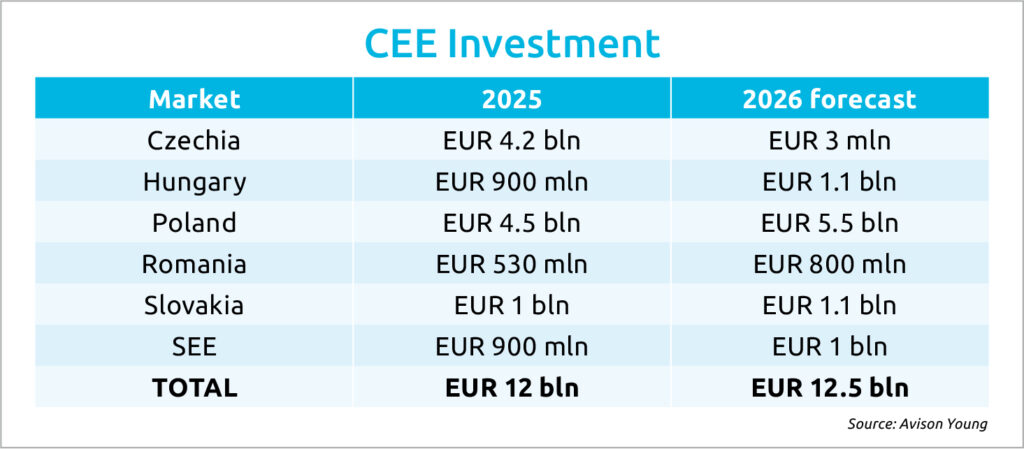
“For Hungary, we project a range similar to 2025 with around EUR 700 mln-900 mln. We should, nevertheless, bear in mind that 2026 is a big election year for Hungary, that the easing policy for EUR and USD is coming to an end, and that we have significant geopolitical challenges (Ukraine war, Iran, Russia, U.S.),” says Benjamin Perez-Ellischewitz, principal at Avison Young Hungary.
Annual volumes are likely to recover toward EUR 1 bln-1.5 bln, assuming several larger portfolio or platform transactions close, according to Valter Kalaus, managing partner at Newmark VLK Hungary.
“This would represent an improvement on recent years but still below pre-2022 peaks. Activity will remain concentrated in fewer, higher-quality assets,” he says.
“Assuming current momentum continues and several pipeline transactions close, I would expect Hungary to reach an annual investment volume of around EUR 1 bln,” agrees Máté Szoboszlay, business development and investment director at Faedra Group.
“This would represent a meaningful improvement compared to the previous two years and signal a healthier market environment,” he adds.
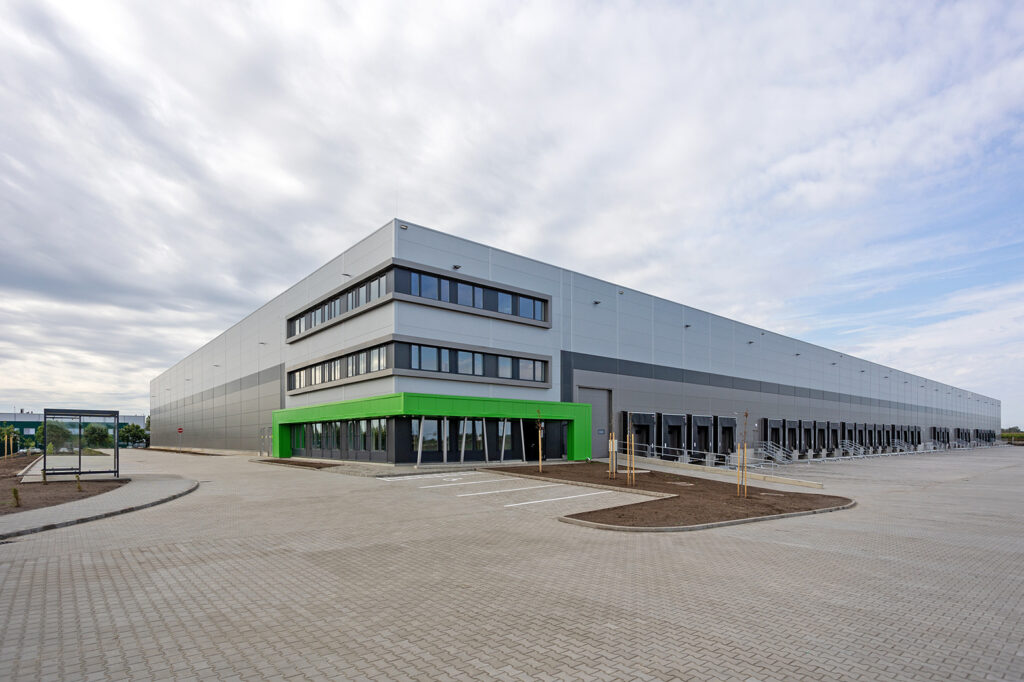
Two buildings at the recently completed IGPark Kecskemét South industrial-logistics park have successfully obtained BREEAM certification, according to the Hungarian developer, Innovinia. This reflects the need for developers to produce ESG-compliant, third-party-accredited industrial and logistics assets to gain tenants and secure the possibility of an exit to investors.
At the core of Innovinia’s development philosophy is the creation of long-term, competitive, efficiently operated, and environmentally conscious industrial and logistics properties. For IGPark Kecskemét South, priority was given during design and construction to energy-efficient technical solutions and optimized mechanical systems.
Additionally, the project features scalable spatial layouts that adapt flexibly to tenant needs, offering attractive solutions for both major logistics players and mid-sized manufacturing and industrial companies, Innovinia says.
“The BREEAM certification is important feedback for us, proving that our development direction creates value not only from a business perspective but also in terms of sustainability. Our goal is for every new element of our portfolio to meet the growing ESG expectations of modern industrial tenants,” comments Balázs Czifra, sales and asset management director at Innovinia.
Cordia has launched its latest residential development: construction of the 274-unit Centropolitan in Bucharest began at the start of this year. Cordia Romania, a member of the Futureal Group, acquired the 8,200 sqm land plot for residential development with an additional 3,345 sqm of integrated retail space.
The development follows the so-called “10-minute city” concept, supported by its wide range of services. The key functions of everyday living will be available within a short stroll or even directly within the development itself. Bucharest Mall is just a one-minute walk away, and the area is well served by excellent public transport, says Cordia.
Meanwhile, Cordia has completed the Parcului20 residential development, also in Bucharest, delivering 485 apartments in two phases. As a European residential developer and investor, Cordia operates in the mid and mid-to-high segments of the residential for-sale market in Hungary, Poland, Romania, and Spain, and in the build-to-rent market in the United Kingdom.
Indeed, the Birmingham-based Cordia U.K. has secured a sustainable finance package from Lloyds Bank to support the redevelopment of the Bradford Works project. The financing recognizes Cordia’s commitment to urban regeneration and energy-efficient design across the United Kingdom, according to the developer.
“Bradford Works, located on the edge of Birmingham’s Jewelry Quarter, will transform a derelict industrial building into a 54-unit shared living scheme. The project balances architectural heritage and modern sustainable designs,” Cordia says.
“Lloyds supported the project with a GBP 5.25 mln Clean Growth Financing Initiative finance package, a solution that recognizes firms that demonstrate measurable progress in a range of environmental considerations, including carbon reduction, energy efficiency, and responsible material use. The design integrates modern materials and energy-efficient systems that ensure a reduced carbon footprint while preserving the building’s historical context,” adds Cordia.
This article was first published in the Budapest Business Journal print issue of February 13, 2026.


