


The documentation, prepared in consultation with specialist authorities and utility providers, could be submitted for permitting within weeks. The 138-meter-long, 3.5-meter-wide bridge will be financed entirely by Biggeorge Property.
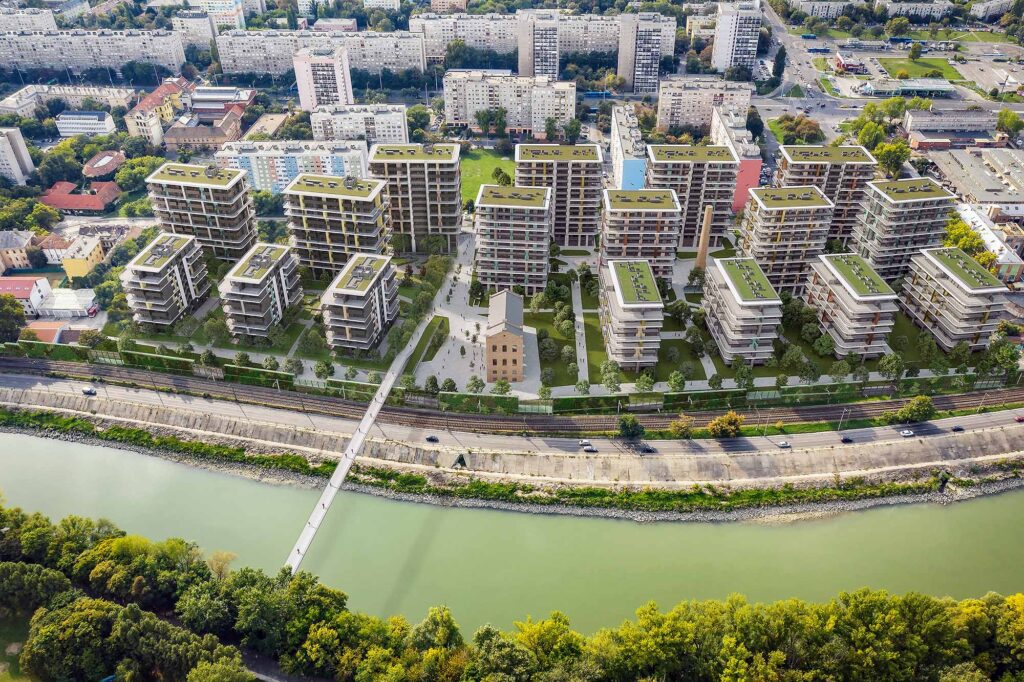
The slim, accessible crossing will begin at the central square of Waterfront City and span the suburban railway line, the embankment and a branch of the Danube. It will be equipped with an elevator and bicycle push rails, providing a direct connection to Óbuda Island.
The bridge will also feature public and decorative lighting. It will become the island’s fourth bridge after Árpád Bridge, K Bridge and H Bridge, but the first designed specifically for pedestrians.
Biggeorge Property first proposed the crossing more than seven years ago, when the Waterfront City project was launched. Following the removal of earlier administrative obstacles, the Budapest Assembly gave the project the green light in spring 2025.
The bridge was subsequently included as a formal developer commitment in a planning agreement signed in fall 2025 in connection with the Waterfront Park development.
The investment, valued in the billions of forints, will be financed entirely from private sources. It will provide residents of the Waterfront developments and several thousand people living in nearby housing estates with access to the island’s parks within a few minutes’ walk.
“Biggeorge Property’s mission is to have a positive impact on its environment and society beyond achieving market success. The pedestrian bridge is perhaps the best example of this: a crossing financed by the developer that will create a new connection to Óbuda Island for everyone in Budapest,” said Zsolt Bozsovics, member of the board of Biggeorge Property Nyrt. and CEO of Biggeorge Homes Zrt.
The bridge is planned as part of one of Budapest’s largest brownfield regeneration projects.
“Global cities of a similar size to ours, from Vienna to Copenhagen, have already recognized that the key to a sustainable future is the revival of existing, underused urban areas. The urban significance of brownfield developments such as Waterfront City and Waterfront Park lies in the fact that they create compact urban districts by building on and comprehensively renewing existing urban infrastructure, while eliminating the remnants of former industrial environments,” Bozsovics said.
“These newly designated districts, primarily intended for housing development, help prevent urban sprawl caused by people moving to the agglomeration, the declining efficiency of urban infrastructure services and a further increase in commuter car traffic within the city,” he added.
Biggeorge Property said the public-purpose investments it had committed to in both projects were several times higher than the Hungarian market average of up to HUF 800,000-HUF 1 mln per home.
According to the company’s latest calculations, the expected cost of public-purpose elements amounts to HUF 3 mln per home at Waterfront City and HUF 7 mln per home at Waterfront Park.
The developer’s contributions at Waterfront City have included four new transport junctions, the planned renovation of surrounding parking areas and roads, and the phased construction of the Óbuda Promenade. The company is also providing a substantial area of land for public use free of charge.
Biggeorge Property previously renovated the nearby Kaszap István Park, covering almost 10,000 square meters.
Under the Waterfront Park planning agreement, the pedestrian bridge will be accompanied by major transport improvements, including pedestrian, cycling and public transport infrastructure.
A 70-year-old utility network will be renewed, while hundreds of public parking spaces will be created or upgraded to help meet demand generated by older residential buildings in the area.
The phased construction of the promenade will continue, and a new street connecting Szentendrei Road with the Filatorigát suburban railway stop will be built. The developer will provide the land for both projects free of charge.
Waterfront Park will also include 130 municipal rental homes, which the Metropolitan Municipality of Budapest will lease from the developer at a discounted rate. Óbuda Municipality will receive HUF 1.2 bln from the company for social infrastructure improvements and rental housing construction.
Both developments are intended to follow sustainable and environmentally conscious urban planning principles.
Waterfront City occupies a five-hectare site previously used by the concrete-covered BUSZESZ industrial complex, where green areas accounted for just 14% of the property.
The developer plans to increase green coverage to 50.2%, or 25,114 square meters, around 30% above the officially required level.
Green coverage will be even higher at Waterfront Park, where a continuous internal park of more than 10,000 square meters will be created between the buildings and made accessible to the public.
Both projects will feature car-free, landscaped pedestrian areas between buildings with green roofs, while vehicle traffic will be directed underground.
A total of 351 trees will be planted at Waterfront City and 310 at Waterfront Park, around three-and-a-half times the number previously standing on the former industrial sites.
Waterfront City won Hungary’s FIABCI award in the Sustainable Development category in 2024 and received the international FIABCI World Silver award in 2025.


