



Recognizing that disability is not an individual limitation but a societal challenge, the report underscores the importance of dignified access as a critical component of the social pillar of ESG standards.
The publication shares key insights from Cushman & Wakefield’s partnership with Access4you, a leading social impact organization that audits, certifies and qualifies the accessibility of the built environment for diverse disability groups.
The report addresses common misconceptions around disabilities, such as the belief that they are always visible or that accessibility compromises design, and offers counter-narratives backed by data. For instance, 70-80% of disabilities are invisible, and the majority of accessibility improvements are cost-effective and visually integrated into modern design.
Key statistics further contextualize the urgency: globally, one in six people lives with a disability; in Europe, it is one in four. In Hungary, 22% of those aged 15 and above report some form of disability. These numbers highlight the growing need for barrier-free, inclusive design in both physical spaces and organizational culture, Cushman & Wakefield argues.
The audit assesses environments for 8+1 major disability groups and provides a roadmap for strategic development. Key recommendations include: tactile and visual markers for the visually impaired; induction loops and sign language options for the hearing-impaired; clear wayfinding systems for individuals with cognitive disabilities; and entrance and interior adjustments for wheelchair accessibility.
“An accessibility audit offers a data-driven starting point,” says Balázs Berecz, founder and CEO of Access4you, and wheelchair user since 2005. “Our social mission is to provide credible and detailed data for people with disabilities and encourage property owners to prioritize inclusion,” he added.
Cushman & Wakefield’s research shows that nearly 50% of Budapest’s office market is already Access4you certified, with the Váci út Corridor leading at 64%. Accessibility also correlates with building age; post-2020 developments tend to be the most inclusive, showing that inclusive design is becoming an industry norm.
Cost concerns are also addressed in the research. Many accessibility improvements, such as tactile signage, step indicators, and induction loops, can be implemented at a relatively low cost, averaging around EUR 10,000 per access point, especially when considered in relation to the long-term social and economic benefits.
Cushman & Wakefield has joined Access4you’s Accredited Partner Program, enabling it to conduct accessibility audits. Through its project management department, it can support clients in creating more inclusive and accessible environments.
“The Accredited Partner Program is one of the strategic pillars of our operations. They are the evangelists for growing our social impact. They don’t just talk about it; they actively engage in sales and certification activities themselves,” says Berecz.
“Inclusion is not a destination, but a continuous journey. By investing in dignified access now, we are shaping a more resilient, equitable future for all,” concludes Gergely Pados, managing director of Cushman & Wakefield Hungary.
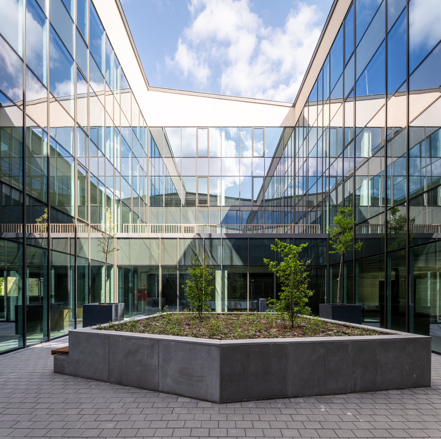
The class “A” RoseVille office complex has become Hungary’s first commercial property to receive EU taxonomy certification from an independent verifier, meeting the “climate change mitigation” requirements. As a consequence, the new owner of the 15,000 sqm office building, the RV Real Estate Investment Fund, managed by Hermes Investment Fund Management, was able to acquire a green loan to fund the property acquisition.
“Thanks to the close cooperation between the MNB [Hungarian National Bank] and our organization, a well-defined framework for applying EU taxonomy requirements has emerged. Based on this, the HuGBC [Hungarian Green Building Council] can provide independent verification for developers, as in the case of RoseVille,” comments Gábor Szarvas, president of the council.
“RoseVille’s EU taxonomy certification was validated by the HuGBC. The MNB’s green programs, such as capital requirement relief for mortgage loans on green buildings, are a strong incentive for investors in the commercial real estate market. While some still perceive green certification as a complex and expensive process with uncertain outcomes, practices, however, show otherwise,” Szarvas adds.
EU and Hungarian regulations are becoming increasingly stringent, making compliance a significant challenge, especially for those aiming to exceed minimum standards. New regulatory frameworks, such as EU taxonomy regulations or upcoming zero-emission building requirements, help developers navigate sustainable real estate development.
BREEAM certifications increased by 54% in Hungary between 2023 and 2024. LEED and WELL certifications are also becoming more common, carrying not only prestige but also significant business value.
“Environmental considerations are an integral part of Erste’s strategy and core operations. This means incorporating sustainability into all areas of activity to make the bank’s entire operation more sustainable,” says György Salamon, head of real estate financing at Erste Bank. Erste’s goal is for 25% of its corporate loan portfolio to make a significant contribution to the environmental objectives of the EU taxonomy by 2026.
“Progress is going well: by the end of 2024, these loans accounted for 20.7% of the corporate portfolio. One reason for this is that Erste now only finances real estate projects that significantly contribute to climate change mitigation,” he adds.
According to international benchmarks, green buildings have on average 2-10% higher investment costs; however, this green premium can pay off in as little as three to five years due to 25-50% lower energy and operational expenses. Further, sustainable buildings depreciate more slowly, providing more stable long-term returns according to Zsombor Barta, founding partner of Greenbors Consulting.
Investors, developers, and owners are increasingly being supported by designers, consultants, and now also financial partners, whether it’s about compliance, certification, or financing structures.
Experts agree that the real estate market of the future will gradually split in two: sustainable, future-proof properties, and so-called “stranded assets” that lose value. Greening existing portfolios will become inevitable, especially for institutional owners. Those real estate players who recognize and adapt to these trends in time will gain a competitive edge, while others may be pushed to the margins by shrinking demand, concludes Szarvas.
This article was first published in the Budapest Business Journal print issue of June 27, 2025.


