


This marks a significant improvement on recent years and confirms that investor confidence is returning to the region. However, it is not yet seen as a broad-based recovery.
“Capital is flowing selectively towards assets offering resilient income, strong ESG performance and long-term relevance in a changing economic environment,” says Colliers. The consultancy forecasts a full-year investment total of EUR 12.5 bln-13 bln.
“Half of the investment volumes in the region is undertaken by domestic capital and a further quarter by CEE investors, so we are not so reliant on Western European, American or Asian capital as we once were,” says Gábor Borbély, head of CEE business development and research at CBRE.
“However, Chinese capital is still important for Hungary, and the Nordic countries are extending into CEE, starting with Poland and filtering further to the south. In all markets, there is more domestic capital active, as international capital is not moving around,” Borbély adds.
Czech capital dominated CEE real estate in 2025, deploying a record EUR 5.4 bln and capturing 44% of all CEE investment activity according to Colliers. In the first half of 2026, Czech capital accounted for EUR 1.98 bln of investment activity, while Hungarian capital represented EUR 700 million, according to Colliers.
“Domestic buyers should keep the lead, though likely a touch below the 75% plus share they held in the first half of 2026, up from under 60% a year earlier,” the consultancy adds.
“The rebound looks structural rather than seasonal. First-half 2026 turnover topped EUR 460 mln, up 57% year-on-year, spread across a dozen deals in every core sector rather than resting on one large transaction,” says Borbély. “Whether it counts as fully sustainable still depends on who is buying, and that base has not yet broadened much beyond domestic capital,” he comments.
Many analysts expect an upturn in investment market activity in Hungary this year.
“We started to see an improvement in terms of liquidity in the second half of 2025,” comments Benjamin Perez-Ellischewitz, principal at Avison Young Hungary.
“The trend was confirmed in the first semester of 2026 with some EUR 560 mln transacted, and the expectation to pass the EUR 1 bln volume of transactions by year-end. That would be the first time since 2021,” Perez-Ellischewitz adds.
Borbély, of CBRE, says his firm expects full-year turnover of EUR 900 mln to EUR 1 bln, up from EUR 610 mln in 2025 and more than double the EUR 314 mln in 2024.
“That assumes roughly EUR 450 mln of assets currently under offer close in the second half, drawn from a broader EUR 2 bln deployment pipeline still being worked through,” he adds.
Retail led in Hungary in the first half of the year at about EUR 200 mln, ahead of offices at roughly EUR 150 mln across seven deals, including Capital Square and Millennium Towers I. Industrial came in at about EUR 105 mln, anchored by a Budapest-North logistics deal, according to CBRE. Retail and hotel assets are scarcest, held back by longstanding development restrictions, while industrial supply is comparatively abundant; living and student housing remain almost entirely absent from the market.
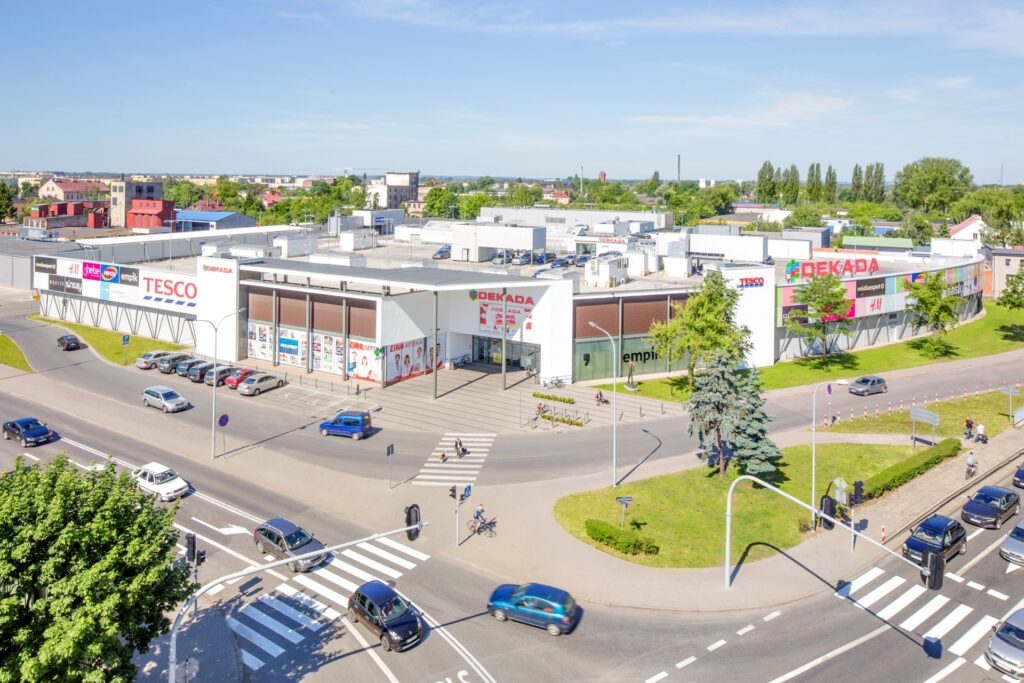
Hungary’s Appeninn Asset Management Holding has finalized the purchase of 11 modern retail properties (seven retail parks and four shopping centers) located in towns and cities across Poland from Dekada S.A. The transaction value exceeded EUR 100 million. The total GLA is approximately 53,000 sqm, with the properties completed between 2011 and 2024.
“From the very start, we have focused on creating modern retail centers, mainly in city centers, that meet the needs of local communities. We developed each project with long-term value in mind, for tenants, local residents and investors alike,” says Aleksander Walczak, CEO of Dekada.
Retail parks are set to play a defining role in shaping the CEE consumer and investment landscape, according to analysts. As domestic demand strengthens and EU integration advances, the format’s adaptability positions it as both a community hub for households and a defensive, income-generating asset class for investors.
The purchasers of the portfolio are companies belonging to Appeninn Holding Plc., one of Hungary’s largest publicly listed investment groups. The group is already present on the Polish market as the owner of the Wiśniowy Business Park in Warsaw and the Goodyear logistics center in Tarnów. Indotek Polska will assume responsibility for the asset management of the acquired portfolio.
“The acquisition of the Dekada portfolio gives Appeninn immediate scale in the Polish retail property market and adds a substantial retail component to our existing office and logistics investments in the country,” says Györgyi Szűcs, CEO of Appeninn Plc.
“The portfolio’s geographic reach, high occupancy and established tenant mix reflect the quality of the assets Dekada has developed over more than a decade and align closely with our strategy of investing in income-producing properties across Central and Eastern Europe. We thank the Dekada team for their professional and constructive cooperation throughout this complex transaction,” he adds.
Indotek Group, Appeninn’s largest shareholder, acted as transaction advisor to the buyer, alongside Cushman & Wakefield, the law firm Greenberg Traurig Poland, and Sentient. Dekada S.A. was advised by CBRE and the law firm Dentons. Consultancy TPA Poland advised both parties.
This article was first published in the Budapest Business Journal print issue of September 18, 2026.


