


For more than a decade, the retail industry has been debating the same question: Are physical stores becoming obsolete? The rise of e-commerce, combined with cost pressures and shifting consumer behavior, has fueled repeated predictions about the gradual decline of brick-and-mortar retail. Yet this narrative is increasingly outdated. The more relevant question today is not whether stores still matter, but whether they are being used to their full potential.
Recent global analysis by EY suggests that widespread store closures would be a strategic misstep. While digital channels continue to grow faster, physical retail still represents the majority of sales in most markets and categories. More importantly, stores continue to play a critical role not only as points of transaction, but as centers of experience, trust and brand engagement.
This perspective is highly relevant in the Hungarian context. The domestic retail market is not experiencing a structural decline of physical retail, but rather a period of adjustment. Consumer behavior has evolved in response to recent economic conditions: households have become more deliberate in their spending, more value-conscious and increasingly selective. At the same time, retail activity shows signs of stabilization and gradual recovery. Sales volumes have been strengthening across key categories, supported by improving real incomes and a more predictable inflation environment, even if consumer sentiment remains cautious.
The implication is clear: stores continue to play an important role — but only if they evolve alongside changing expectations.
A fundamental shift in mindset is required. Too often, stores are still assessed primarily as transactional spaces — measured by footfall, turnover per square meter, or immediate profitability. In an omnichannel environment, however, this is no longer sufficient.
The store must be understood as a multi-functional asset. It is simultaneously a showroom, a fulfillment node, a service point, and a source of customer insight. When integrated effectively with digital channels, it becomes a key enabler of both growth and efficiency. This broader role is particularly relevant in Hungary, where retailers operate in a complex environment shaped by cost pressures, evolving regulation and intense competition. In such a landscape, decisions about store networks cannot be based solely on short-term performance metrics.
A store that appears marginal in isolation may deliver significant value when its broader contribution is considered. Click-and-collect volumes, product returns, last-mile delivery support, and even local brand visibility all influence overall performance. Retailers that fail to capture these dynamics risk underestimating the importance of their physical footprint.
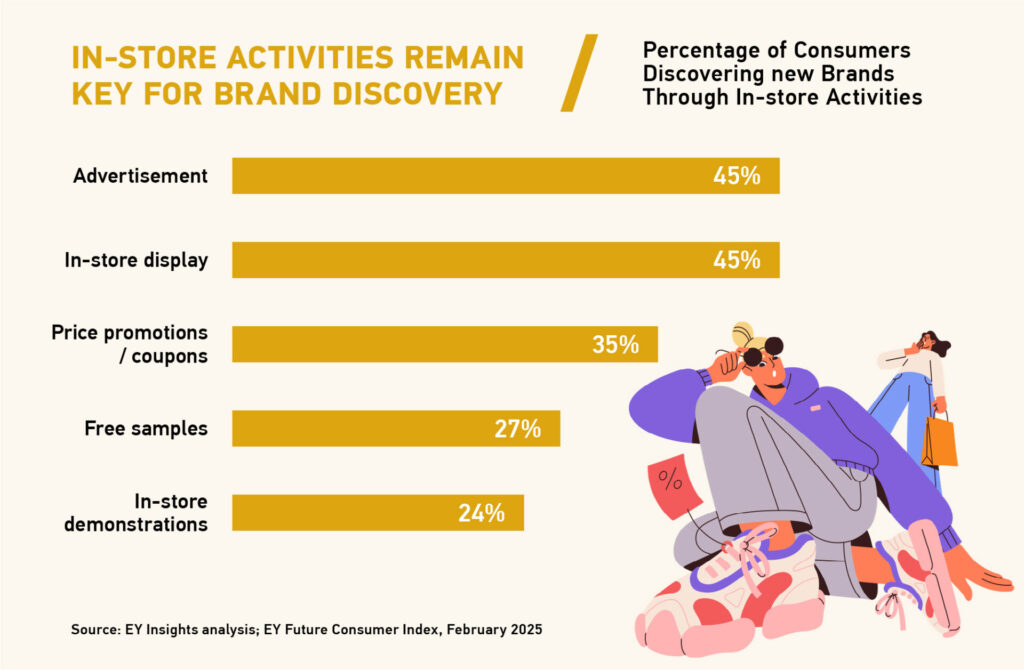
As customer journeys become increasingly fragmented across channels, traditional performance measurement is becoming less relevant. A typical purchase today may involve multiple touchpoints: online research, in-store validation, mobile purchasing, and physical returns or service interaction. In such a journey, attributing value to a single channel becomes both difficult and misleading.
For retailers in Hungary, this creates a pressing need to rethink internal metrics and decision-making frameworks. Instead of managing physical and digital channels as separate profit pools, leading companies are beginning to evaluate performance across the full customer lifecycle.
This shift is not only analytical — it is strategic. Capital allocation, store network decisions and digital investments all depend on understanding how channels interact rather than compete.
The evolution of store strategy is also reflected in the real estate market. Hungary is not seeing a uniform withdrawal from retail space. On the contrary, prime locations — particularly in Budapest — continue to demonstrate resilience, with strong occupancy levels and ongoing redevelopment activity. At the same time, secondary locations and smaller, less efficient stores are under greater pressure. This divergence reinforces an important point: the future of physical retail is not about preserving every store, but about optimizing the portfolio.
“Making stores work harder” does not mean maintaining footprint at all costs. It means ensuring that each location has a clear role, delivers measurable value, and fits into a coherent omnichannel strategy. In Hungary, where structural factors and economic conditions can vary significantly by region, this level of precision is essential. Looking ahead, three strategic priorities stand out.
First, redefine the role of the store. Physical retail remains a powerful differentiator, particularly in categories where trust, experience and immediacy influence purchasing decisions. Stores should be designed not simply for transactions, but for engagement, advice and service.
Second, align commercial, operational and tax perspectives. Omnichannel retail is not only a customer proposition; it is also an operating model. Inventory placement, last-mile fulfillment, returns management, marketplace participation and cross-border sales all have tax, VAT, customs and transfer pricing implications. In a market like Hungary — and for businesses serving the wider region from here — these questions are no longer technical details. They are strategic enablers or constraints.
Third, invest in data-driven decision-making. Better insights are essential to navigate complexity. Retailers need a more granular understanding of customer behavior, location performance, fulfillment costs and channel interaction. The ability to translate this data into actionable decisions will be a defining capability in the years ahead.

The deeper point is this: stores should not be defended nostalgically, nor abandoned hastily. They should be rebuilt as part of a more intelligent retail system. Hungary offers a good test case for this approach. The market remains inflation-shaped, promotion-sensitive and highly competitive. International entrants, online marketplaces and changing customer expectations are forcing retailers to sharpen their propositions. But that pressure also creates opportunity. As consumer confidence gradually improves and spending normalizes, the retailers that will outperform are not those that simply waited for footfall to return. They are the ones that used this period to rethink what the store is for.
Physical retail is not dead. But the old store model may well be. The task now is not to choose between digital and brick-and-mortar. It is to build a retail model in which each store justifies its existence not by occupying space, but by generating value in more ways than one. In Hungary, as elsewhere, that may prove to be the difference between a store network that drags on performance and one that becomes a strategic advantage.
This article was first published in Agro & Food Review 2026.


