



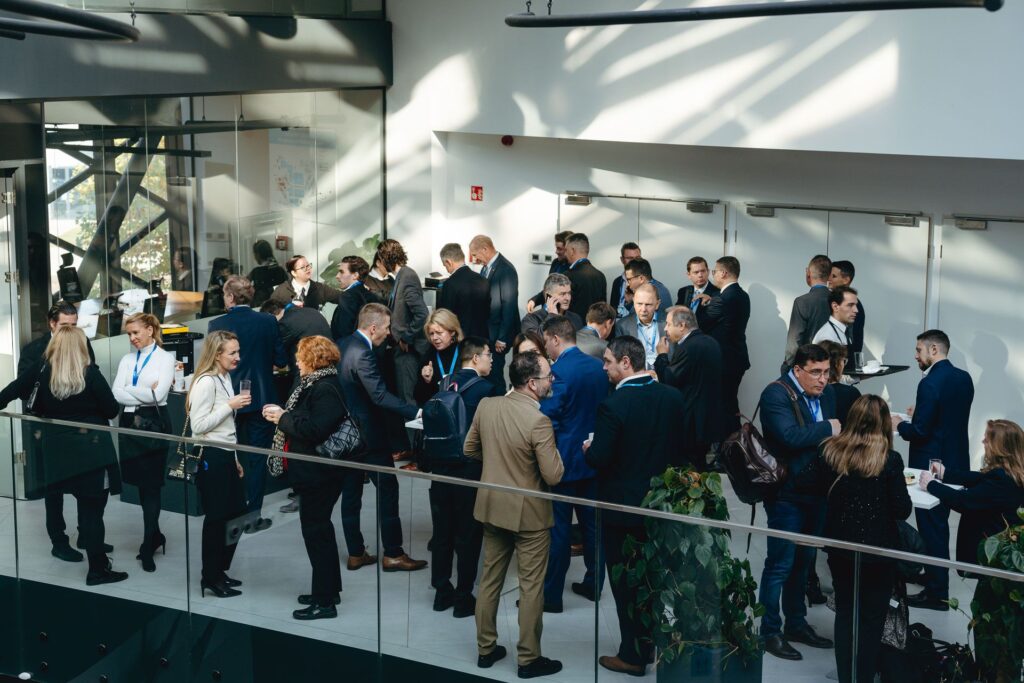
Organized by the Hungarian Battery Association and White Paper Consulting and taking place at the Hungexpo Budapest, the expanded event builds upon three years of success with the Hungarian Battery Day conference, now extended into a longer gathering.
In opening remarks, Péter Kaderják, executive director of the Hungarian Battery Association, emphasized CEE’s strategic position in the European battery sector, as well as the importance of fostering collaboration to drive innovation and sustainability.
“Our sector has seen something of a bumpy 2024 after extreme growth in recent previous years,” Mr Kaderják said. “It seems that we are now going through a process of industry consultation,” he added, saying that uncertainty in politics and climate policy was being felt by the industry.
As the event got underway, Jason Chen, general manager of Operations at CATL Europe, drew attention to how batteries and energy storage solutions are key to dealing with climate change and the green transition and that the CATL cell plant in Debrecen will be operational from next year after the successful start of operations of the module assembly plant earlier in October.
“CATL was founded in 2011 by people with extensive experience in battery production,” Chen said. “And by now we have become industry leaders in services for green transportation and clean energy storage solutions.”
The first roundtable discussion of the day focused on developing a European regulatory framework for the battery industry, which experts said is vital for boosting competitiveness.
Fabrice Stassin, secretary general of BEPA, highlighted key trends impacting the EV market, noting that many people are hesitant to buy an EV right now due to high costs and the rapid pace of technological upgrades. “There are also broader economic trends, where many EU member states cannot afford to subsidize the EV market,” he said. Stassin concluded that scope, scale, speed, and sustainability will be essential to making meaningful progress.
Ákos Nagy, senior counsel at the Kinstellar law firm, emphasized the growing need for recycling, reuse, and sustainability within the industry. “We still miss out on a huge amount of recycling potential in the EU […] it has to have more funding because competency and capacity in this area must be increased,” he said.
Bob L. Galyen, an SAE International fellow and battery production expert, delivered a keynote speech highlighting how companies can adopt advanced battery technology to accelerate global battery production. Citing China’s success in the field, Galyen emphasized that strong government support, incentives and tax relief are as crucial as private equity investment and industry-specific education and training.
Keith Norman, chief sustainability officer at Lyten, introduced a lithium-sulfur battery technology concept, presenting insights on the requirements for producing and marketing highly manufacturable, mass-market batteries with broad applications.
“We’ve come a long way in the development of batteries,” he said while noting that further progress is needed to introduce a true mass-market battery that meets current demands. “As we currently depend on a very small number of countries to provide all of our raw minerals, lithium-sulphur batteries present competitive advantages,” he added.
In the next roundtable discussion, focused on the development of the battery energy storage systems market in Hungary and beyond, Csaba Fekete, business development director at Alteo Group, emphasized the critical role of batteries and energy storage technology in addressing the climate crisis and advancing the green energy transition.
He added that the market is ripe with opportunity, but said: “The market has to evolve here […] and we have to shift our revenue streams to elsewhere […] I don’t see any specific obstacles to us in achieving this.”
Gábor Bercsi, CEO of SPIE Hungaria highlighted the challenges of project timeframes and delays, especially in design and construction, saying: ”What we observe when trying to realise our projects […] is that there is extensive preparation and decision-making time, yet the actual realisation time is too short,” he said.
Following the discussion, Thierry Pollet, energy sector executive at Huawei, delivered a speech on grid-forming battery systems, PV integration, grid stability and merchant market grid services. He emphasized that batteries can play a significant role in enhancing grid stability and explained how grid forming is “a necessary technology to facilitate the transition of the energy system to enable a large share of renewables in the mix.”
“It allows for inverter-based systems to take similar grid-supporting behaviour as conventional thermal generators,” he said. “It also provides virtual inertia and other grid stability capabilities.”
Dennis Haardt, global key account manager for Battery Recycling at BASF SE, gave a speech on the importance of establishing a battery recycling value chain for the European electric vehicle market. “When we talk about battery recycling, we are talking about closing the whole loop,” he said, explaining that BASF had seen success in specializing in the hydrometallurgical processes and the whole recovery of valuable materials.
In a keynote speech on a closed-loop approach to recycling in Hungary’s battery industry, Soo Chul Park, senior VP and EU managing director at SungEel HiTech Hungary, addressed the challenges his company has faced with its battery recycling operations in the country.
The next session featured a roundtable discussion on advancing sustainability and addressing the challenges in battery recycling for a circular future in the battery industry across Central and Southeast Europe.
Péter Vermes, Battery and WEEE Division business consultant at Éltex, remarked that the battery industry is poised for a “revolution” in recycling practices. Dennis Haardt of BASF SE emphasized that his recycling business aims to be “efficient, sustainable and fast.” Meanwhile, Soo Chul Park of SungEel HiTech Hungary highlighted the challenges posed by recycling technology, as well as the sometimes restrictive licensing processes in Europe.
Tamás Bakos, regional general manager for Central South Europe at Atlas Copco, then addressed the audience, noting that all of the company’s segments are currently active in the battery sector. “Innovation keeps us successful,” he said, before leading participants into a roundtable discussion on opportunities for Hungarian and European suppliers at both local and regional levels.
Discussing his expectations for the battery industry in Hungary and the region, Bakos stated, “Hungary has cemented itself as a strong player in the battery industry in this region for the next decade,” partly thanks to strong government support. He added that the recent decline in EV sales across Europe is temporary and expressed confidence that battery manufacturers and suppliers are finding ways to stay competitive.
Balázs Szilágyi, senior public affairs manager at CATL, delivered a presentation on battery research, development, and testing. He emphasized that safety is the top priority in R&D, followed closely by factors such as temperature resistance and faster charging capabilities. “We are working hard on developing better and better solutions,” he said, noting that innovative electrolyte technology is an ongoing key area of focus.
In the final roundtable discussion of the day, focused on battery logistics, shipping, storage, and transportation, panelists emphasized that the circular supply chain of the battery industry requires innovative, cost-effective, and optimized logistics solutions, across sea, air, rail, and road.


