


Lajos Vida, country manager of Synology Hungary, discusses ransomware preparedness, changing storage needs and how regulation and AI are shaping data-management strategies.
BBJ: As companies generate and store more data across on-premises systems, endpoints and multiple cloud environments, what are the biggest data-management challenges you currently see among Hungarian businesses, and where do you think companies are still underinvesting?
Lajos Vida: The biggest challenge for Hungarian businesses today is data fragmentation. Data is increasingly distributed across on-premises servers, endpoints, SaaS applications and multiple cloud environments. As a result, companies can lose visibility over where their critical data resides, who has access to it, and whether that data can actually be recovered when needed.
The second challenge is a shift in mindset. Too many organizations still approach cybersecurity primarily from a prevention perspective, focusing on firewalls, endpoint protection and access controls. These remain essential, but with ransomware and other threats becoming increasingly sophisticated, the more important question is: How quickly can you recover when prevention fails? Backup is no longer simply an IT operational task; it is a fundamental part of business continuity.
I see three areas where companies still have room to improve: tested recoverability, a unified data-protection strategy and data classification. Having a backup is not enough if recovery has never been properly tested. Similarly, many organizations still rely on separate tools for protecting local infrastructure, endpoints and cloud data, making it difficult to maintain a consistent strategy.
Ultimately, companies will continue to need more storage capacity as data volumes grow across the organization. But the challenge is no longer simply about storing more data. Businesses also need greater visibility and control over that data — where it is, who can access it, how it is protected, and how quickly it can be recovered when needed.
BBJ: Ransomware has made backup strategy a board-level issue rather than simply an IT concern. How prepared are Hungarian companies today, and what are the most common weaknesses you see in their ransomware protection and recovery plans?
Vida: Hungarian companies have become significantly more aware of the ransomware threat, but preparedness still varies considerably. The biggest weakness I see is that many organizations still confuse having backups with having a proven ability to recover.
The real question is not simply whether a backup exists, but whether it is protected from attackers, regularly tested and capable of restoring critical business operations within an acceptable time frame. Companies also need clear recovery priorities and a well-defined plan for which systems and services must be restored first.
Another important change is that ransomware is no longer only about encrypting data. Attackers increasingly target credentials, backup infrastructure and sensitive information itself. This means that cyber resilience has to cover the entire data environment, rather than relying on backup as a last line of defense. Ransomware has therefore become much more than an IT security issue. It is a business continuity and resilience challenge, which increasingly requires attention at board level.
BBJ: Companies often assume that having a backup means their data is protected, but recovery can be the real test after an attack or system failure. How should businesses think about recovery times, testing their backups and ensuring that clean data can actually be restored when needed?
Vida: Businesses need to move from thinking about backup as a copy of their data to thinking about it as a recovery strategy. The traditional 3-2-1 backup principle remains a strong foundation, but against modern ransomware threats we recommend extending it to the 3-2-1-1-0 approach:
The last point is particularly important. A backup that has never been tested is essentially an assumption. Organizations need to understand their recovery time objectives, identify which systems are most critical to the business, and regularly demonstrate that those systems can actually be restored.
A board of directors should therefore no longer ask IT simply, “Do we have a backup?” The more relevant question is: “If all our critical systems were encrypted tomorrow morning, exactly when could we be operational again?” The answer should be based on testing and evidence, not estimation.
That is the real measure of cyber resilience: knowing which systems are critical, knowing that the backups are protected, and knowing how long recovery will actually take.
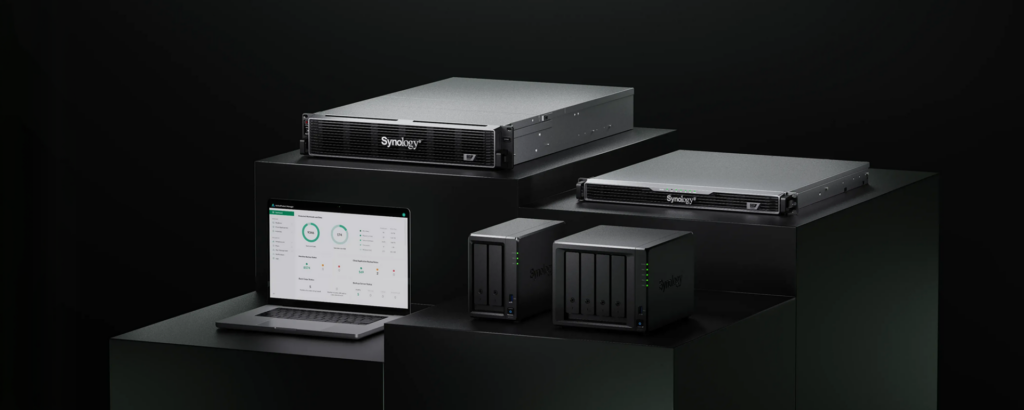
BBJ: How is the Hungarian market changing for Synology? Are you seeing demand move beyond traditional NAS and storage toward more comprehensive data-protection, backup and hybrid-cloud solutions, particularly among small and midsized companies?
Vida: Absolutely. The Hungarian market is clearly moving beyond the traditional NAS and storage use case. Storage remains important, but customers increasingly want to address backup, data protection, security and recovery as part of a broader strategy.
This shift is particularly visible among small and midsized businesses. They are dealing with growing amounts of data and increasingly complex IT environments, while at the same time facing pressure to control recurring software and infrastructure costs. They are therefore looking for solutions that are easier to manage and can protect multiple workloads from a central platform.
We also see strong interest in hybrid approaches. Companies do not necessarily want to move everything to the public cloud. They are looking for the right balance between on-premises infrastructure, cloud services, cost control, flexibility and data sovereignty. This creates an opportunity for solutions that can bridge local infrastructure and cloud environments rather than forcing customers into one model.
At the same time, there is an interesting development at the enterprise end of the market. Synology is increasingly being considered not only as a backup or secondary storage platform, but also for primary enterprise storage workloads.
The launch of the PAS7700, our active-active dual-controller NVMe storage platform, is a good example of this evolution. Following its European launch, the first two PAS7700 systems deployed in Europe were installed in Hungary. For me, this is a strong indication that the Hungarian enterprise market is technically mature and increasingly willing to consider new approaches to high-performance infrastructure.
BBJ: Regulation is also placing greater emphasis on cybersecurity and business continuity. How are requirements such as NIS2 changing conversations with Hungarian corporate customers, and are companies treating compliance as a regulatory exercise or using it as an opportunity to rethink their wider data-protection strategy?
Vida: One of the positive effects of NIS2 is that cybersecurity and data protection are moving higher up the management agenda. Companies are paying more attention not only to preventing incidents, but also to how quickly they can detect, respond to and recover from them.
For us, this means that conversations are becoming less focused on individual IT products and more focused on the overall resilience of the organization. Backup, disaster recovery, access control and the protection of data across on-premises and cloud environments are increasingly being considered as interconnected elements of one broader strategy. This is where Synology provides tangible value: instead of forcing companies to build complex, multi-vendor architectures, our purpose-built solutions — like the ActiveProtect series — allow them to seamlessly implement the immutable, air-gapped backups and built-in disaster recovery testing that strict frameworks like NIS2 require.
Of course, there are still companies that see NIS2 primarily as a box-ticking exercise. But I believe the organizations that will benefit most are those that use the regulation as a catalyst to strengthen their long-term digital resilience rather than simply meeting the minimum requirements.
BBJ: Looking ahead three to five years, what will have the greatest impact on enterprise data management: the continued growth of cloud infrastructure, AI-driven workloads, more sophisticated cyberattacks, or the sheer volume of data companies need to retain and protect?
Vida: Over the next three to five years, I believe AI-driven workloads will have the biggest impact on enterprise data management. However, I would not look at AI in isolation, because it will accelerate several existing trends at the same time: data volumes will continue to grow, cloud and hybrid environments will become more complex, and the need for stronger security and data governance will increase.
AI will make data even more valuable, but also more sensitive. Companies will need to understand not only where their data is stored, but also what data is being used by AI systems, who or what has access to it, and how that data is protected.
At the same time, the economics, security and sovereignty considerations around AI workloads may lead companies to adopt a combination of public cloud, private cloud and on-premises infrastructure rather than moving everything to the public cloud.
For this reason, I expect the focus to shift from simply storing more data to managing and protecting data intelligently across different environments. The companies that are best prepared will be those that build flexible data infrastructures where AI, security, backup and governance are considered together rather than as separate IT priorities.
Learn how Synology can help your organization strengthen ransomware resilience, protect critical data and recover with confidence. Explore Synology’s data protection solutions.


