


This sounds lovely, but the sun still sets every day. This means that oversupply during the day often leads to negative prices, whereas peak demand in hot summer evenings causes price spikes, not an ideal setup for the grid operator.
This is where batteries come in, as they are the only market-ready technology that can adjust solar power generation to market conditions. They bank on the intraday spread by charging during cheap periods and selling when prices are at their highest. In fact, price volatility is 20% higher in Hungary than in Germany, making the concept even more lucrative for developers.
No wonder battery deployment has been rising lately. Solar-purpose batteries were pretty much non-existent until 2023. Now, market players and Mavir, the Hungarian transmission system operator, have nearly 1 GW of capacity in their records, and residential households possess an additional 141 MW more. This rapid growth is largely due to targeted grants, but experts note that energy storage technology is now viable even without state aid.
On the other hand, Sight-e analytics CEO Mihály Dolányi stresses that expectations must be managed, since this equipment alone won’t solve every security of supply and market issue.
“They are no wonder weapons, but rather devices that have constraints and work in cycles,” he tells the Budapest Business Journal.
As the expert explained, batteries can function as producers for 2-4 hours at a time; then they switch to charging mode and become consumers. They can’t replace baseload power generation, either, unlike nuclear or gas-turbine-run plants that produce electricity whatever the weather or time of day.
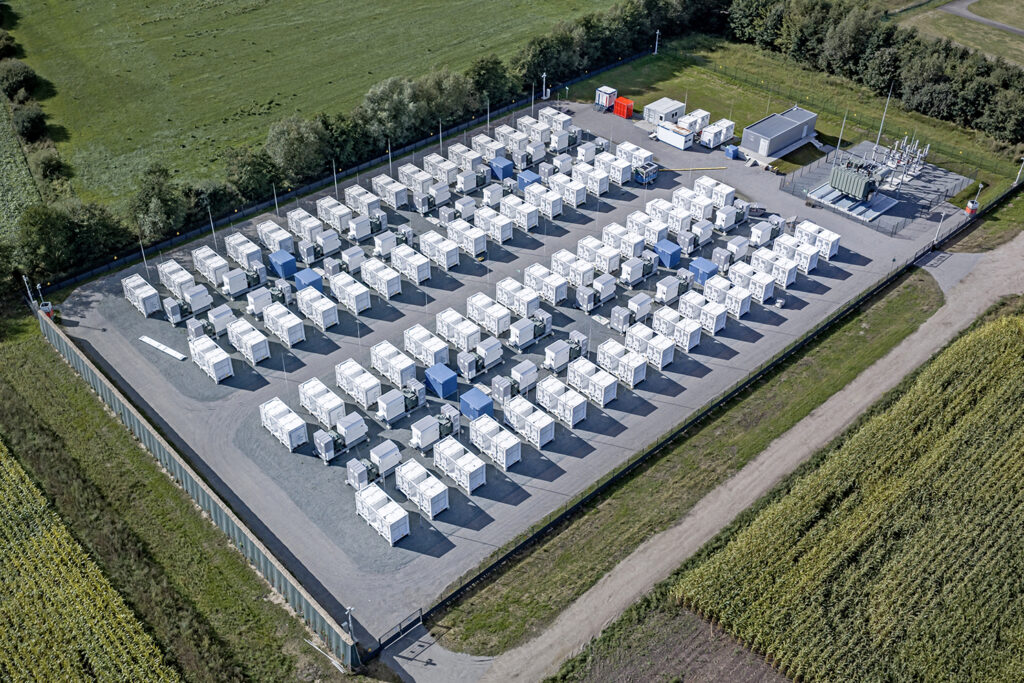
Batteries are especially important in the summer. Total domestic capacities can now contribute up to 1 GW to meet peak demand. This works, however, only as long as the price difference between charging and discharging is large enough.
“If too many batteries appear at once, prices will flatten too much, pushing down the profitability of related investments,” Dolányi warns.
The founder of Sight-E analytics emphasizes that, beyond the hardware, software is becoming even more crucial. The technical specifications of equipment from major manufacturers are often similar, so from an investor’s perspective, one of the most important questions is how batteries are utilized in the markets.
Optimizing an energy storage system introduces new levels of complexity compared to optimizing a traditional power plant because the storage system operates with a finite amount of energy. If it sells energy during a given hour, it reduces its future options, and sooner or later it must also act as a buyer in the market and recharge.
“In reality we don’t really store energy; we rather buy time and room for maneuver,” Dolányi points out. He adds that batteries don’t create energy, but take it and give it back. “Value is derived from the fact that they do so at the right time and on the right market.”
For this reason, algorithmic, automated decision-making systems play a key role in battery operations. According to Dolányi, these are not necessarily classical artificial intelligence systems based on large language models, but rather optimization solutions that make new decisions every few minutes based on physical constraints, market prices, forecasts, and economic parameters.
“The goal is for the battery storage system to operate adaptively across multiple markets and to maximize its theoretical revenue potential,” he says.
“Such an automated trading system must remain operational even in crisis situations,” Dolányi notes. “It does not necessarily need to understand exactly what event lies behind a given market shock; what matters is that it detects lost capacity, price movements, and changing market conditions.”
During the current turbulent periods, battery storage systems’ revenues have reached as much as double the usual summer levels for several days, but Dolányi emphasizes that the risks are also high. A single bad decision or technical error in an extreme situation could wipe out several weeks’ worth of revenue in a single hour.
One major question for the future is how many storage facilities the Hungarian and regional energy markets will need. According to Dolányi, the market may be able to move in the optimal equilibrium without regulatory interventions, but there is also a risk of over installing the national capacities. Since obtaining permits and completing a project takes months, many players could enter the market at once, leaving it with more short-term capacity than the market would have needed. That is why he believes that continuous regulatory monitoring, modeling, and, if necessary, intervention are important.
Dolányi argues that the role of energy storage systems hasn’t suddenly become important; rather, the current energy market situation is intensifying discussions around them.
Indeed, experts have suggested that if the country had more battery storage capacity, the summer crisis over the Paks nuclear power plant might have had a significantly lower market impact.
Investor interest is already significant, with many projects in the pipeline, being built, or in pre-connection stages. While storage facilities cannot solve the challenges of Hungary’s energy system on their own, with appropriate software-based control, market integration, and regulatory oversight, they could become one of the most important flexibility tools and key enablers for more renewable installations in the coming years.
This article was first published in the Budapest Business Journal print issue of October 2, 2026.


