



Richard Végh, CEO of the Budapest Stock Exchange (BSE), highlighted in his remarks that AutoWallis stands out among successful Hungarian companies as it has achieved growth not through bank loans but by relying on its own performance.
He pointed out that AutoWallis has been a member of the BSE for five years and has completed multiple acquisitions and bond issuances during this period, which Végh described as “exemplary.” He also noted a broader market trend, with the number of Hungarian companies issuing bonds rising from 40 in 2016 to 70 today.
Meanwhile, Sándor Mátrabérci, managing director of Wallis Motor, explained the reason behind showcasing the latest business results in the group’s BYD outlet. Since introducing the Chinese brand nine months ago, the BYD showroom has been expanded, as the brand has swiftly secured a leadership position in Hungary’s electric vehicle market. The company has captured a 26% share in state-supported tenders, and in recent months, more than 600 contracts have been signed for Chinese models.
“The automotive industry is an extensively analyzed sector,” remarked Csaba Debreczeni, chief equity analyst at MBH Investment Bank. His analysis follows MBH’s recent initiation of coverage on AutoWallis Nyrt., with a one-year target price of HUF 223 for its shares.
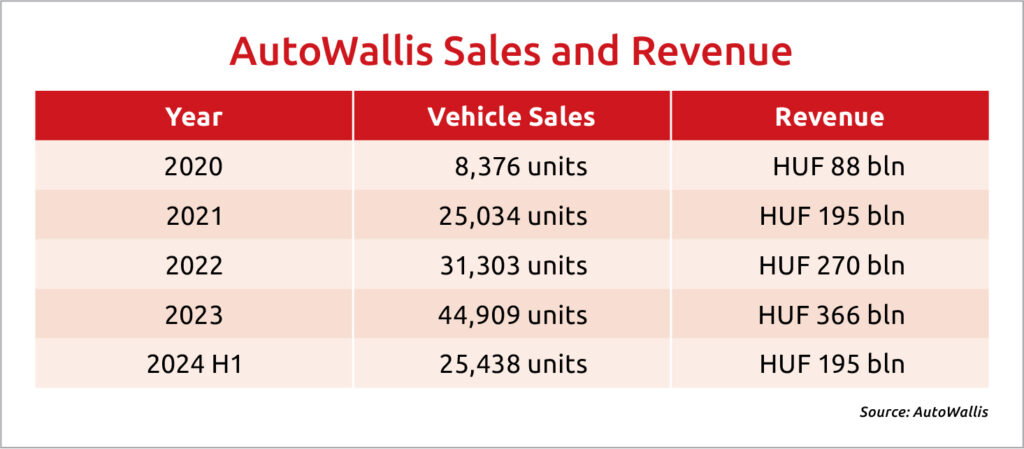
Debreczeni emphasized that the target reflects current economic, industry, and corporate conditions, although adjustments may be needed in the future. He also mentioned that AutoWallis had outlined ambitious goals for the next five years in May 2024. These targets include the potential doubling of revenue, EBITDA, and net income by 2028, alongside the goal of executing two to three acquisitions annually.
Debreczeni also drew attention to the increasing need for European policymakers to shield the automotive sector, which has been increasingly affected by economic policies in the face of competition with China.
“The European Union’s automotive sector directly employs 6.5 million people and indirectly supports 13 million jobs while contributing 32% of the EU’s total R&D expenditures,” Debreczeni pointed out.
Furthermore, he observed that around 500 Chinese automotive companies, primarily focused on electric vehicles, had been established over the past decade. However, many of these firms have since disappeared, with only a few remaining in an industry that rapidly consumes state funding.
Despite these challenges, Debreczeni remains cautiously optimistic about European automakers. He believes the sector still holds potential, although there is no room for significant expansion.
“European manufacturers can only take market share from each other,” he explained. From an investment perspective, luxury car manufacturers remain the most profitable, with Ferrari trading at 12 times its revenue.
“I wouldn’t want to be a car manufacturer in Europe, but I would like to be a car dealer,” Debreczeni noted, adding that several subsectors, though becoming more expensive, have managed to weather the economic turbulence.
According to MBH’s analysis, AutoWallis Group’s revenue is projected to reach nearly HUF 400 billion in 2024, with further growth expected to increase this figure by 50% by 2028.

Gábor Ormosy, CEO of AutoWallis Nyrt., highlighted several critical developments over the past six months. These included a HUF 5.7 billion capital increase, a five-year extension of the Opel import contract, and the acquisition of SsangYong’s import rights in four additional countries.
He also announced plans to open the company’s first Renault and Dacia dealership in Budapest on Oct. 1, 2024. Furthermore, AutoWallis expanded its reach in the Czech market by acquiring three BMW dealerships from Stratos Auto.
Ormosy underscored that the firm’s retail division consistently outperformed the market across all regions and brands.
“For example, AutoWallis now controls 10% of the BMW market in the Czech Republic,” Ormosy said, emphasizing the significance of the Czech market due to its larger GDP (USD 326 billion) and higher per capita GDP (USD 29,000) compared to Hungary.
Ormosy also addressed the topic of Chinese manufacturers, noting that despite “incredibly turbulent news and a challenging negotiation environment,” no significant changes have been observed. He anticipates further consolidation among Chinese automakers, with some failing to survive the intense competition.
Discussing the impact of the EU’s new tariffs (ranging from 17.4% to 37.6%, up from the previous 10%), Ormosy acknowledged that while the new tariffs have created setbacks for some Chinese manufacturers, “BYD’s performance has not been affected, though other brands have been impacted.”
He added that the market share of Chinese automakers in Europe reached 5% last year and continued to grow in the first half of 2024. However, with a potential shrinkage of up to 25% in the cost advantage of Chinese brands, their competitiveness could be diminished.
Despite the short-term fluctuations in the market, Ormosy remains confident that the company’s strategic goals for 2028 are not at risk and the targets set for 2024 are stable. He further revealed that AutoWallis is engaged in more than 10 negotiations, primarily with international partners. Some deals could take 18 months to finalize, while others might conclude sooner. According to Ormosy, an announcement on another acquisition could be made before the year’s end.
This article was first published in the Budapest Business Journal print issue of October 4, 2024.


