


During the presentation of the survey results, DUIHK chairman Róbert Keszte emphasized the particular significance of the German market and German companies for the entire Hungarian economy. Around a quarter of Hungarian exports go to Germany, whilst German companies in Hungary employ more than 230,000 people and generate more than 12% of the country’s total value added. Therefore, the chamber’s survey provides important signals for economic policymakers.
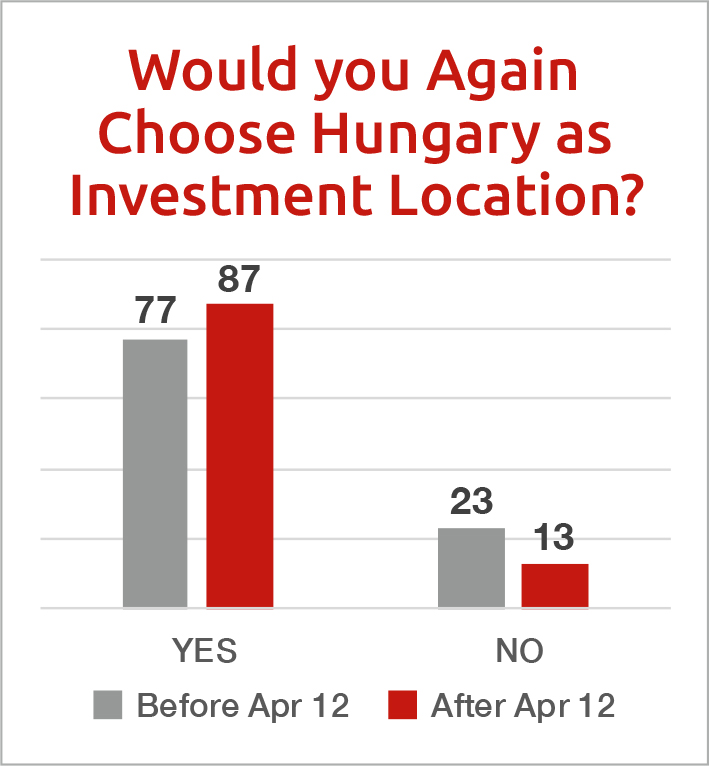
This year, DUIHK conducted its 32nd annual survey just days ahead of the April 12 parliamentary elections, but swiftly rolled out a second flash survey immediately after the polls. The message from the comparison is hard to miss: The two-thirds majority of Tisza in the new National Assembly sparked a spectacular improvement in the business sentiment among the respondents.
Referring to the survey, Keszte noted that local trends should always be checked against a broader environment. After all, Hungary competes with many other countries for capital, EU funds, and talents.
This is why the chamber’s surveys are particularly helpful: uniquely, they also feature the results of nearly identical surveys in as many as 15 countries in the CEE region, giving the national findings a comparative regional perspective. In 2026, 1,538 managers in CEE provided their insight to the survey.
Reflecting on the outcome of the parliamentary elections, Keszte stated that many of the survey’s findings and other feedback from the member companies are in line with the priorities outlined in the Tisza party’s program, such as the fight against corruption, the strengthening and internationalization of Hungarian SMEs, the overhaul of the education system, and even the eventual introduction of the euro.
However, Keszte also saw some topics where “further consultation” would be needed, not least on labor market questions.
The pre-election survey reflected a rather gloomy atmosphere among companies. Economic and business expectations stayed at the poor levels of the last 2-3 years, and even weakened further to their lowest points in many years in some cases. As a result, investment and employment intentions dropped further and, on an overall balance, signaled more reductions than increases. The election outcome literally reversed this negative balance into a positive one.
Nonetheless, Dirk Wölfer, the chamber’s head of communications and the author of the Hungarian analysis, noted that even after this rebound, sentiment in Hungary has caught up with other countries in the region and remains far from pole position. Further, while the post-election rebound may help stabilize investment activity in the short term, Wölfer said the ultimate motivation for corporate investment remained predictable prospects of positive returns in the long run.
In the German chamber’s survey, this is clearly reflected in the risk assessment before and after the elections. The lack of predictability, legal uncertainty and untransparent public procurement had been a constant subject of severe dissatisfaction among companies. After the election, the risk potential of these factors dropped sharply on the expectation that the new government will re-establish a fair, reliable regulatory framework decisively and quickly.
Another remarkable shift occurred on the demand-side risks: Before the elections, lack of demand was mentioned as a risk to their own business by 72% of respondents, but this dropped sharply to 53% after April 12.
In-depth analysis by the chamber showed that optimism grew above average among companies that mainly serve domestic customers, for example, in the gross and retail trade and services sectors. At the same time, large industrial exporters drew little support from the national election outcome.
The pre-election survey also asked companies which policy areas they considered most urgent for the next government to address. At the top of the list were measures aimed at restoring a cooperative relationship with the European Union, followed closely by reform of the education system, along with stabilization of public finances and legal security.
The post-election flash survey revealed that companies are quite confident about rapid progress in areas where legislative measures could heal many current wounds, but complex structural issues such as education, budgets, social security systems and energy supply will probably take longer.
For many years, the DUIHK has conducted detailed analyses of the regulatory and institutional conditions in areas such as labor markets, taxation, economic policies, the ecosystems of suppliers and R&D partners, and public-private infrastructure. In some of these fields, investors were and are pretty happy with the current situation; in others, satisfaction doesn’t live up to expectations yet. Compared to other CEE countries, Hungary frequently performs just around the regional average.
Regarding labor markets, weak economic growth over the last 2-3 years has reduced wage pressure and the perceived shortage of skilled labor. This year, companies expect wage costs to increase by 6.5%, which seems rather moderate compared to previous years. Nonetheless, Hungarian labor costs have increased by about 75% since 2020, whereas regional peers such as Slovakia and the Czech Republic saw increases of only 47% and 36%, respectively.
Among the 25 factors of the business environment that were evaluated in the study, Hungary performed quite well in those related to local suppliers, the public infrastructure, and the labor code.
The plans of the new government to pave the way for the adoption of the euro largely match the preferences of the corporate sector: According to the survey, 75% of companies are in favor of adopting the single currency, the highest ratio the DUIHK has recorded since 2011.
Some 264 member companies were surveyed from March 2 to April 2 (178 online, 86 by telephone). The flash survey after the election was conducted from April 16–23, and featured 139 participants. The full report and additional documents can be downloaded via the chamber’s website, ahkungarn. hu The wider CEE Business Survey 2026 was conducted from March 2 to April 2 and featured 1,538 participants from 15 countries.
This article was first published in the Budapest Business Journal print issue of May 22, 2026.


