



The research teams involve scientists from Europe and from all over the world, working together on solving problems of global challenges, on the three priority domains – digital transformation, healthy living, green transition and circular economy – of the John von Neumann Program, that defines the RDI strategy for Hungary.
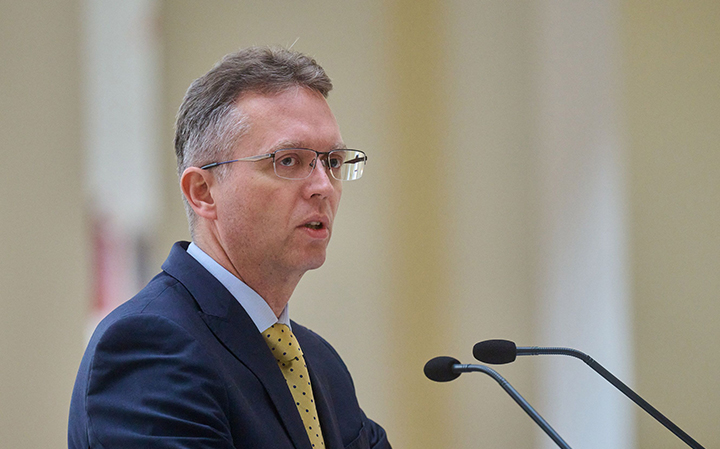
Minister of Culture and Innovation Balázs Hankó, when announcing the results of the HU-rizon Program on November 16, underlined that the Ministry raised the budget from HUF 8 billion to HUF 12 bln to support 30 out of 112 projects.
He highlighted that within all these projects Hungarian researchers work together with scientists from universities ranked in the top 100 of the world. Scientific communities all around the world, including the European Union, rely on Hungarian researchers, he stressed, since top universities across the globe are lining up to participate.
Research teams from Europe and all across the globe welcomed the opportunity to collaborate and were ready to join in research projects led by Hungarian universities. An outstanding example of cooperation is the project lead by Óbuda University, which is conducting research on medical robotics and artificial intelligence in collaboration with Stanford University and the National University of Singapore, enabling real cooperation between West and East.
The University of Szeged will investigate with the University of Cambridge and the University of Ulm on the impact of micro- and nanoparticles in plastics on healthy life The University of Debrecen teams up with Seoul National University and the University of Florida on novel developments of self-driving vehicles. “We are focusing on topics that bring real solution for digitalisation, healthy living and the green transition. Hence the winning projects can be launched with the support of the Hungarian Government,” the minister said.

Ádám Kiss, President of the National Research, Development and Innovation Office (NRDI Office), stressed that the Hungarian Government is spending over HUF 150 bln from the national budget on science policy, and research and innovation funds this year.
All R&I calls for proposals are highly oversubscribed as is also proven by the HU-rizon Program, for which 16 Hungarian universities submitted 112 proposals valued HUF 40 bln in total, he said. In these research projects, the Hungarian consortium coordinator defines the direction of the research, and all parties’, including the Top-100 international universities’ project costs are funded by the Hungarian Government. He explained that the HU-rizon call required Hungarian universities to involve foreign institutions of such type at least in 50%. The projects will last for two to three years.
The HU-rizon Program also enables Hungarian higher education institutions to lead larger research groups with up to five to 10 consortium members independently in the future, he said. He highlighted the importance of the cooperation between universities and business actors to engage in research with real social, economic and financial impact, not just for the sake of research. He named competitiveness as a key factor fostered by all the funding schemes of the NRDI Office, including the HU-rizon Program to be announced also in the coming year.


