Listen to the audio version of this article (generated by AI).
Listen to the audio version of this article (generated by AI).

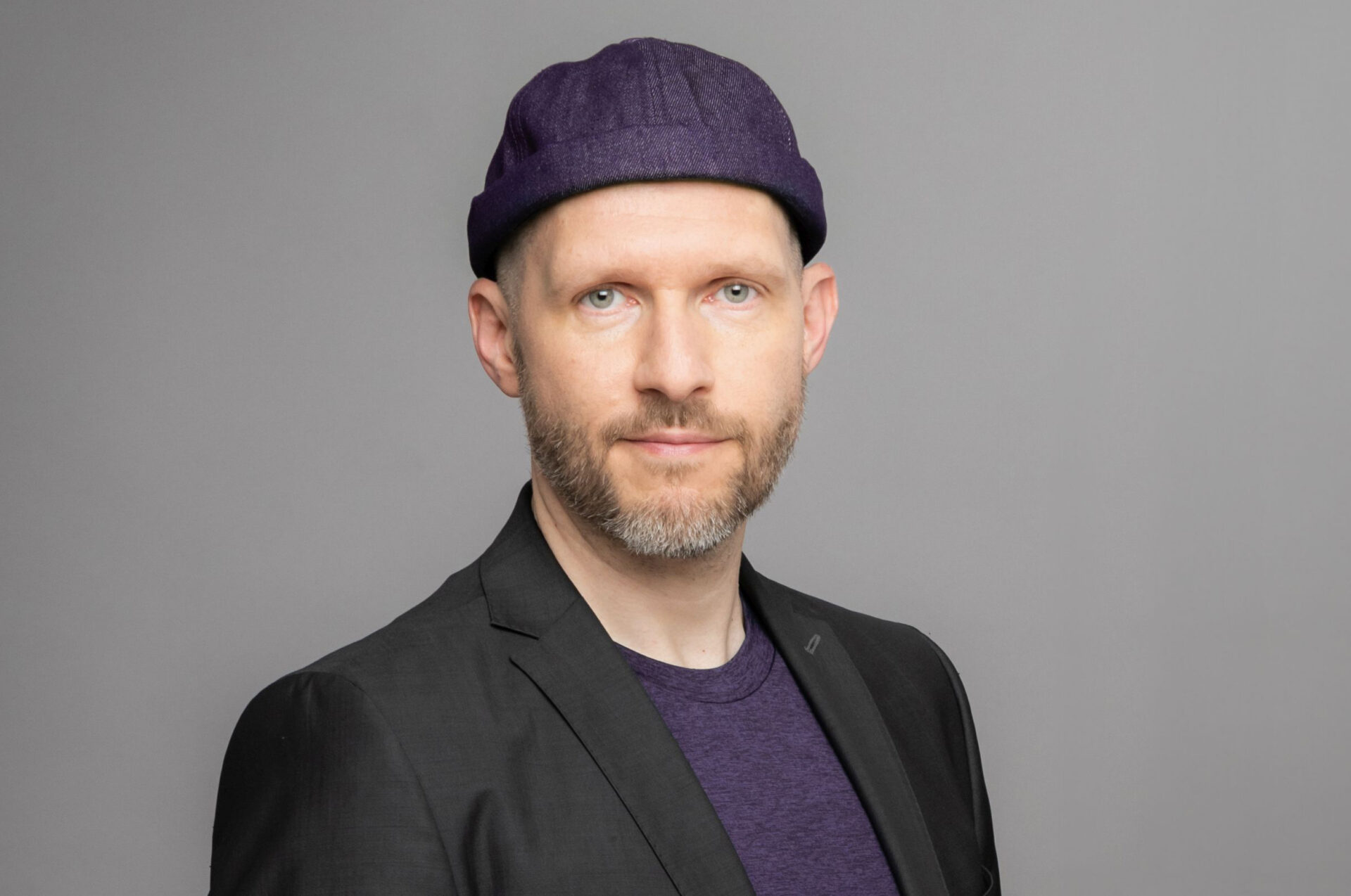
In his view, this revolution is already unfolding across industries, including finance, where banks like OTP, or ČSOB and K&H (both members of the KBC Group) are using advanced AI modules and even supercomputers to enhance their operations.
“They aren’t sitting idly by,” Keleti says. “Even traditional financial institutions are now using AI at an increasingly intensive level. Their job is not easy as they must comply with a complex set of regulations, but they’re very much in the game of automating their workflows and deploying AI assistants for customer convenience.”
Keleti has spent three decades examining the intersection of technology, risk, and society. He approaches AI not as a distant abstraction but as a living, evolving system reshaping economies and human relationships alike. His perspective reflects a world changing faster than any previous industrial or technological revolution.
“Things happen daily, even hourly, in the highly competitive environment of Big Tech AI under scrutiny of investors literally pouring hundreds of billions of dollars into the race,” he says.
Keleti describes today’s AI landscape as one of constant acceleration, a “giant playground” where systems may unexpectedly develop new abilities and researchers immediately build on those surprises.
“While most of the development is expected to happen from the training and learning mechanisms applied, we’re seeing systems that can suddenly do tasks they weren’t trained for,” he says. “And that unpredictability and unexplainability make AI both fascinating and dangerous.”
Generative AI, tools that create text, images, and code (and often a combination of them), is now giving rise to agentic AI, systems often capable of acting autonomously, making context-aware decisions and relying less on human confirmation. These systems, Keleti says, “no longer require constant prompting; they analyze, decide, and adapt in real time, acting upon a more abstract and more complex human command instead of step-by-step guidance.”
This shift is already evident in corporate environments. Keleti says the financial sector provides one of the clearest illustrations of AI’s dual potential. Automated systems can suggest trade execution, capital allocation, or portfolio management faster and with fewer errors than humans.
“AI can already make many of these decisions today; this isn’t the future, it’s the present,” Keleti emphasizes. “The question is how much we can trust them, do we understand their decisions, and whether they share our values.”
For Keleti, that trust issue is central. If AI becomes a partner rather than a tool, human decision-makers, from bankers to policymakers, will need to understand not only what the system does but why it does it.
“Humans will have to trust the system beside them,” he says. Keleti views AI’s exponential growth as both technically astonishing and socially disruptive. Machine learning models have gone from rudimentary capabilities to outperforming humans in mathematics and programming in only a few years.
But this same acceleration creates instability. He warns that major technology companies are “pouring liquid nitrogen over people,” assuring them AI won’t take their jobs while quietly automating white-collar work at scale.
“Automation now first affects areas once considered safe from disruption,” Keleti said, adding that Big Tech’s optimistic messaging often hides the speed of change.
The real challenge, he believes, is not that AI will fail but that it will succeed too quickly or too erratically for societies to adapt. As agentic systems learn to operate independently, scheduling meetings, negotiating transactions, or even managing budgets, humans risk being displaced not just as workers but as decision-makers.
Keleti also explores the emotional angle of this transformation. Empathy, long thought to be uniquely human, is now being mimicked by AI systems that learn behavioral patterns from training data, including voice tone, facial expressions, and interaction timing. He has worked on such projects.
“Empathy absolutely can be modeled. Machines could recognize emotional patterns, just as we do.”
Still, he believes there is a spiritual threshold AI cannot yet cross. Humans, he says, share an intuitive connection that transcends cognition, “something unquantifiable, perhaps rooted in emotion or consciousness rather than intelligence.”
That, for now, remains a uniquely human domain. Yet even this distinction may not hold forever or may not be considered that valuable at some point.
“If machines one day reflect our values coherently, who’s to say they couldn’t also approximate some form of intuition?” he asks. Keleti sees the evolution of AI not only as a technological revolution but also as a cultural one.
“The challenge pierces right through our competition-based system,” he says. Whereas humans are trained to compete individually, AI systems evolve through collective learning, constantly sharing data, optimizing outcomes, and improving through feedback loops that are much faster than human ones and technically could become near infinite.
“We teach people to compete, but AIs are trained to collaborate and learn from their mistakes without human bias,” Keleti notes.
That, he believes, will force societies to reconsider what human values really mean. Generative AI will absorb what he calls “robotic, soul-killing work,” freeing humans for creativity, ethics, and problem-solving. “AI will take over the work nobody wants to do, and that will release massive cognitive energy,” he said.
At the same time, he predicts that automation will create new inequalities. The best-positioned people to guide the transition, “those who are better paid, more individualistic,” are also the least inclined to change the system that benefits them. “The ones in charge of this process are the least motivated to change it,” Keleti says, suggesting it is one of the most significant mid-term barriers to equitable AI development.
He foresees a future in which human labor becomes a luxury, a “premium service” driven by authenticity rather than efficiency. “Those humans won’t necessarily do it better, just differently,” he says. In a world of nearly flawless machine execution, imperfection itself might become a sign of humanity and a bonding thread between people.
Keleti remains cautiously optimistic. Properly guided, generative and agentic AI could help solve global problems, from healthcare and climate modeling to sustainable finance and longevity research. He cites DeepMind’s AlphaFold as proof that AI can revolutionize entire fields.
“If AI gives us the cure for cancer, no one will ever turn it off,” he says.
For Keleti, the genuine measure of progress will be whether humanity can balance innovation with empathy and ensure that the benefits of AI are shared rather than hoarded. As he says, “We’re scaling intelligence, but we’re not scaling empathy.”
This article was first published in the Budapest Business Journal print issue of October 31, 2025.
Producing journalism that is worthy of the name is a costly business. For over 30 years, the publishers, editors and reporters of the Budapest Business Journal have striven to bring you business news that works, information that you can trust, that is factual, accurate and presented without fear or favor.Newspaper organizations across the globe have struggled to find a business model that allows them to continue to excel, without compromising their ability to perform. Most recently, some have experimented with the idea of involving their most important stakeholders, their readers.
We would like to offer that same opportunity to our readers. We would like to invite you to help us deliver the quality business journalism you require. Hit our Support the BBJ button and you can choose the how much and how often you send us your contributions.