


Essentially, nearshoring has made CEE an attractive industrial and logistics destination; however, new supply has been moderating since the peak of 2022, according to consultancy CBRE. Across Europe, Garbe Industrial Real Estate has traced moderating industrial rental growth and an overall vacancy rate of just below 6%.
“When taken into account collectively, CEE, SEE and the Baltics markets take second spot among European markets’ supply after Germany, amounting to 73.4 million sqm, 61.6 million sqm [of which is] in the CEE-5 [the Czech Republic, Hungary, Poland, Romania, and Slovakia] which corresponds to 10% growth year-on-year,” CBRE comments, looking at the figures as of mid-2024.
Hungary has a total industrial stock of more than five million sqm, with almost 500,000 sqm under construction and due to be delivered in 2025 or 2026, with a pre-lease rate of 30%, according to Cushman & Wakefield.
“While the growth of industrial stock will continue, it is expected to occur at a slower pace,” the consultancy comments.
The largest recent Hungarian delivery is the new 100,000 sqm Tesco warehouse on a 60-hectare site at CTPark Sziget. In Poland, CTP is developing three new logistics parks in Lodz, Czestochowa and Bydgoszcz, totaling 215,000 sqm.
The leading CEE industrial developer has 10 complexes across Poland at various stages of development in addition to a land bank of 2.5 million sqm. The company owns and operates more than six million sqm of space across CEE, it says.
CBRE recorded more than 33 million sqm of stock across several logistics and industrial hubs in Poland and 1.9 million sqm under construction in 2024, representing a significant fall in volume of around 50%. From a development strategy perspective, the speculative option constitutes less than 50% of this. The Wroclaw region was the leading development hub, with more than 570,000 sqm of industrial space under construction.
“While dynamics have modified, Poland remains one of the fastest growing countries in Europe’s logistics and industrial market, ranking fifth in terms of total stock supply within the European regions,” says CBRE.
For the Czech Republic, industrial development for 2025 looks positive, with 870,300 sqm of space currently scheduled for completion and a further 384,700 sqm in shell & core status, potentially available within 3-6 months.
There are currently 2.7 million sqm of projects whose permitting process has been completed and, in addition, 3.2 million sqm of potential projects in various permitting stages. The total potential planned area, therefore, stands at around 5.9 million sqm at the moment, says Josef Stanko, director of market research at Colliers. The stock has risen to more than 12 million sqm with vacancy of around 3%.
According to Colliers, Romania’s industrial and logistics stock continued to grow in 2024, bringing the total to 7.4 million sqm, with a further 650,000 sqm under construction in industrial hubs across the country.
“Expanding to 11-12 million sqm by the end of the decade is a realistic goal. In the short term, however, economic and political uncertainties may impact the pace of expansion, but large-scale transactions could bring positive surprises and support market activity,” says Victor Coșconel, head of leasing for office and industrial at Colliers.
Poland and Hungary have the highest vacancy rates at around 8%, although these are expected to fall as speculative pipelines are more restrained. The lowest vacancy rates are in the Czech Republic at around 3% and SEE (Bulgaria, Croatia, Serbia, and Slovenia) with an estimated 2% overall.
In general, vacancy rates in the CEE logistics and industrial markets tend to be increasing. Cushman & Wakefield say average vacancy across the region is in the single-digit range, indicating very tight supply markets with low availability of quality industrial and logistics space.
“Stabilizing construction costs are enabling new industrial developments, though demand varies regionally. Prime locations and transport corridors in Hungary and Poland attract the most interest, with growing attention from Asian companies in logistics and manufacturing,” Colliers concludes.
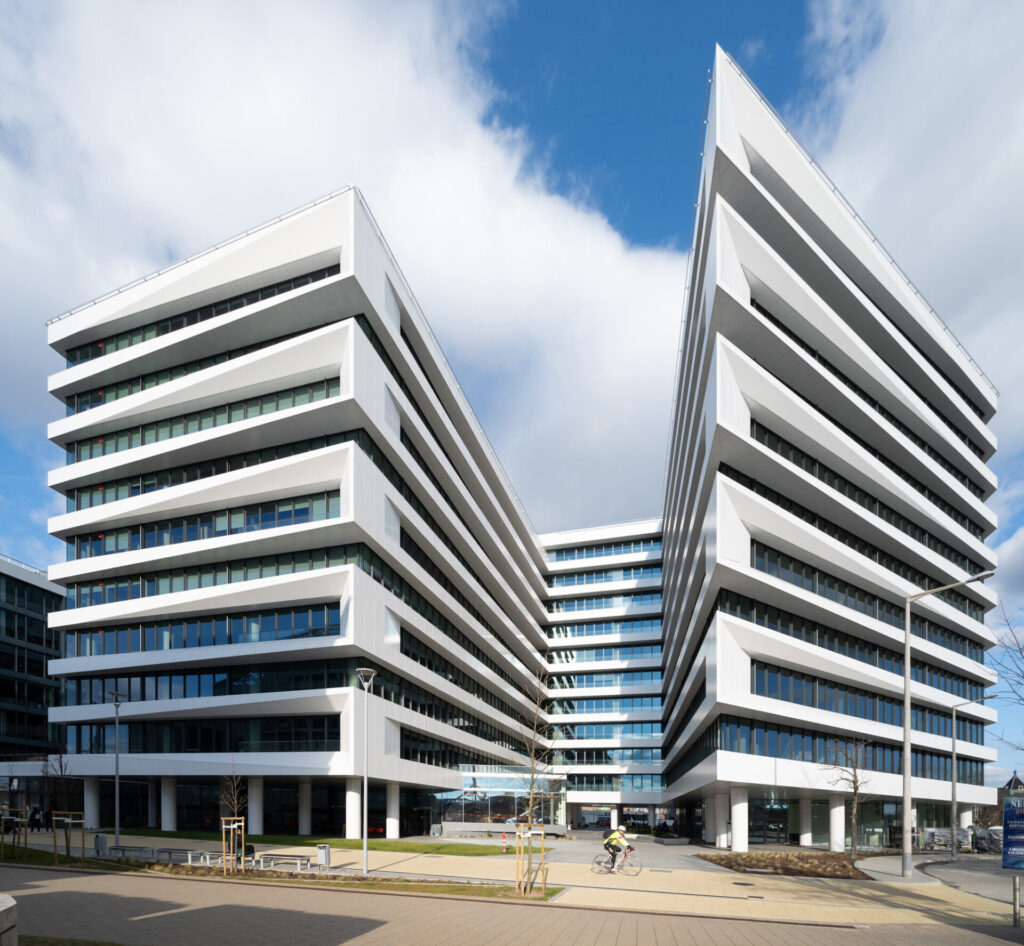
Revetas Capital and developer TriGranit have confirmed that ARM Processors, a global leader in semiconductor and computing solutions, will establish its new Budapest headquarters in Millennium Gardens, occupying more than 3,400 sqm of space on upper floors overlooking the Danube.
“The relocation of ARM Processors to Millennium Gardens is a fantastic example of how premium assets remain highly attractive in today’s market. Leading tech companies with strong growth potential continue to seek high-quality office spaces, and Millennium Gardens offers exactly that: modern, sustainable, and future-ready workspaces,” comments Károly Dömötör Makk, leasing director of TriGranit.
With the new letting, the 37,000 sqm Breeam “Excellent” Millennium Gardens is now 50% let and is expected to be fully leased by 2027, according to TriGranit. The North Tower, completed in 2022, is almost fully occupied. The South Tower, delivered in the second quarter of 2024, is close to 30% occupied.
Revetas Group bought TriGranit in 2018 from TPG Real Estate but disposed of the developer in August 2024 to DRFG Investment Group. Revetas retained ownership of Millennium Gardens, however.
Total office stock in the Budapest office market stands at 4.45 million sqm, with vacancy rising to 14%, according to Cushman & Wakefield.
“Looking ahead, the speculative office pipeline is slowing, with only 113,000 sqm of new speculative office space scheduled for delivery through to 2027.”
The transaction was facilitated with the support of CBRE, who represented Revetas Capital. iO Partners acted as tenant representatives for ARM Processors and will be project managers up to the handover.
This article was first published in the Budapest Business Journal print issue of February 21, 2025.


