


A survey released in June by workforce placement group Manpower Hungary found that local companies are not planning significant hires in Q3. Barely more than a quarter of employers, some 28%, plan to expand their headcount, while 23% forecast layoffs.
Péter Varga, CEO of Manpower Hungary, highlighted another figure: “In the current macroeconomic environment, a large proportion of employers are in a holding position: 47% are planning neither expansion nor reduction of their headcount in the coming months.”
Companies are hoping for GDP growth to take off, so they are postponing mass layoffs and reducing headcount by leaving positions unfilled, Varga explained.
Examining specific sectors, there are marked differences between industries. While communication services, healthcare and life sciences may see significant layoffs, finance, real estate, and information technology, may see notable headcount increases.
From an economic perspective, the most significant is the raw materials and manufacturing industry, where headcount increases may be slightly above average. In contrast, the consumer goods and services sector, also a significant contributor, shows a near-stagnant outlook, according to the Manpower report.

Data released a month later by market research company GKI confirms that Hungarian companies’ willingness to hire weakened in early 2025. In May, only 9% of firms planned to expand headcount over the following three months, while 12% anticipated reductions.
In retail and construction, downsizing intentions outweigh expansion plans. In manufacturing, the two trends are roughly balanced, whereas business services show expectations of net job growth. The unemployment rate in May stood at 4.3%, and the average duration of job searches now exceeds 12.8 months.
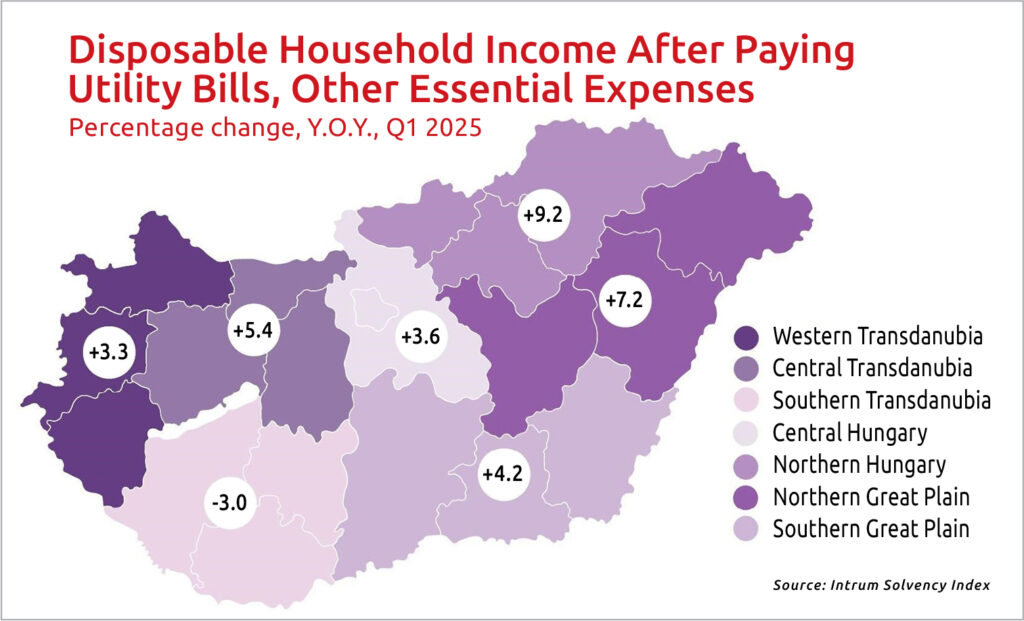
How are employees faring in terms of income? Intrum has been publishing solvency index surveys for several years, measuring the amount of disposable income households have after paying utility bills and other essential expenses. Data published on June 13 reflects the regional indexes for Q1 2025. In some Hungarian regions, the solvency index improved; in others, it deteriorated.
The Northern Hungary region registered the highest growth at 4.2% compared to the previous quarter and 9.2% year-on-year. This is a significant improvement, given that, based on purchasing power parity, the region’s GDP remains low at 48% of the EU average.
Moving south, growth is also evident: 1.3% quarter-on-quarter and 7.2% y.o.y. Central Hungary, traditionally much more developed than other regions, saw a slight decline of 1%, while a sharper drop occurred in the southern part of the country, down 3.2% from the previous quarter.
Intrum, in cooperation with GKI, also analyzed a key indicator that directly impacts purchasing power: inflation. According to a study released on May 28, the financial situation of Hungarian families has not improved since the end of the COVID-19 pandemic in 2023.
This is largely due to rising prices, which continue to erode purchasing power. Up until March, Hungary recorded the highest inflation rate among EU countries, driven by steep increases in food and service prices. This has led to a decline in consumer confidence, with families becoming increasingly cautious about spending.
The government is attempting to contain inflation through artificial measures, such as capping profit margins on certain food items. However, according to Intrum, this is worsening the situation by distorting the market. Hungarian households are making efforts to minimize spending, but the current price index and persistent inflation are offering little relief.
“Some form of economic recovery is necessary to create financial stability, so we are not expected to return to pre-COVID conditions this year. The latest employment data from KSH [the Central Statistical Office], showing an unusual decline at this time of year, is also cause for concern,” says Judit Üveges, head of sales at Intrum.
In this situation, the obvious solution would be to seek better-paid jobs; however, recent surveys offer contradictory insights. Career platform wherewework.hu (formerly munkahelyeink.hu) conducted labor market research revealing that more than two-thirds of Hungarian employees are willing to change jobs, primarily motivated by the prospect of better salaries and benefits.
However, the findings also highlight a significant gap between workers’ expectations and what employers are offering, particularly in terms of income levels and fringe benefits.
Another survey, conducted by Pulzus Kutató, found that employees are cautious: only 17% of respondents are definitely planning to change jobs, while a further 16% remain undecided. This means that 67% of Hungarians do not intend to change jobs, at least not within the next six months.
Among those aged 18-39, 29% expect to seek new employment, compared with 7% of respondents aged 60 and above. Regarding recruitment methods, 48% of those surveyed said most jobs are obtained through acquaintances, while 35% believe positions are filled equally via personal networks and informal advertising. Only 7% expressed trust in open applications.
Beyond salary, the issue of remote work remains a significant concern for employees. Having experienced the benefits of a flexible working environment during the COVID period, many now wish to retain that flexibility, while employers are increasingly expecting a full-time office presence, according to HR services company WHC Group.
It found that diverging expectations regarding flexibility are causing growing tension in recruitment processes. While working from home at least one or two days a week has become a baseline requirement for candidates in intellectual roles, many managers still favor full in-office attendance. This conflict is particularly challrnging for candidates who have organized their lives around remote work in recent years, WHC notes.
This article was first published in the Budapest Business Journal print issue of July 25, 2025.


