


The Budapest Climate Summit was opened by János Áder, former President of Hungary and chairman of the board of the Blue Planet Climate Protection Foundation, who suggested that global climate talks should continue in the framework of the G7 or G20 after COP30. According to him, it will be hard to reach and finance the USD 300 billion target promised to developing countries.
Diana Ürge-Vorsatz, Vice Chair of the Intergovernmental Panel on Climate Change (IPCC), provided an international outlook on the mitigation of climate change. “Climate mitigation is costly, but the benefits of accelerating climate transition outweigh the cost of it.” As she underlined, “we can also profit from this transition, and we have to go on because the world is losing a lot if we don’t step ahead, not only from the business point of view.”
She added that, besides decarbonizing, we also need to reduce the demand side and focus on heating, cooling, and building sustainable houses. “We have tremendous opportunities, and we can do it,” she said.
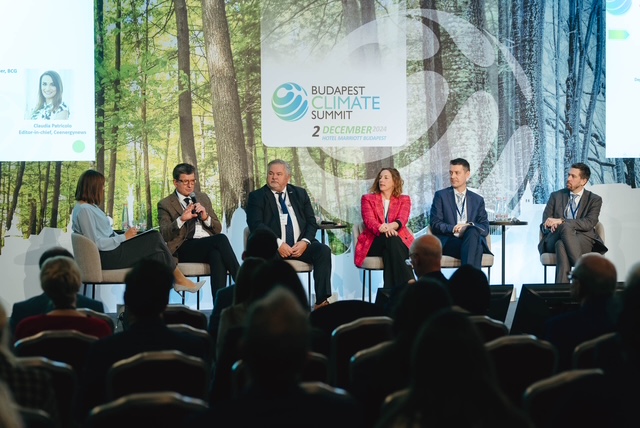
Attila Steiner, State Secretary of Hungary’s Ministry of Energy, provided insight into Hungary’s EU presidency’s work on the EU’s 2050 climate target. Regarding Hungary’s point of view, he mentioned that the country aims to enhance its energy storage capacities to 500 megawatts (MW) by 2026, while planning the development of a pumped-storage hydropower plant, advancing geothermal energy projects, and increasing biogas utilization. On the EU perspective, he noted that Hungary urged the European Commission to negotiate a new competitiveness deal and discussed nuclear energy as a key solution.
Barbara Botos, Hungary’s Ambassador-at-large for climate, talked about the results and insights of COP29 in Baku. She explained the spirit of the negotiations as resembling a kurultai, the political and military council of the ancient Mongol and Turkic chiefs and khans. Botos emphasized the simple mathematics of climate change: achieving zero emissions only halts warming, while reaching negative emissions is necessary to start cooling. During COP29, she noted, several countries with significant and growing emissions failed to provide concrete and transparent commitments.
Byung Kim, lead country manager of ExxonMobil Hungary, presented the company’s report on the global energy outlook for 2050. According to him, the world in 2050 will be vastly different: there will be 2 billion more people on the planet, and the global economy will double, requiring 15% more energy, though emissions are expected to decline by 25% from today’s levels. He added that the world is not currently on a path to net zero and that additional public policies and cost-competitive tech advancements are necessary to achieve this goal amidst economic hardship.
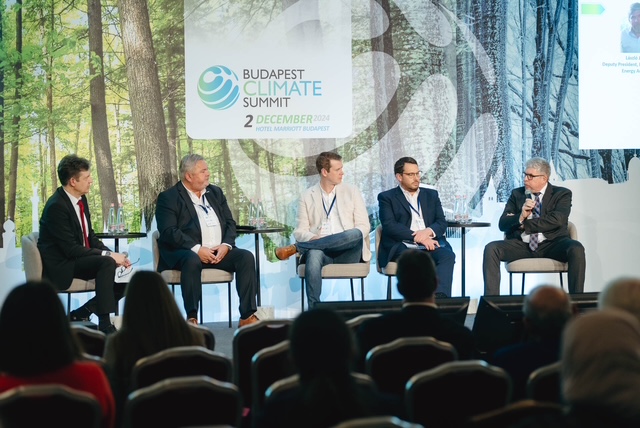
For the urgent modernization of Europe’s distribution grids, investment needs to double to €67 billion per year from 2025 to 2040, said Zsolt Jamniczky, deputy CEO of E.ON Hungaria. He emphasized overcoming challenges as essential, noting that many companies see greater opportunities in China and the U.S., a trend that reflects the EU’s declining competitiveness and attractiveness.
Csaba Kiss, deputy CEO, chief generation and nuclear officer at MVM Energy, stressed the need for more renewables to reach zero emissions. He highlighted the importance of storage capacity, even if it is not a cheap technology. MVM is exploring building a pumped-storage plant, which is highly needed in the Hungarian market, while also pursuing nuclear projects such as lifetime expansion for Paks NPP and examining opportunities for small modular reactors (SMRs).
Under the Climate Bank Roadmap, the European Investment Bank (EIB) Group aims to support €1 trillion in investment by 2030 and is on track to meet that target, said Laurent Maurin, head of the economic studies division at EIB. He stressed that financing sustainability cannot rely solely on public funds. EIB plays a critical role as a catalyst, encouraging private financial institutions to join projects as EU countries face increasing budgetary barriers to granting subsidies.
One of the day’s highlights showcased innovation at its finest. In collaboration with the Blue Planet Climate Protection Foundation, three visionary companies were introduced: Agroloop, pioneering alternative protein solutions; eChemicles, working toward a more energy-efficient chemical industry; and Planergy, addressing energy storage challenges in solar power.
SMR technology provides a significant opportunity for fuel suppliers, said Michael Bryant, vice president of marketing and sales at URENCO Group. He advised that securing fuel supplies in time is critical, given current market conditions. URENCO plans to finalize a new facility capable of producing higher-enrichment fuel needed for future SMRs.
Under normal circumstances, biogas is not economically competitive, but it remains essential, agreed participants in the biogas and biomethane panel. Many Central European countries, like Poland and Hungary, have significant potential, but regulatory support is crucial. The first step should be differentiating biogas from natural gas. While quantifying biogas’s green value is challenging, its positive externalities should be recognized and monetized.


