


When I was first told about the book by the editor of the “Panel” literary magazine (she said it was the only guidebook I needed to read), I was delighted. Only to be thoroughly disappointed to discover it was out of print.
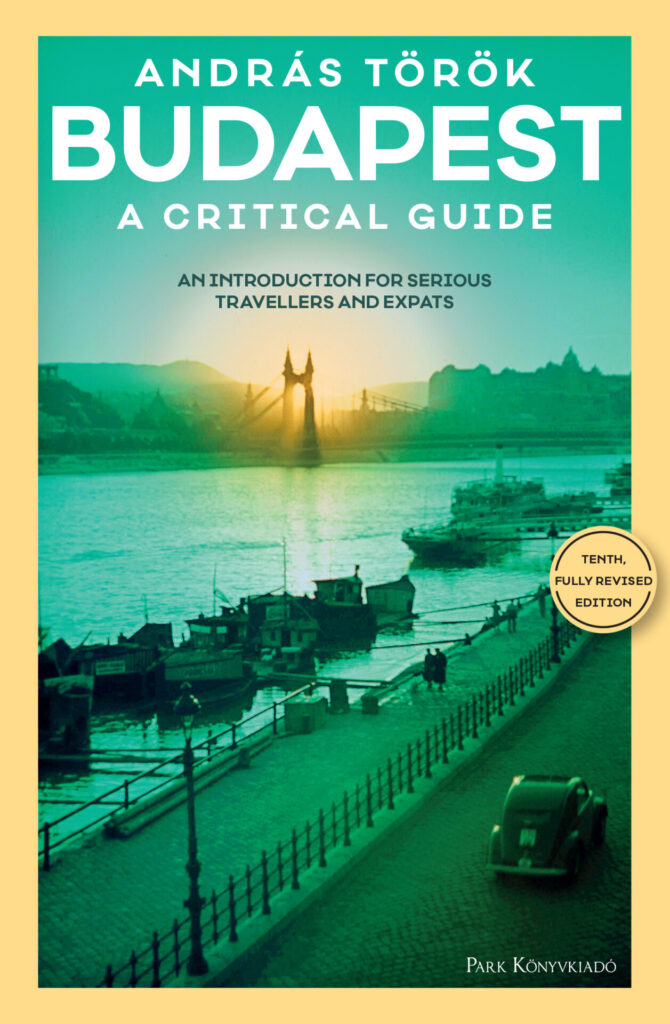
After I interviewed Török, he kindly sent me an electronic copy of the soon-to-be-new edition of the book, and it’s exactly what I, and I’m sure any visitor to Budapest, is looking for.
Török’s book is written in a wryly amused and amusing, poetic style and illustrated with evocative black and white photographs from the city’s history.
The core of the guide is taken up with suggestions for a series of Budapest walks, each described in rich detail. Wrapped around this are chapters on subjects such as “That Awful Hungarian Language,” where to eat and stay, and so on.
Eschewing the cocky bombast of your average guidebook, Török self-deprecatingly introduces a chapter called “A Crash Course for Wannabe Insiders” by writing, “In this chapter, I try to pretend to be able to convert you from an expat or a traveler into a Budapest original.”
One of Budapest’s best vantage points is recommended for “a successful car dealership owner (who meets for the first time in decades a childhood friend who had left for Yale University in 1978 and who gently belittled him for his mediocre high school diploma).”
But don’t be fooled by the tone, Török really knows the city and its history. A section of the chapter on where to eat and drink headed “Frames of a Film” is a fascinating insight into Hungarian culinary history that I defy you to find in English anywhere else.

Referencing Hungarian movies “Két Emelet Boldogság” (“Two Storeys of Happiness,” 1960) and “Szindbád” (1971), Török explains how Budapest went from being a pre-WWII gourmet’s paradise to a communist city where the arrival of lemons in the stores was a major event. He then lovingly describes a scene in “Szindbád” that singlehandedly revived Hungarian interest in the country’s classic cuisine.
Reading information truffles like these dotted throughout the book made me realize that it’s best read as a history of Budapest. At 400 pages long, I couldn’t imagine carrying it around. Pocket-size it ain’t.
The latest edition does include QR codes that link to movies or Török talking about places, but I’d say this a book to savor in a Budapest bar or café, or in your hotel room before setting out for the day.
Török signs off “Budapest. A Critical Guide” as “your invisible host.” Meaning, I assume, that he walks with you as you explore his city.
Born and raised in Budapest, Török is a a third generation “Budapesti” which he says is very rare. He describes himself as “Mr. Budapest. An urban patriot.” After studying history then languages, Török became a translator of literary works before switching to biographies.
In 1986, Török honeymooned in Vienna. Realizing he didn’t know the city very well, he headed for Shakespeare & Company on Sterngasse and bought a guidebook. By the time he returned to Budapest, Török had decided to write a book on the city for foreigners.
“I’ve been the observer of the urban scene since then,” he says.
“Budapest. A Critical Guide” has been published since 1989. Now retired, Török never made enough money from the book for it to be his sole source of income. He worked for the government as a deputy minister of culture, as director of the Mai Manó house of photography, and finally as a director of a tiny non-profit philanthropy consultancy.
For the past 10 years, Török been the right-hand man of Miklós Tamási, helping to manage Fortepan, a community-based photographic archive of around 200,000 photos. I would imagine that this is where the wonderful photos in his book come from. On retirement, Török decided to dedicate as much of his time as possible to the guidebook.
I explain to Török that I’ve always thought getting lost in a city is the best way to get to grips with what it’s really about. Török disagrees.
“If you’re lost in the urban jungle, you’ll never find authentic life without a guidebook. I want to pass on the way of life of a Budapest aboriginal.”
This is how Török speaks, peppering his conversation with slightly archaic words. At one point, he asks me if I know the meaning of the word “naff,” a word I haven’t heard since probably the 1980s. Talking to Török feels like reading his book, like meeting the “invisible host.” When I say that one of the reasons I like Budapest is that it’s not beautiful, Török defends the city.
“You’re not looking at it in the right way. It’s like eating a sandwich. If you head in the right direction, it’s bread, salad, mayonnaise, meat and back to bread. Budapest is partly beautiful, partly naff.” We finish with me asking where I’d find authentic Budapest.
“Apart from being invited into a family home, I’d suggest you go to a non-central, working-class neighborhood like the 18th or 19th districts. There’s a restaurant called Café Zila in the 18th near the tram terminus. In the 19th-century it was a shooting range. Then it became a swimming pool changing room. When they privatized the pool, the former ice-cream vendor turned it into a two-story glitzy restaurant. There are no tourists here.”
When it’s published, you’ll be able to find “Budapest. A Critical Guide” in good city bookshops. Or you can order directly from the invisible host himself at budapest-criticalguide.hu.
This article was first published in the Budapest Business Journal print issue of October 4, 2024.


