

The Hungarian capital ranked 26th in a separate global comparison, which included 162 cities in 70 countries.
The StreetPulse project, led by researchers from Corvinus University of Budapest and the Toulouse School of Economics, used AI to rate streetscapes on seven criteria: beauty, perceived safety, vibrancy, walkability, historical character, comfort and perceived wealth.
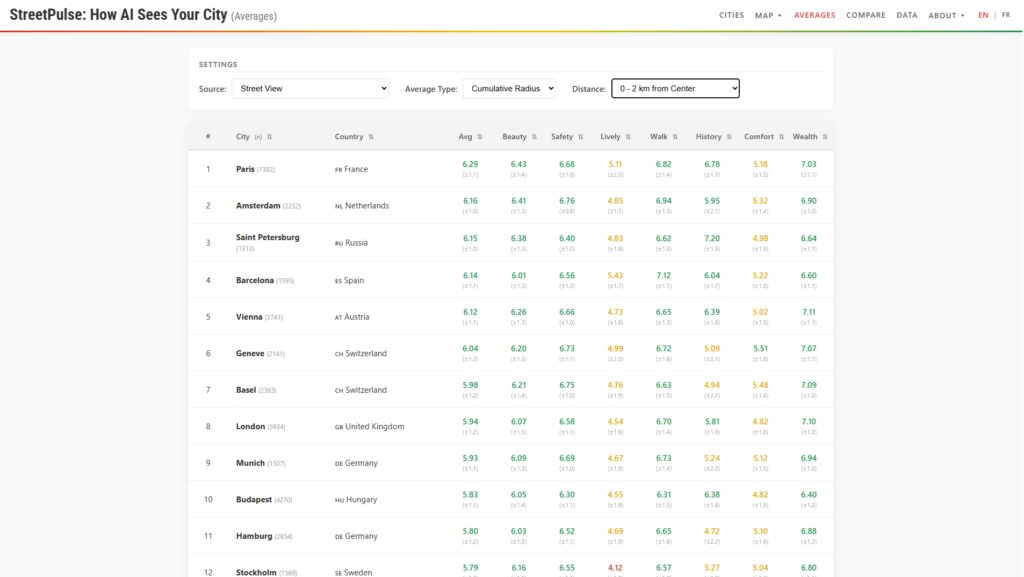
In the European ranking, based on Google Street View images taken within 2 km of each city center, Paris led with 6.29 points, followed by Amsterdam, St. Petersburg, Barcelona and Vienna. Budapest scored highest for perceived wealth (6.4), historical character (6.38), walkability (6.31) and perceived safety (6.30). It scored 6.05 for beauty, 4.82 for comfort and 4.55 for vibrancy.
Budapest dropped to 15th when the comparison was widened to a 5 km radius and to 42nd when researchers considered the entire urban area covered by the study. Geneva, Amsterdam and Vienna led that wider comparison.
Venice, Paris and Amsterdam topped the separate global city-center ranking, which used openly accessible images from Mapillary and Panoramax. The researchers said open imagery makes the analysis cheaper and easier to replicate, although image quality and how often the images are updated can vary.
The interactive StreetPulse platform lets users explore neighborhood scores, compare cities and build their own rankings. Visitors can also compare pairs of street images to help researchers assess how closely the AI ratings match human judgments. The team says the platform can help planners identify issues such as highways that divide neighborhoods and streets that people perceive as less safe.
“We aim to continue developing the StreetPulse platform by assessing cities against an increasingly wide range of criteria, helping them improve the quality of their urban spaces. We welcome opportunities to collaborate with researchers, local authorities and civil society organisations interested in contributing to this work,” said César Hidalgo, the project’s lead researcher and director of the Center for Collective Learning.
StreetPulse builds on more than a decade of research at the center, which is based at the Corvinus Institute for Advanced Studies and the Toulouse School of Economics. The European Driving Urban Transitions Partnership supports the project.