


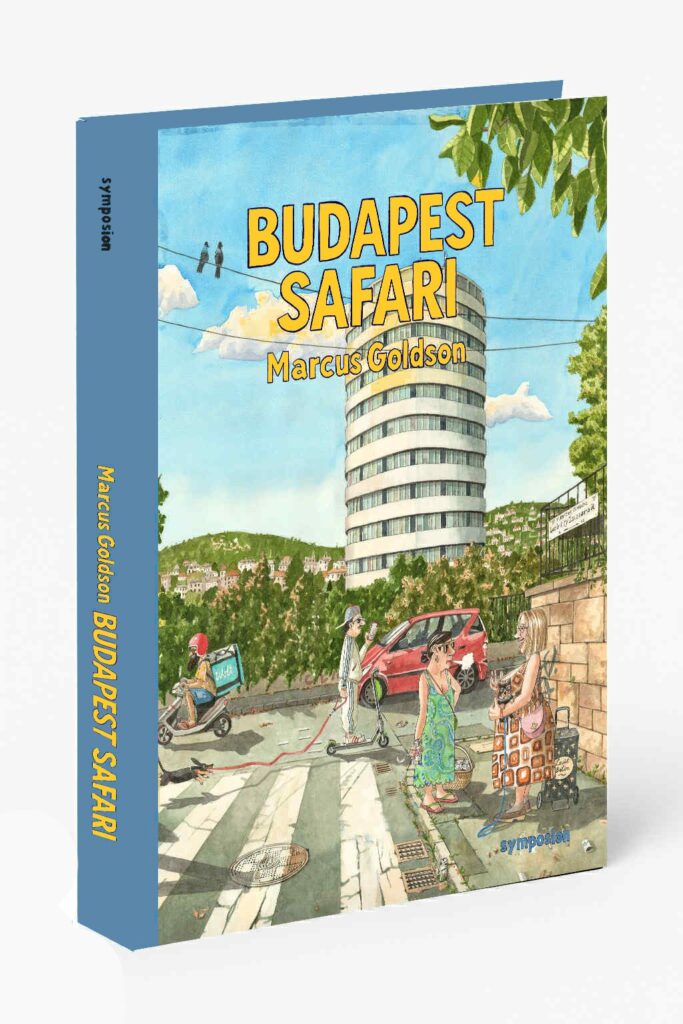
The book reflects his time living in Budapest, where he has been creating images of the city since the 1990s.
“My new book brings together my watercolor paintings and drawings, created over many years, each one an attempt to capture the life, atmosphere, and quiet daily dramas of Budapest. Alongside these are scenes and impressions from travels farther afield; each image, I hope, tells its own small story,” Goldson tells the Budapest Business Journal.
The artist was born and raised in Kenya. He trained as a sculptor, working in various metals, and earned a degree in sculpture and art history in 1990 from Winchester School of Art in the United Kingdom.
When he arrived in Hungary in 1993, he started painting in watercolors because they were economical and portable. He has worked in set design and created illustrations for books, magazines, newspapers, and online publications. He sells his work online and through outlets and art markets in Budapest and elsewhere in Hungary. He also works as an art teacher and has created art courses for primary, secondary and university-aged students.
BBJ: What is your aim with the book?
Marcus Goldson: My paintings are visual diaries, records of where I’ve been, what I’ve noticed, and what has made me pause. But I also see them as shared experiences: open invitations for others to step in, reflect, and perhaps rediscover their own memories and meanings. I seek out the overlooked details of daily life, forgotten fashions, routines, and the unnoticed drama unfolding in the most unexpected places. I want to capture all of this, to experiment with traditional media in fresh and challenging ways, and to offer glimpses that feel familiar, surprising, or simply worthy of a big smile. With few exceptions, the pictures in this book are inspired by real people and places. My ideas begin with observation but come alive through drawing, juxtaposition, and remodeling. Sometimes, reality itself, seen at the right place and time, needs no alteration at all.
BBJ: How do you define the look and feel of Budapest as reflected in your pictures?
MG: Budapest is an attractive and liveable city, and I love living here. I think this is reflected in my paintings, whether they be grand views, local neighborhoods or places that are a little rough around the edges. I show places I like to go to or people I meet or observe. In short, [it is] a visual diary of my interactions in the city.
BBJ: How do you define your painting technique?
MG: I draw everything in a sketchbook that is always on me. I draw from direct observation or put down ideas that I have imagined. Sometimes I complete a painting while observing the scene; more often than not, I use the sketchbook to plan and work out most of the details and decisions for a larger, more complicated work in the studio. My larger works (50cm × 70cm, 70cm × 100cm) are also painted in watercolor, sometimes in conjunction with collage or screen-printing, and some can take up to five weeks to complete. The key, though, is the sketchbook, and I refer to it all the time.
BBJ: What do you see as your most notable pictures?
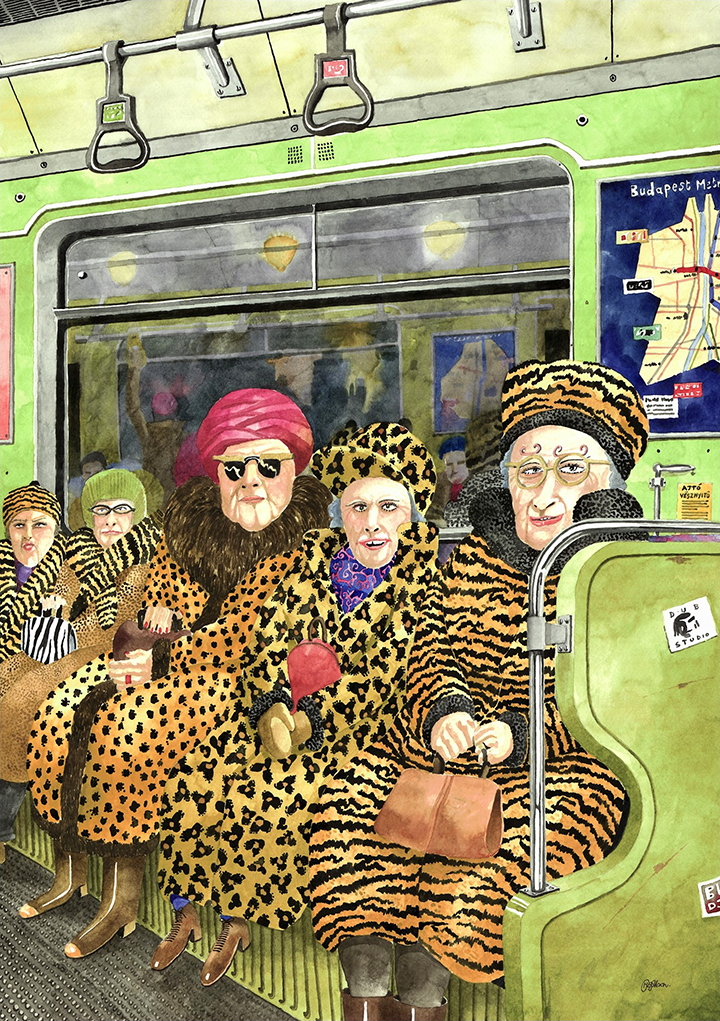
MG: Budapest never ceases to inspire me. It offers endless variety: beautiful buildings, eccentric figures, quiet inner courtyards, and lively public squares. But my sketchbook has also travelled far beyond the city limits, to Africa and Asia, across Europe and into the Middle East, capturing the colors, light, and moods that make each place distinct and special. Most of my pictures are simple observations of real life, though sometimes they are lightly embroidered by imagination. For me, anything that hints at a story, provokes a smile, or stirs memory or curiosity is a valid and irresistible subject. Further, I create pictures that describe a situation, or, more exactly, remind you of a situation or place you may have experienced yourself, and saying it with some humor or irony counts as notable pictures.
BBJ: How do you see the pros and cons of working as an independent artist?
MG: As an independent artist, I’m my own boss in that I paint what I like, but I also need to sell the work to make a living. I need to be enterprising in what and how I choose to sell my work. I have been selling at art and craft markets in Hungary for more than 15 years, and I soon learned what goes and what does not in a local setting, as well as what is popular for an international audience. Luckily, I’m able to sell my work, but it has been a long journey, particularly learning about the business of selling art, something I didn’t know much about when I started and that wasn’t taught at art school. Staying relevant and aware of emerging new ideas, methods, and movements locally and internationally is vital. You’ve got to keep observing!
BBJ: How does an artist make a living in Hungary?
MG: You need to be passionate about your art and enterprising. I use social media, art markets and fairs, and sell my work in shops and online. Initially, a lot of friends and acquaintances bought my paintings and helped me with exhibitions. I asked cafés and bars if I could have exhibitions and made sure that there was a prominent poster advertising it, and that the works were visible and for sale. As I got to know more people, my art became known through word of mouth, and I also took every opportunity to show my illustrations in publications and books. A lot of my paintings are sold as prints, which broadens the audience for my work.
BBJ: Do any classic Hungarian artists influence you?
MG: I’ve been influenced by many different artists from many different eras and places. From the 19th century, JMW Turner, amongst many others, got me into watercolors. David Hockney’s work inspired me to draw, and I also follow many contemporary Hungarian artists. I love the work of József Csató and Máté Orr, and admire the graphics of Andrej Tóth. African art, especially textiles, has influenced my preference for strong, bold colors and patterns.
This article was first published in the Budapest Business Journal print issue of November 28, 2025.


