Countries listed in the basic GfK report were as follows. Purchasing-power index rating for each nation is listed in parentheses; the European average was given as 100.
1. Liechtenstein (456.5)
2. Switzerland (282.0)
3. Norway (246.0)
4. Luxembourg (218.6)
5. Sweden (167.9)
6. Austria (165.2)
7. Denmark (164.2)
8. Germany (160.0)
9. France (151.8)
10. Finland (150.9)
17. Spain (96.0)
23. Slovakia (58.14)
31. Hungary (38.9)
41. Ukraine (17.1)
42. Moldova (10.0)
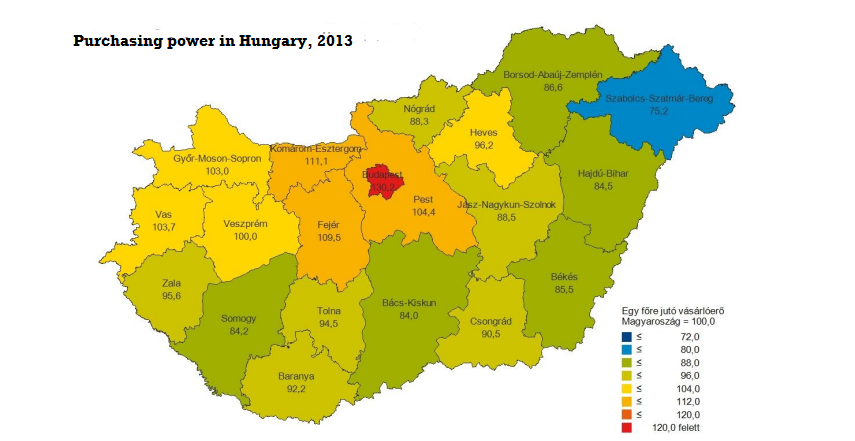
Within Hungary, GfK naturally found Budapest citizens to have the greatest amount of purchase power, with a score of 120.0 against the Hungarian benchmark rating of 100. Within Budapest, Buda districts dominated the top of the table: The top five districts in the index were XII (166.5), I (162.9), II (162.3), V (146.1), and III (141.1).
In a regional breakdown, the highest incomes were in Budakeszi, in Budapest’s green belt. The lowest were in the northeast of the country.
In the county-by-county analysis, the northwest regions fared best: Komárom-Esztergom (111.1), Fejér (109.5), Pest (104.4), Vas (103.7), Győr-Moson-Sopron (103.0) and Veszprém (100.0) counties were the only regions with average or better scores on the index.
Szabolcs-Szatmár-Bereg finished dead last among Hungarian counties, with its index rating of 75.2 significantly lower than any other.
– Material from Gergő Rácz was used in this story
Producing journalism that is worthy of the name is a costly business. For over 30 years, the publishers, editors and reporters of the Budapest Business Journal have striven to bring you business news that works, information that you can trust, that is factual, accurate and presented without fear or favor.Newspaper organizations across the globe have struggled to find a business model that allows them to continue to excel, without compromising their ability to perform. Most recently, some have experimented with the idea of involving their most important stakeholders, their readers.
We would like to offer that same opportunity to our readers. We would like to invite you to help us deliver the quality business journalism you require. Hit our Support the BBJ button and you can choose the how much and how often you send us your contributions.