

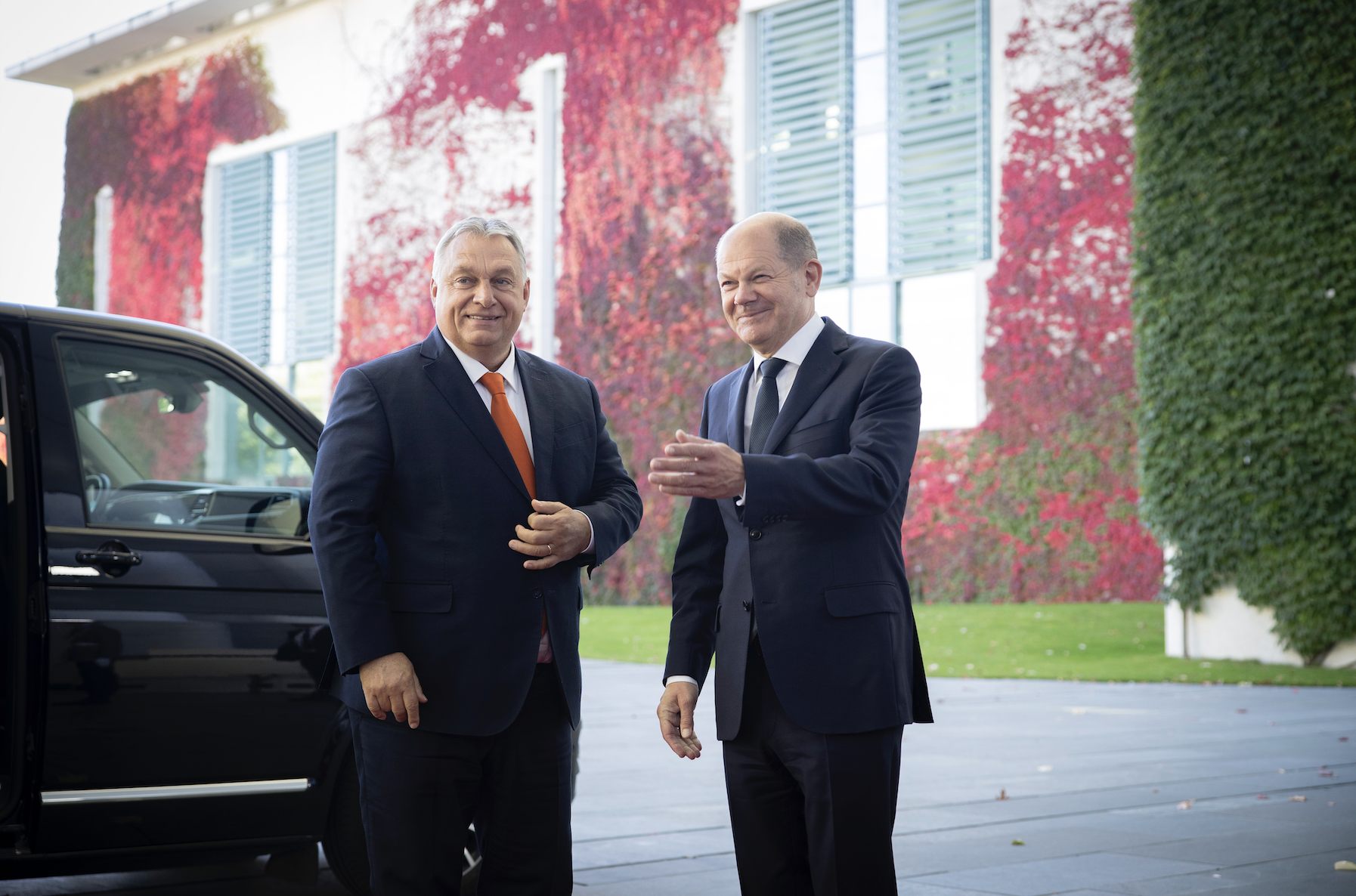

Speaking at a forum of business leaders late in the day, Orbán said the two-hour meeting addressing "all difficult and complicated issues" had been "fruitful". He added that "everyone can be satisfied" with the outcome.
He said that, since 2010, Hungary has emerged from every crisis – the global economic and financial crisis of 2008, the migration crisis and the pandemic – stronger, because of government policies directed at resolving structural challenges rather than remedying cyclical downturns. He added that Hungary's social policy is conservative and recalls policies in Germany under former Chancellor Helmut Kohl.
The government believes in a work-based society at the center of which stands the family, he said. Hungary's spending on family support, relative to GDP, is unmatched, and the government finances that support through work, he explained
He said that Hungary's employment rate is now around 75%, up from just over 50% in 2010.
Orbán said low taxes are an "important component" of the government's economic policies, noting Hungary's low, 9% corporate tax rate, flat-rate personal income tax, and lack of an inheritance tax.
For Hungary, an open country, border defense must be a part of economic policy, he said, adding that the European Union's single market could fall apart without Hungary's protection of the EU frontier.
He pointed to the need for political, energy, and physical security in the coming period, adding that the stability of government guarantees political security, while physical security is ensured by Hungary's status as "an island of peace", and the country's energy security is backed by gas reserves sufficient to meet six months of demand.
He noted that a number of German companies have made agreements with Hungary's government on cooperation in areas such as telecommunications, digitalisation and the green transition. He said economic cooperation between Hungary and Germany rests on foundations "of a cultural nature", adding that the basis for bilateral cooperation is invulnerable to "political campaigns" or "disagreements".
Around 6,000 German-owned companies operate in Hungary, providing for the livelihoods of 300,000 households, he said.
According to a report by DW, Scholz and Orbán largely focused on the war in Ukraine during the talks. The pair did not hold a joint press conference following the meeting.
Germany's DPA news agency reported that Orbán also met with former German Chancellor Angela Merkel on Sunday.
Minister of Foreign Affairs and Trade Péter Szijjártó said Hungary's government would continue to preserve the "most competitive conditions for investment in Europe", noting its continued opposition to the introduction of the 15% global minimum corporate tax.
Technology and Innovation Minister László Palkovics told the business forum that the government had been loath to roll out windfall profit taxes but they were "a matter of necessity". He added that the taxes do not discriminate against foreign-owned businesses and would be wound up "as soon as possible".
Thomas Spannagl, CEO of Schwenk Zement, an owner of Hungarian cement company Duna-Drava Cement, said the windfall profit taxes have a "serious negative" impact on business, adding that importers don't have to share the burden.
Philipp Haussmann, who heads Ost-Ausschuss der Deutschen Wirtschaft, an organization of German companies that do business in Central and Eastern Europe, said the government needs to "take seriously" the concerns of German companies in strategic sectors in Hungary.
Hans-Peter Kemser, the director of a plant German car maker BMW is building in Debrecen, said the location for the manufacturing base is "ideal in every condition". "BMW's future starts in Debrecen," he added.
Producing journalism that is worthy of the name is a costly business. For over 30 years, the publishers, editors and reporters of the Budapest Business Journal have striven to bring you business news that works, information that you can trust, that is factual, accurate and presented without fear or favor.Newspaper organizations across the globe have struggled to find a business model that allows them to continue to excel, without compromising their ability to perform. Most recently, some have experimented with the idea of involving their most important stakeholders, their readers.
We would like to offer that same opportunity to our readers. We would like to invite you to help us deliver the quality business journalism you require. Hit our Support the BBJ button and you can choose the how much and how often you send us your contributions.


