


BBJ: You were elected president of the chamber in May of last year. Now that you have more than 12 months of experience to look back on, how have you found the role? What has surprised you?
Róbert Keszte: I have found it both inspiring and extremely rewarding. It is a great honor to serve as president of the chamber, and over the past year I have had the opportunity to gain many new experiences and perspectives. The role is very interesting because it brings me into contact with a wide range of people, companies and topics. At the same time, it has been a continuous learning experience. I have learned a great deal about the different challenges and opportunities our members face, and I have also gained new insights into how the chamber can best support the business community.
Overall, the past year has been very enriching, and I am grateful for the trust placed in me and for the opportunity to contribute in this role. What surprised me, particularly at the beginning, was how difficult it sometimes proved to establish an open and receptive dialogue with the previous government on some of the chamber’s key concerns and those of its member companies.
Looking ahead, however, we are confident that with the new government we can rebuild a constructive and trust-based partnership and return to a more open, pragmatic dialogue. Ultimately, we share a common interest in strengthening the business environment and creating the best possible conditions for companies to invest, grow and succeed.
BBJ: What is your vision for the chamber? Where and how would you like to see it grow?
RK: My vision is for the chamber to be an even stronger voice and partner for companies operating in Hungary. For me, the key word is competitiveness. If Hungary is competitive as a business location, and if the companies operating here are competitive in their respective markets, then we create the conditions for further investment, secure jobs, and sustainable growth. And ultimately, that is what creates prosperity for society as a whole.
So, going forward, I would like the chamber to strengthen its role as a platform for dialogue between business and policymakers, to bring the experience and concerns of our member companies into the debate, and to contribute constructively to improving the overall business environment. Growth, in that sense, is not only about growing in membership. It is also about increasing our relevance, our impact, and the value we provide to our members. The stronger the chamber is as a network, and as a voice for competitiveness, the more effectively we can support companies and contribute to Hungary’s long-term economic success.
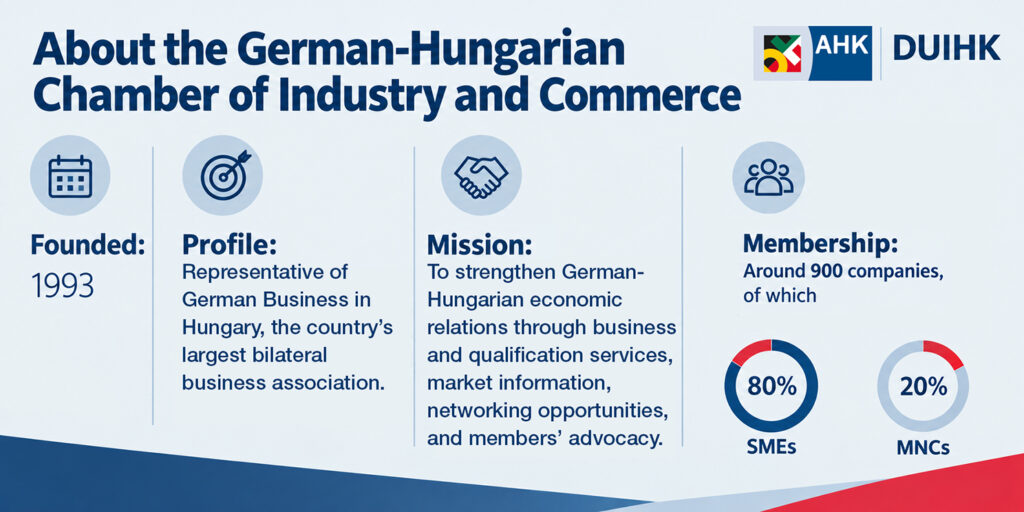
BBJ: What is the role of DUIHK in the German-Hungarian bilateral economic relationship?
RK: The DUIHK plays a central role. With around 900 member companies, we are the largest bilateral business organization in Hungary, and our core mission is to strengthen economic ties between Germany and Hungary further. We do this in several ways. First, we support companies on both sides with a broad range of services related to investment, market entry, and business development in the other country. We also provide targeted training and professional development programs on topics particularly relevant for SMEs, such as AI skills, energy efficiency, and productivity.
A second important role is providing reliable information and data. We keep our members, as well as the wider business community, informed about developments that matter for German-Hungarian economic relations. One widely used example is our economic survey, which we publish twice yearly and which provides a clear picture of business sentiment and the challenges companies face.
Thirdly, we represent the interests and practical experience of our member companies in dialogue with political decision-makers. We aim to contribute constructively to improving the framework conditions for investment, competitiveness and economic prosperity. Our position paper published this summer, for example, sets out concrete proposals in three strategically important areas: the competitive business environment, energy, and the labor market. This dialogue is a particularly important part of our work. At our recent Business Roundtable, for instance, representatives of the business community discussed key economic issues directly with Germany’s Federal Minister for Foreign Affairs Johann Wadephul and Hungary’s Minister for Economy and Energy István Kapitány.
BBJ: The strength of the German automotive industry in Hungary is well known. What other sectors attract significant German FDI?
RK: Automotive is certainly the most visible pillar of German investment in Hungary, but it is by no means the only one. German companies also have a strong presence in electronics and industrial technology, including automation, sensors and connectivity solutions. We also see significant investment in chemicals, business services, logistics and increasingly in high-value-added functions such as R&D and digital services. Hungary’s business services sector in particular has continued to expand, while electronics has recently accounted for a very substantial share of overall investment activity.
What is important is that German investment in Hungary is becoming more diversified. It is no longer only about manufacturing capacity, but increasingly also about technology, innovation and knowledge-intensive activities. This changing environment also provides the context for our German-Hungarian Business Forum on Nov. 5 in Kecskemét, one of the highlights of the DUIHK’s fall program, and is also open to non-members. The forum will focus on how German companies and Hungarian SMEs can work together more strategically to deepen local value creation, foster innovation and strengthen competitiveness, and on the concrete steps needed, both at company level and in economic policy, to make that happen.
BBJ: Are there any up-and-coming sectors bubbling away that might be below the radar today, but which could become significant in the future in terms of bilateral trade?
RK: One area with significant potential is certainly the defense industry, where we are already seeing growing activity and opportunities for closer cooperation. Beyond that, I also see potential in sectors where market opportunities for foreign companies have, in the past, been more selective. These include areas such as food retail, transport infrastructure and construction. If access to these markets becomes more open and competitive, they could become much more significant areas of German-Hungarian economic cooperation in the future.
This article was first published in the Budapest Business Journal print issue of October 2, 2026.


