


The cut on July 21 was in line with market expectations and guidance provided by MNB governor Mihály Varga in June. In its statement explaining the decision, the central bank cited inflation running below its previous expectations, easing household inflation and the low-risk premium on Hungarian assets as the main factors supporting the rate cut. Despite renewed increases in energy prices, the MNB therefore still sees room for further easing.
The central bank’s forward guidance was essentially unchanged from June. The Monetary Council will decide on the continuation of the easing cycle based on its September Inflation Report, leaving the door open for another reduction in August but providing no firm commitment beyond that.
Analysts broadly agreed that the July decision was fully anticipated, but warned that the renewed geopolitical tensions require a more cautious approach in the months ahead.
“The low inflation trajectory, the strong forint and the clear forward guidance meant that the rate cut was not a surprise, but rising European gas and oil prices and volatility in the forint exchange rate could make the central bank more cautious. As a result, no new strong commitment to rate cuts can be expected for the time being,” says Péter Kiss, investment director at Amundi Asset Management.
He adds that government bond and foreign exchange markets had already priced in the positive developments surrounding Hungary in recent months, meaning that shifts in international sentiment are once again having a stronger impact.
“Although the renewed conflict involving Iran is once again making life more difficult for central banks, the MNB may still continue along the rate-cutting path during the summer,” Kiss says.
He also stresses that the country’s economic policymakers will need to communicate carefully, as markets are now more sensitive to external developments.
Dániel Molnár, chief analyst at the GFÜ Gazdaságelemző Központ, says the continuation of monetary easing had been made possible by favorable inflation developments. He expects inflation to remain sustainably below the central bank’s target.
The international environment, however, has become significantly less favorable. The collapse of the cease-fire with Iran and the resumption of fighting have increased risks, with effects already visible in the forint exchange rate and in market expectations for major central banks. Based on current market pricing, those institutions could raise interest rates once or twice before the end of the year.
Despite the escalation, Molnár notes that the tone of the MNB’s statement remained relatively dovish. His base case is for another 25 basis point cut in August, although the outlook for September is much less certain.
“Geopolitical conflicts and their impact on inflation will determine the further course of the rate-cutting cycle,” he says.
János Nagy, macroeconomic analyst at Erste Bank, also describes the MNB’s forward guidance as essentially unchanged. However, he notes that the stability of the foreign exchange market has gained greater prominence.
He expects the mini-easing cycle announced for the summer to continue into August if economic and financial conditions remain favorable. Nagy is maintaining his forecast for an end-year policy rate of 5%, but warns that both the consequences of the Middle East conflict and Hungary’s fiscal trajectory represent upside risks to that forecast.
Dávid Németh, chief macroeconomic analyst at K&H Bank, similarly expects another 25-basis-point reduction in August, followed by a pause. While the market may be pricing in a more aggressive easing cycle, K&H remains more cautious due to international uncertainty.
Gábor Regős, chief economist at Gránit Bank, says the decision had been fully anticipated and therefore had little immediate impact on the forint. The third rate cut of the year was supported by the recent low inflation readings, the strong (albeit somewhat weaker in recent weeks) forint and an improvement in Hungary’s risk assessment.
The picture has, nevertheless, become cloudier since June. The renewed fighting with Iran has pushed oil prices from around USD 72 a barrel to approximately USD 90, while natural gas prices have also risen substantially.
The MNB’s main message remained that there is room for another rate reduction in August, while the future of monetary easing will be assessed using the September Inflation Report.
“The key question will be what data arrives by then, how the forint exchange rate develops and what happens to energy prices,” Regős says.
“[MNB governor] Varga Mihály highlighted the better-than-expected June inflation figure and the favorable risk assessment as the main reasons for easing, while for the future he pointed to the fiscal trajectory, expectations surrounding the introduction of the euro and the situation in the Middle East as important factors determining the country’s risk assessment,” Regős adds.
He said the MNB’s communication was neither particularly hawkish nor dovish, suggesting that policymakers had deliberately avoided sending a strong signal to markets. This may have disappointed investors who had expected a tougher stance, potentially contributing to the forint’s weakening after Varga said he did not consider the currency excessively strong.
Regős expects the promised August rate cut to go ahead, but says it remains uncertain what will happen to his forecast of two additional cuts this year.
Analysts at MBH’s Analysis Center are even more confident about August. They believe the next cut could only be derailed by a very severe deterioration in Hungary’s risk assessment over the coming weeks, an outcome they consider highly unlikely even against the backdrop of the Middle East conflict. MBH expects the benchmark rate to be 5.5% at the end of this year, then fall to 5% in 2027.
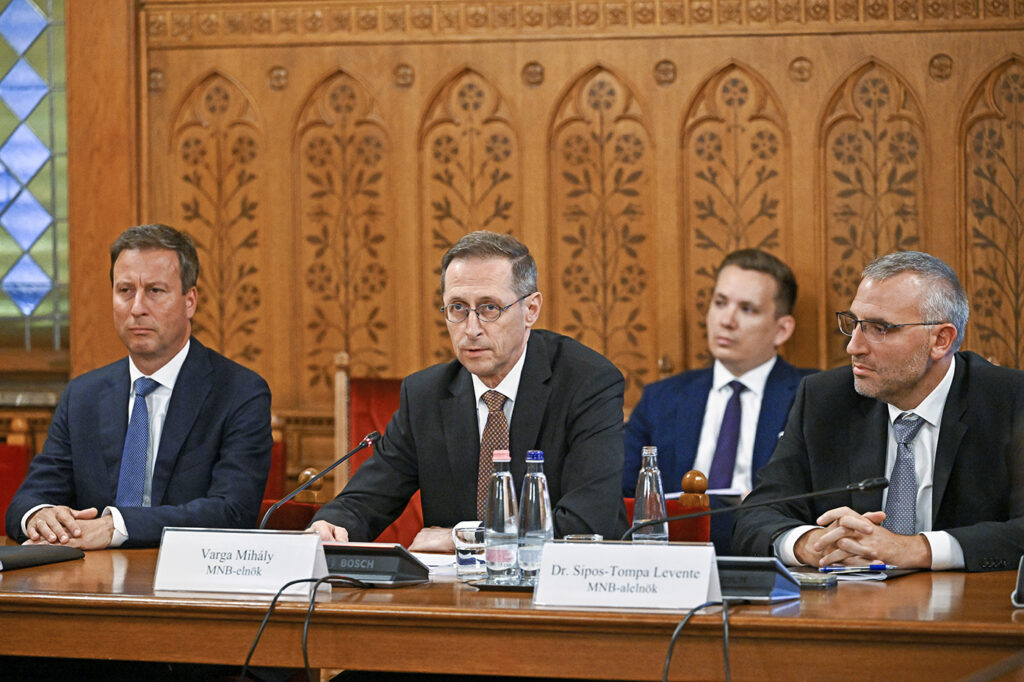
Speaking to parliament the day after the rate decision, at a hearing on the MNB’s 2025 business report, governor Mihály Varga said the central bank under his leadership had returned its focus to its fundamental task: achieving and maintaining price stability.
“That was our most important task, and it is also our statutory obligation. At the same time, we wanted to strengthen monetary policy by stabilizing the exchange rate and increasing reserves,” Varga said. He also rejected the idea that a country’s competitiveness can be sustainably improved through a weak currency.
“I do not believe that an economy can be made competitive in the long term only through devaluation, a weak currency or a weak exchange rate,” he insisted, adding that while such a strategy could produce temporary gains, it would not make an economy competitive over the long term. The exchange rate, therefore, is not a direct target of monetary policy, Varga stressed, adding that the MNB has no exchange-rate target.
This article was first published in the Budapest Business Journal print issue of July 31, 2026.


