

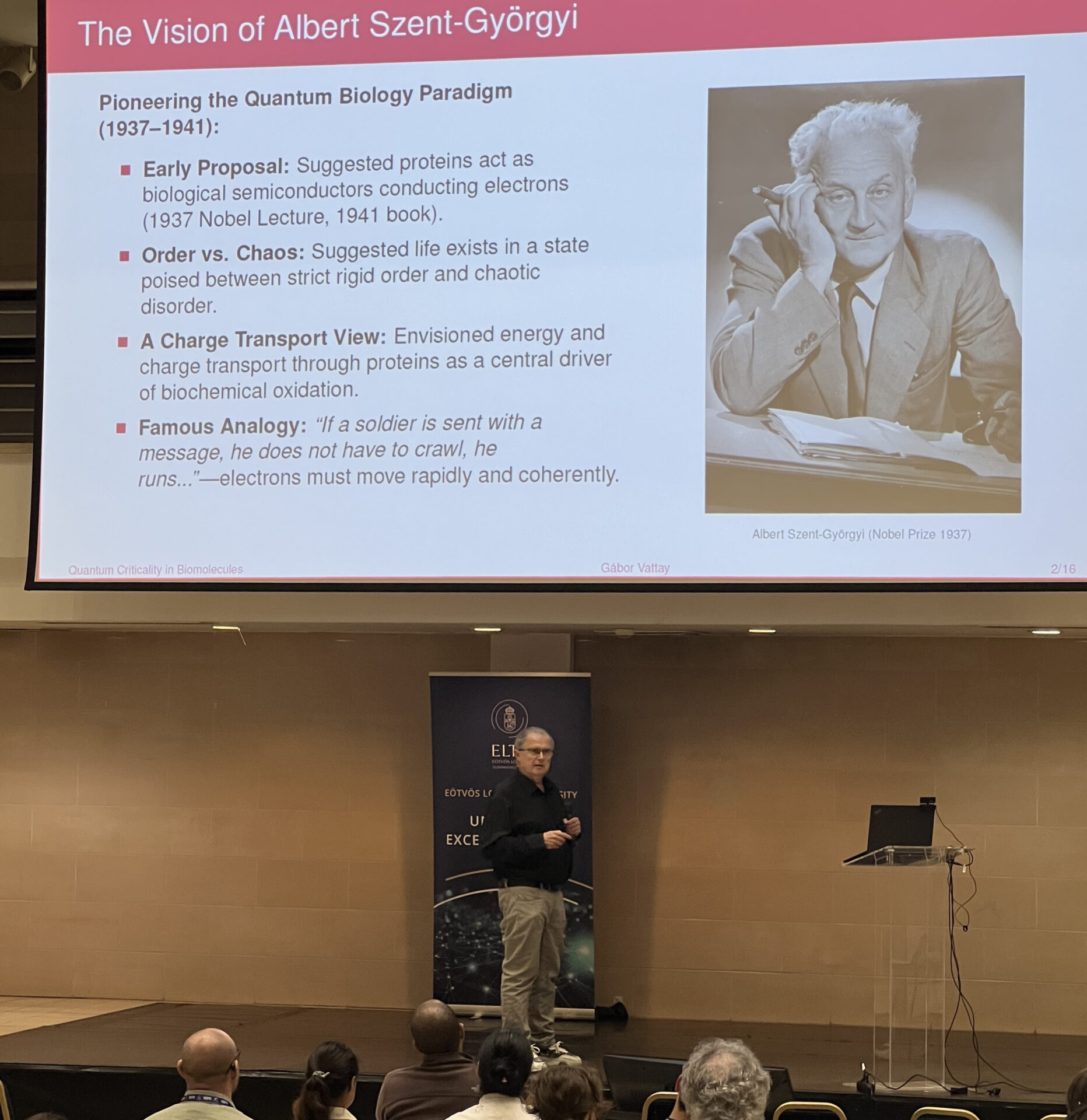

Held at ELTE’s Lágymányos Campus, the conference in June brought together physicists, biologists, chemists, biophysicists and engineers working on one of the most unusual and fast-developing interfaces in modern science: the question of how quantum effects may shape living systems, and how biological systems may in turn inspire new quantum technologies.
The official conference site described QuEBS as “a premier international forum exploring the interface of quantum science and biology.” The field is no longer limited to theoretical debates about whether quantum phenomena can persist in warm, wet biological environments. It now extends to applications in sensing, imaging, bioengineering, drug discovery and biomimetic quantum devices.
The Budapest program was structured around three linked themes: quantum in biology, quantum for biology, and biology for quantum. The first asks whether living systems exploit quantum effects such as tunneling, coherence, superposition or radical-pair spin chemistry. The second looks at how quantum technologies can be used to study biological systems with greater precision. The third examines how biological structures may help engineers build more robust quantum tools.
The keynote program showed how wide the field has become. One of the early scientific focal points was the Ulm University contribution on full microscopic simulations and persistent quantum effects in primary photosynthesis, presented by Nicola Lorenzoni.
Prof. Alexandra Olaya-Castro of University College London spoke on quantum phenomena in and for photobiology, a topic linked to the long-standing question of how biological systems move energy efficiently at the molecular scale. The subject remains one of the core areas of quantum biology because photosynthetic light-harvesting systems have often been discussed as possible examples of quantum effects operating in living matter.
Another keynote focused on animal navigation. Prof. Alex R. Jones of the United Kingdom’s National Physical Laboratory and University College London discussed animal magnetoreception under the title “Animal Magnetoreception: Nature’s Quantum Sensor?” The question is central to quantum biology because one leading model for how some animals sense Earth’s magnetic field involves radical-pair reactions in light-sensitive proteins, where spin dynamics may influence biological response.
The Oxford contribution gave the event a strong applied technology angle. Gabriel Abrahams and Harrison Steel of the University of Oxford presented work on “Quantum Spin Resonance in Engineered Proteins for Multimodal Sensing,” recently published in the journal Nature. The paper reports that engineered magneto-sensitive fluorescent proteins can exhibit optically detected magnetic resonance in living bacterial cells at room temperature. In the authors’ own wording, the results represent “a suite of sensing modalities for engineered biological systems.”
This is where the business and innovation relevance becomes clearer. Quantum biology not only asks if nature uses quantum mechanics. Increasingly, it is asking whether quantum-mechanical behavior in biological materials can be engineered into practical sensing tools. The Nature study describes the work as a “proof of principle for MFPs and their applications,” pointing toward possible uses in biological sensing, measurement and actuation.
The conference also included keynote lectures supported by The Guy Foundation, with speakers including Travis Craddock from the University of Waterloo, Philip Kurian from Howard University, and Rhys Mould and Alix Bailie from the University of Westminster. Their section, titled “Quantum Effects in Physiology: Life’s Responses to Quantum Stimuli,” explored how living organisms respond to quantum-level physical effects.
The wider framing of QuEBS 2026 placed Budapest within a growing international research network. The organizers wrote that the workshop aims to foster collaborations “from the wet lab to the quantum processor,” a concise description of a field that sits at the intersection of laboratory biology, theoretical physics, advanced instrumentation and emerging quantum engineering.
For Hungary, the event mattered because it connected ELTE to a highly specialized international research community. The local organizing committee was chaired by Prof. Gábor Vattay, head of ELTE’s Department of Physics of Complex Systems and a researcher at the National Quantum Information Laboratory. The co-chair was Prof. István Csabai, a member of the Hungarian Academy of Sciences and an expert in AI and complex systems, while Dr. Eszter Papp led the local organizing work.
The conference also highlighted Budapest’s position in the European quantum technology landscape. The official QuEBS description noted the role of ELTE, the Wigner Research Center for Physics and the Budapest University of Technology and Economics as academic hubs in this ecosystem.
While Hungary is better known in business coverage for automotive manufacturing, logistics, pharmaceuticals and information technology, conferences such as QuEBS show another layer of the country’s innovation environment: fundamental research with potential long-term technological spillovers.
That potential should not be overstated. Quantum biology remains a field in which some claims are mature, others are still debated, and several proposed mechanisms require further experimental validation. Photosynthetic energy transfer, tunneling in enzymatic reactions and radical-pair chemistry in magnetoreception are among the better-established or more actively investigated areas, while more speculative claims remain contested.
Even so, the direction of travel is significant. The field is moving from asking whether quantum effects can exist in biology toward testing how they can be measured, engineered and used. Quantum sensors based on biological components, genetically encoded probes, quantum-inspired drug discovery and biomimetic quantum devices are all part of that shift.
For a university-hosted conference, this gives QuEBS relevance beyond academic exchange. It sits at the intersection of science policy, research infrastructure, biotechnology and future industries. The commercial applications may still be early, but the scientific questions already connect to areas with clear economic weight: medical imaging, biosensing, molecular diagnostics, pharmaceutical research and advanced materials.
QuEBS 2026, therefore, offered Budapest more than a specialist scientific meeting. It placed ELTE inside an international conversation about whether the next generation of quantum technologies may learn not only from physics laboratories, but also from living systems themselves.
This article was first published in the Budapest Business Journal print issue of July 17, 2026.
Producing journalism that is worthy of the name is a costly business. For over 30 years, the publishers, editors and reporters of the Budapest Business Journal have striven to bring you business news that works, information that you can trust, that is factual, accurate and presented without fear or favor.Newspaper organizations across the globe have struggled to find a business model that allows them to continue to excel, without compromising their ability to perform. Most recently, some have experimented with the idea of involving their most important stakeholders, their readers.
We would like to offer that same opportunity to our readers. We would like to invite you to help us deliver the quality business journalism you require. Hit our Support the BBJ button and you can choose the how much and how often you send us your contributions.


