


The findings also point to a clear tension between the strategic importance of technology-led transformation and the pressures of day-to-day management. Hungarian CEOs say they spend 60% of their working time on issues with a time horizon of less than one year, while only 10% is devoted to strategic questions looking more than five years ahead. AI returns, however, rarely come from a single investment decision. They depend on long-term capability building, robust data and governance foundations, and the organization’s ability to learn and adapt.
Hungarian companies are already using AI across many areas, but in most cases not yet at enterprise scale. Large or very large use was reported by 18% of companies for demand generation, 17% for products and customer experiences, 12% for support functions, 11% for demand fulfillment, and 8% for defining strategic direction.
The financial impact is more limited. Only 13% of Hungarian CEOs said AI had increased their company’s revenue over the past 12 months, while 16% reported cost reductions. In Hungary, 77% of CEOs (compared with 55% globally) said AI had not yet contributed either to higher revenue or lower costs. The picture is therefore mixed: AI is already present in business, but its returns are not yet widespread.
PwC’s research suggests that AI investment creates lasting value when companies treat the technology not as a sequence of isolated pilots, but as part of business transformation. According to the CEO Survey, around one in five companies in Hungary and globally have strong AI foundations: responsible frameworks, the right technology environment, high-quality data and an operating model that enables enterprise-wide integration.
These foundations mark the difference between experimentation and measurable returns. In Hungary, CEOs at companies with strong AI foundations were three times as likely to report AI-linked revenue growth, with the share rising from 9% to 28%. The gap is similar in costs: 33% of more AI-mature companies reported tangible cost benefits, compared with 12% of those without strong foundations.

PwC’s AI Performance Study shows the widening divide even more clearly. The global study, based on responses from 1,217 senior executives, found that almost three-quarters (74%) of the economic value created by AI is captured by just 20% of companies. These organizations are not simply deploying more AI tools. They are using AI to identify growth opportunities, rethink their business models and redesign the way work gets done.
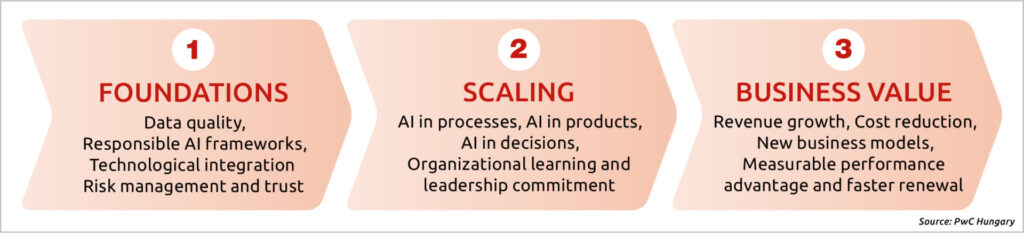
For AI investment to translate into measurable business value, companies first need stable foundations. These then enable enterprise-wide scaling, which can ultimately show up in revenue growth, efficiency gains and new sources of growth.
The benefits of AI do not emerge from a single point of intervention. Without the right foundations, scaling remains risky or ad hoc. Without scaling, the technology does not become embedded in day-to-day operations. And without business value, AI remains a cost item or a showcase project. This is where leading companies stand apart: they are not only using AI, they are building new ways of working around it.
“Addressing concerns around AI, redesigning roles and creating a corporate culture open to innovation all point in the same direction: AI implementation must be treated as an organizational transformation, not just a technology project,” says Gábor Oltyán, a senior manager leading data and AI implementation activities at PwC Hungary.
AI’s business impact is already visible in the labor market. Based on an analysis of more than one billion job postings, PwC’s Global AI Jobs Barometer concludes that artificial intelligence is splitting the global labor market in two. In some roles, it is democratizing work by making more tasks accessible to less specialized employees. In others, the opposite effect is emerging: as routine tasks are automated, human expertise, judgment, creativity and leadership capabilities are becoming more valuable.
According to PwC’s barometer, vacancies in experienced roles are twice as numerous and wage growth is 42% faster, while the wage premium for AI skills has risen to 62%. The number of jobs requiring specialized AI knowledge increased by 69%, around eight times faster than the overall labor market.
The shift is also visible at the entry level. Junior roles most exposed to AI are seven times more likely to require higher-level human skills. These “seniorized” junior positions have grown by 35% since 2019, while traditional junior roles have declined by 10%.
AI strategy. therefore. cannot be separated from talent strategy. Technology investment creates value when organizations also rethink roles, skills and decision-making frameworks. Companies that use AI not to replace people, but to strengthen expertise and accelerate innovation, will be better positioned to grow.
“The 62% global AI wage premium is also a serious warning for Hungarian employers. Employees with AI capabilities are increasingly operating in a global labor market, and domestic companies need to compete not only on pay, but also on development opportunities, compelling AI projects and the internal learning ecosystem. Organizations that do not invest in internal training and reskilling or upskilling may face unsustainable wage pressure and high employee turnover in the long term,” says Oltyán.
In the coming years, the gap between companies will be defined less by whether they have introduced AI tools and more by how deeply AI is embedded in their business. PwC’s surveys point to the same conclusion: real advantage is created where AI is organized around a clear business logic, connected to data, governance, trust, capability building and growth objectives.
This does not mean every company needs to launch a full-scale AI transformation immediately. It means that after pilots, companies need sharper prioritization: where the real business problem lies, what data is available, which decisions can be safely supported or automated, and how the impact can be measured.
“In Hungary, we usually follow Western technology trends with a clear time lag, and AI is no exception. The AI projects we are currently seeing in the local market are still different from the types of projects we deliver from Hungary for clients in markets such as the United States or Germany. But this delay can also be an advantage if companies are smart about importing lessons learned and proven solutions. That can allow players in Hungary to move to the front of the field quickly,” says Péter Lajtai, a partner responsible for data and AI at PwC Hungary.
This article was first published in the Budapest Business Journal print issue of July 3, 2026.


