



But on a sunny, breezy Friday morning a week after that momentous election, my wife and I caught the number two tram at Kossuth Lajos tér for a rattling ride that took us along the river to MÜPA Budapest. The trip took perhaps 15 minutes, and the view of the river, the castle, and the recently reopened Citadella, itself a monument to overcoming oppression, was spectacular.
Bathed in bright sunlight, the modern MUPA building, which houses the Ludwig Museum, the National Theater, and the ziggurat between the two, offered a timely tribute to the creative spirit. Our hearts swelled with pride. Inside, the Ludwig is modern, filled with light and compact.
Paying a visit to the restrooms before braving what I expected to be an adult portion of an exhibition, I was charmed to discover that the Ludwig’s embrace of all things modern extended to, ahem, the can itself. I won’t spoil the surprise for you. Suffice it to say that the Ludwig restrooms have entered my top 10 of Budapest’s finest. After this revelation, it was onward and upward to “Black Mirror. The Long Shadow of the Future.”
The exhibition is a selection of “artistic thought experiments” already in the Ludwig’s collection that “deal with imaginary visions of the future or interpret the present as a dystopian reflection of the past in some way.”
Put simply, a dystopia is an anti-utopia. A dystopian world is always worse than the one we have. It amplifies and criticizes those negative aspects of the present we want to avoid: limited freedom, loss of identity and individual moral dilemmas. Perhaps unsurprisingly, the Hungarian art scene has been engaging with the concept of dystopia for quite some time.
Stepping into the exhibition, we picked up what looked like shiny black plastic table tennis paddles with maps of the exhibition on either side. I only realized that these were meant to evoke black hand mirrors an embarrassingly long time later.
The black mirror is strongly connected to the present and the past. In occult traditions, a black mirror was used by magicians, witches and astrologers for scrying. Gazing at the reflective surface for hours on end, they would have visions. Nostradamus used scrying to make his famous predictions about future events. John Lennon tried it, perhaps to see if The Beatles would get back together again.
Today, the concept of the black mirror refers to the dark surface of a screen when a device is switched off or fails. “In the switched-off display, we see both our own face and the gaze of technology directed at us,” the exhibition curators write. It’s the idea behind Charlie Brooker’s pretty nasty “Black Mirror” TV series, streamed on Netflix.
After picking up our black mirror ping-pong paddles, we walked across a rubber cityscape of Bucharest, made by Romanian artist Ciprian Mureşan, into the exhibition. I’m not quite sure what Mureşan’s piece is meant to mean, but I enjoyed feeling like a Japanese movie monster stomping on Tokyo.
From then on, most of the exhibition was as much about reading long wall-mounted explanatory labels as admiring the art. I was constantly whipping out my reading glasses. Fortunately, the English translations of the labels are well done. Also, there weren’t too many visitors, so I didn’t have to jockey for position and read over several shoulders at once.
A few colorful pieces snagged my attention. There are a couple of deceptively cute baby-pink and powder mosaic sculptures by Hungarian artist Zsófia Keresztes, who represented this country at the 2022 Venice Biennale. Keresztes’ work deals with the search for identity and, so I read, is informed by Schopenhauer’s “porcupine dilemma” parable about the tension between our need to protect ourselves as individuals and to build a society. Another was “Rainbow,” made from communist-era badges by Gulya Várnai and presented in the Hungarian Pavilion at the 57th Venice Biennale in 2017. It speaks to the belief in utopias that ideologies always evoke.
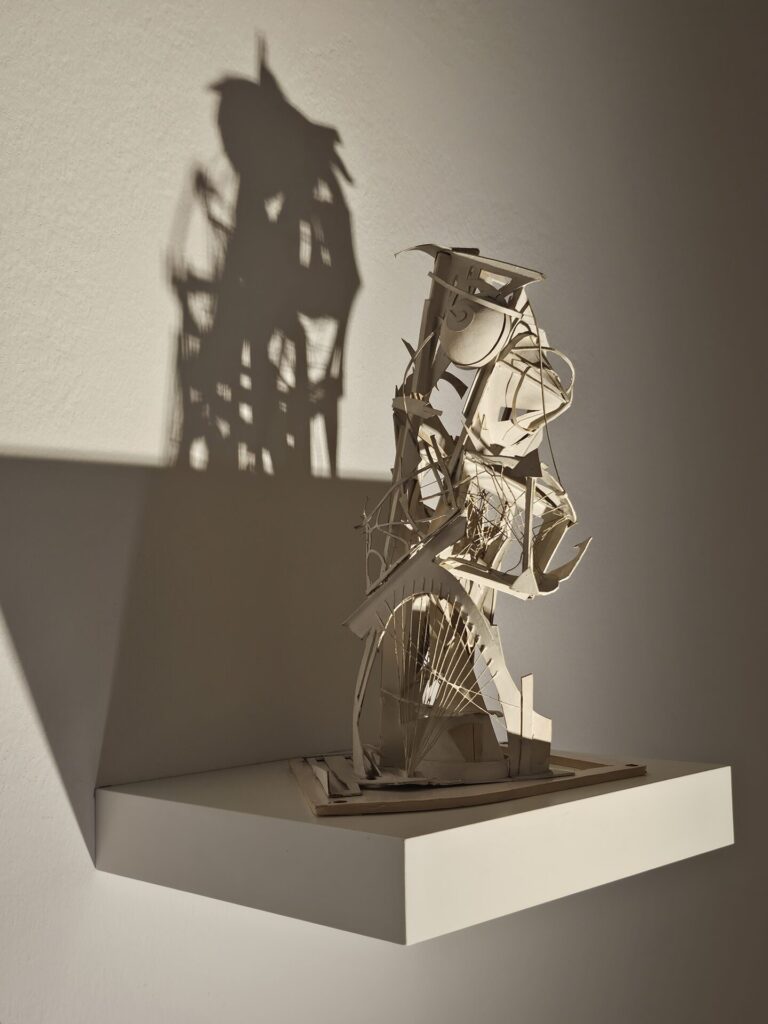
For my Hungarian wife, the best thing about the exhibition was discovering that the artist and architect Tibor Szalai is represented with his “Acadia” photos and paper models of fantastic structures. She never forgot reading about his work 30 years ago and was thrilled to see it in the flesh, finally. For her, it’s amazing that Szalai’s work is still so contemporary.
Even in today’s wonderful online world, it’s hard to find much out about Szalai. After graduating in 1982 from the Budapest University of Technology, where he studied architecture, he formed the Brettschneider group with István Kotsis, Ferenc Salamin and László Vincze. This became part of the 1980s progressive art movement and combined performance, music and plastic arts. From the mid-80s onwards, Szalai made white paper installations of imaginary architecture the size of a room. These bought him international recognition. In 1988, he took part in the Venice Biennale and exhibited worldwide. Tragically, he died aged just 40.
Afterward, as we climbed the ziggurat, dodging exuberant young Spanish tourists, we discussed how, despite years of suppression of individual freedom by one ideology or another, Hungary has always bred maverick artists and thinkers such as Szalai. Long may it continue to do so.
Visit ludwigmuseum.hu for details of the “Black Mirror” exhibition.
This article was first published in the Budapest Business Journal print issue of May 8, 2026.


