


Social support and political stability are crucial now, as they always have been in electoral years for the Orbán cabinet, so the high deficit was somewhat predictable.
The problem is that credit rating agencies are less lenient on domestic political circumstances. Two months ago, Fitch Ratings revised Hungary’s outlook from “stable” to “negative,” citing projections for public finances that are “significantly worsened,” ahead of the April parliamentary elections.
Another issue is that “frequent revisions to [the] government’s targets have weakened policy predictability and increased fiscal risks,” according to Fitch. While these were “high” category risks, the “medium” threats include weak economic growth. Fitch estimated annual growth in 2025 at 0.3%, which was later confirmed by the Statistical Office (KSH), and set the average growth between 2023 and 2025 at 0%.
Fitch is more optimistic for this year, believing private consumption and investments will propel the GDP growth to 2.3%. As for factors that could lead to an upgrade, Fitch suggests a “sustained decline in general government debt/GDP over the medium term, for example, due to faster than projected fiscal consolidation.”
While S&P Global Ratings has not issued a rating action recently (it affirmed the current outlook in October), it has recently published its “Central and Eastern Europe Sovereign Rating Outlook 2026,” which did not offer particularly optimistic conclusions. The agency forecasts a “modest recovery” in GDP growth.
“Geopolitical, growth and fiscal risks cloud the outlook for Central and Eastern Europe sovereigns,” S&P says. In more specific terms, “negative outlooks on sovereign ratings outnumber positive ones by three to one in CEE, reflecting high fiscal deficits and geopolitical uncertainty. Our ratings on Romania, Hungary and Slovakia carry negative outlooks,” the agency notes.
Besides the large budget deficit and the rising public debt, another element draining the Hungarian economy is the lack of EU funds, a concern often raised by the rating agencies. About EUR 20 billion has been frozen due to ongoing rule-of-law disputes between Hungary and the EU.
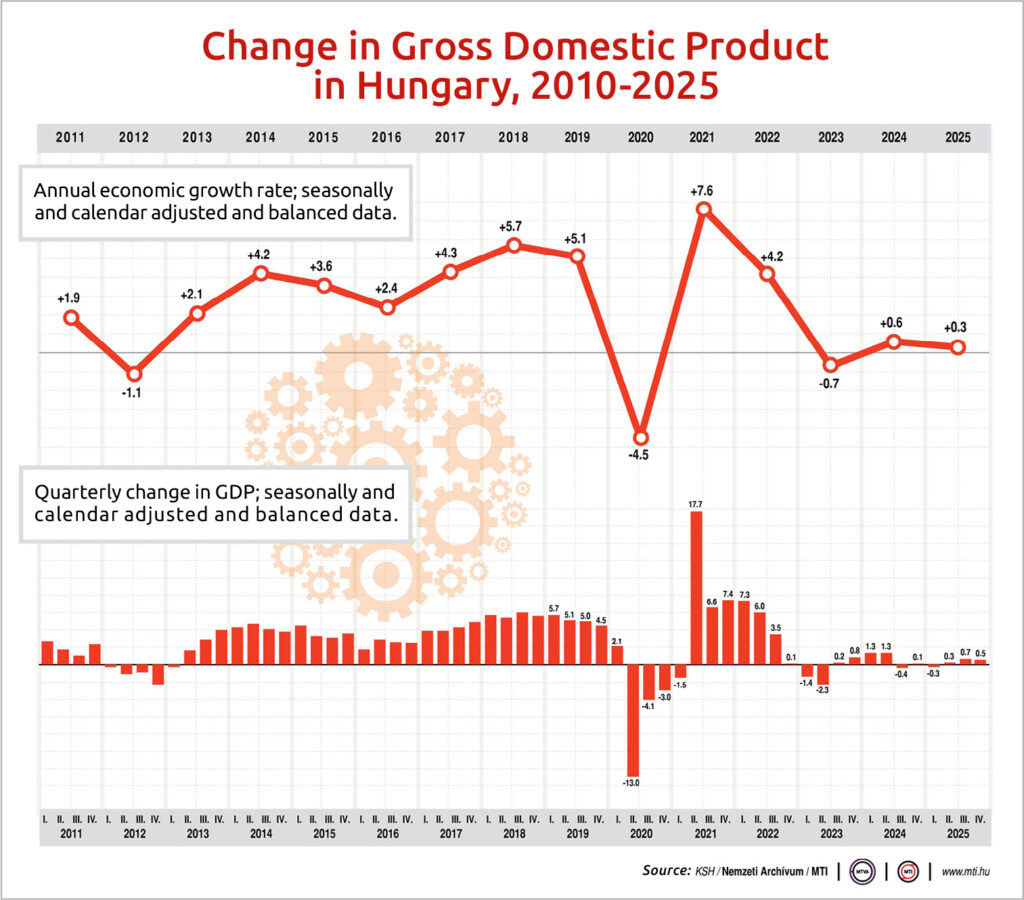
The evolution of the GDP growth rate shows a direct connection to the withholding of EU funds. This started in 2022, and the trend since is evident: 2021: 7.1%; 2022: 4.6%; 2023: -0.8%; 2024: 0.6%; 2025: 0.3%. The figures show that the Hungarian economy can survive without EU funds, but cannot grow.
If the Fitch forecast is true, 2026 can see the stagnating trend broken, even with a continuing lack of EU funds. However, Hungary’s inability to fully unlock suspended EU cohesion funds has limited government revenue and investment, indirectly affecting household welfare by delaying infrastructure, education, and employment-support programs.
While the deficit and debt do not directly impact household budgets, inflation does. In December, it decreased to 3.3%, and is expected to go even lower, to 2.2% in January (KSH will publish the official figures around the time this issue of the Budapest Business Journal is published).
The government’s mandatory cap on price margins has contributed to the lower prices, and the Hungarian authorities are again expected to extend the measure. However, critics argue that this distorts the markets and may lead to legal challenges from the EU. Despite slower headline inflation, many households continue to feel the impact of elevated prices across key categories such as food, energy, and everyday goods.
As for businesses, both short- and medium-term prospects depend on the election outcome. Most polls favor the right-of-center opposition Tisza party over the ruling Fidesz-Christian Democratic People’s Party coalition. Still, analysts warn that the final vote may well be different from what the pollsters are indicating.
One thing seems predictable: the eventual winner will win only slightly above 50% of seats; a two-thirds supermajority, of the type that has given Fidesz a free hand to govern as it wills in the four elections since 2010, seems improbable. Either way, companies are currently in a holding position. The current price controls and sector-specific policies, including windfall taxes on banks and other industries, affect business planning and profitability, and also hinder investment.
Fidesz has not communicated much about its economic program for the next four years, other than “we will continue.” Prime Minister Viktor Orbán acknowledged that the deficit is high, but he stressed that there is no need for austerity measures. He will hold his annual “state of the nation” address on Feb. 14, during which he will likely outline some economic and financial plans.
Tisza has already done that on Feb. 7, with a 240-page program. While some of the plans are vague and lack detail, others shed light on what to expect in the event of a Tisza victory.
Currently, the Orbán cabinet strongly opposes any plans to halt energy imports from Russia, arguing that this is the only way to keep household prices down. Tisza, on the other hand, pledges to end the country’s dependence on Russian energy by 2035.
In terms of nuclear energy, the opposition party would run a “comprehensive review” of the Paks 2 nuclear plant, which relies on Russian credit and, to a lesser degree, technology. Introducing the euro is a priority for Tisza, but there is no target date or roadmap. Healthcare, education, the welfare system, child protection and public transport are also targeted for a complete overhaul, again without specific deadlines.
Other measures include a 1% wealth tax on assets above HUF 1 bln, reducing the tax on the minimum wage to 9%, reducing VAT, allocating more funds to healthcare, and raising family allowances.
This article was first published in the Budapest Business Journal print issue of February 13, 2026.


