



Szabó’s son Blaise wrote to Libisch: “I can’t wait to take my family back to Hungary someday and show them where their ‘Papa G’ once resided. It fills my heart with immense joy to witness the profound impact that my father and his music had on so many individuals.”
Asked what Szabó might have thought of the plaque, his younger brother John says, “I think it would have warmed his heart a little.”
Szabó was born in Budapest in 1936. Inspired by a Roy Rogers “Singing Cowboy” movie he saw as a child, Szabó picked up the guitar. Influenced by Hungarian gypsy music and the Western jazz and pop officially banned by the suffocating socialist regime, he rapidly developed into an extraordinary guitarist with an instantly recognizable sound.
Soon after the 1956 Hungarian Revolution, Szabó, his mother, father and John escaped to Austria before making their way to San Bernardino, California. Graduating from the prestigious Berklee College of Music in 1960, Szabó joined the Chico Hamilton Quintet, one of the hottest West Coast jazz bands at the time.
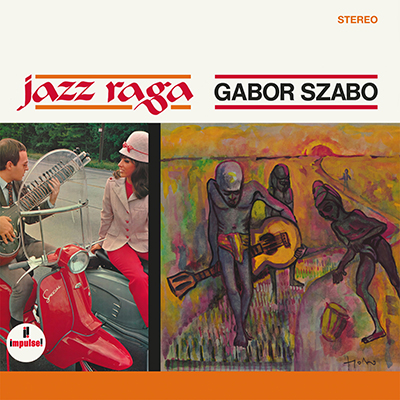
His well-received first solo album, “Gypsy 66,” was released in 1966. A mix of reinterpretations of pop songs and originals, it created the blueprint Szabó would expand on throughout the 1960s on albums such as “Jazz Raga” (1967), “Bacchanal” (1968) and “Dreams” (1968).
On that album, Szabó began to delve deeper into his Hungarian heritage, working with his Hungarian classically trained bassist and old friend Lou Kabok on compositions including “The Fortune Teller” and “Lady in the Moon.” The latter is based on the Hungarian folk song “Tiszán innen, Dunán túl” from Zoltán Kodály’s 1926 opera “Háry János.”
After “Dreams,” which American jazz bible “Down Beat” described as “exceptionally well-conceived and performed,” Szabó appeared to lose his way. Although a close listen to 1970s albums such as “Macho” or “Nightflight” reveals he was still capable of playing superbly, they were dismissed at the time and sold poorly.
Szabó’s last album, “Femme Fatale,” marries his signature style with a more fusion approach. Rejected by his then label Atlantic, “Femme Fatale” was released on the Hungarian state imprint Pepita in 1981, the year before Szabó died of kidney failure in a Budapest hospital after years of heroin addiction and alcoholism.
Szabó was always highly regarded by other musicians and jazz scholars. Carlos Santana covered his “Gypsy Queen” in a medley with Fleetwood Mac’s “Black Magic Woman” on his 1970 Billboard chart-topping “Abraxas” album.
In a “Guitar Player” magazine video, Santana is fulsome in his praise of Szabó. He explains that B.B. King and a certain kind of blues style had him “in a headlock.” Discovering Szabó, Santana realized there were other ways to play. “[T]he guitar became even more fun to play because you weren’t constricted to the same licks or the same approach; the same route home. All of a sudden, you have less-is-more.”
When I spoke to the great contemporary jazz guitarist Bill Frisell in 2021, he, too, focused on Szabó’s ability to play less and make it sound like more. Frisell came to Szabó in the late 1960s. “I was finding some chords too hard or trying to play too much,” he told me.
“My teacher said, ‘Have you ever listened to Gábor Szabó? He plays fewer notes but gets the most power, color and feeling out of them. He chooses what he wants to play and distills this down to the essence.’ That’s been a huge part of my thinking ever since.”
For Frisell, Szabó’s approach to playing in a band was also key. “He was really concerned with the overall sound. He took on the role of orchestrator. Even with his own band, it wasn’t ‘Hey, you guys back me up so I can show off.’ It was really a group sound.”
The foreignness in Szabó’s sound also appealed to Frisell. “He would use open strings as a drone and play other notes against them, which was more like an Eastern European influence. Certain elements I was hearing in his playing came from other stringed instruments. And he was playing the kind of large guitar you’d use for folk music, with flat-wound strings and a pickup. Everything was wrong about what he was doing, but it gave him a unique sound.”
Frisell finished by saying simply, “Somehow, Gábor is in me. And that’s comforting.”
As the plaque proves, more than 40 years after his death, Szabó’s influence continues to grow. This is in no small part down to jazz scholar and self-described “super-superfan” Doug Payne. “I want more people to hear Gábor and the magic he brought into the world,” Payne tells me. “Also, I hope to provide an opportunity to those who are already curious about him and his music to learn more.”
Payne is sure: “Szabó’s place in history is assured. With the help of samplers like Madonna and John Legend and recent practitioners such as the amazing young Hungarian guitarists Ádám Fehér and János Bujdosó of Flemm, I feel encouraged that Gábor’s legacy will survive and thrive.”
The Gábor Szabó plaque is at Városház utca 1, the back entrance into the old Szabó family apartment block at Kossuth Lajos utca 4. You can stream all of Szabó’s albums online (his name is usually spelt without the Hungarian accents), and several are available in handsome vinyl editions from good record stores, many with liner notes by Doug Payne. Second-hand copies of “Femme Fatale” on the Pepita label are easy to find, at least in Hungary, and shouldn’t be expensive. You can read Doug Payne’s thoughts on Szabó at dougpayne.com
This article was first published in the Budapest Business Journal print issue of December 12, 2025.


