


A recent international study involving Corvinus University of Budapest reveals that Asian automotive suppliers are at the forefront of digitalization, significantly outpacing their European counterparts. The research assessed 54 major automotive corporations worldwide, exposing a pronounced digital divide between regions.
The study, conducted by researchers from Babeș-Bolyai University in Cluj-Napoca, Corvinus University of Budapest, and Aalborg University in Denmark, focused on the 30 largest automakers and the top 100 automotive suppliers by revenue. The assessment covered firms with at least five years of reports available from 2012 to 2022.
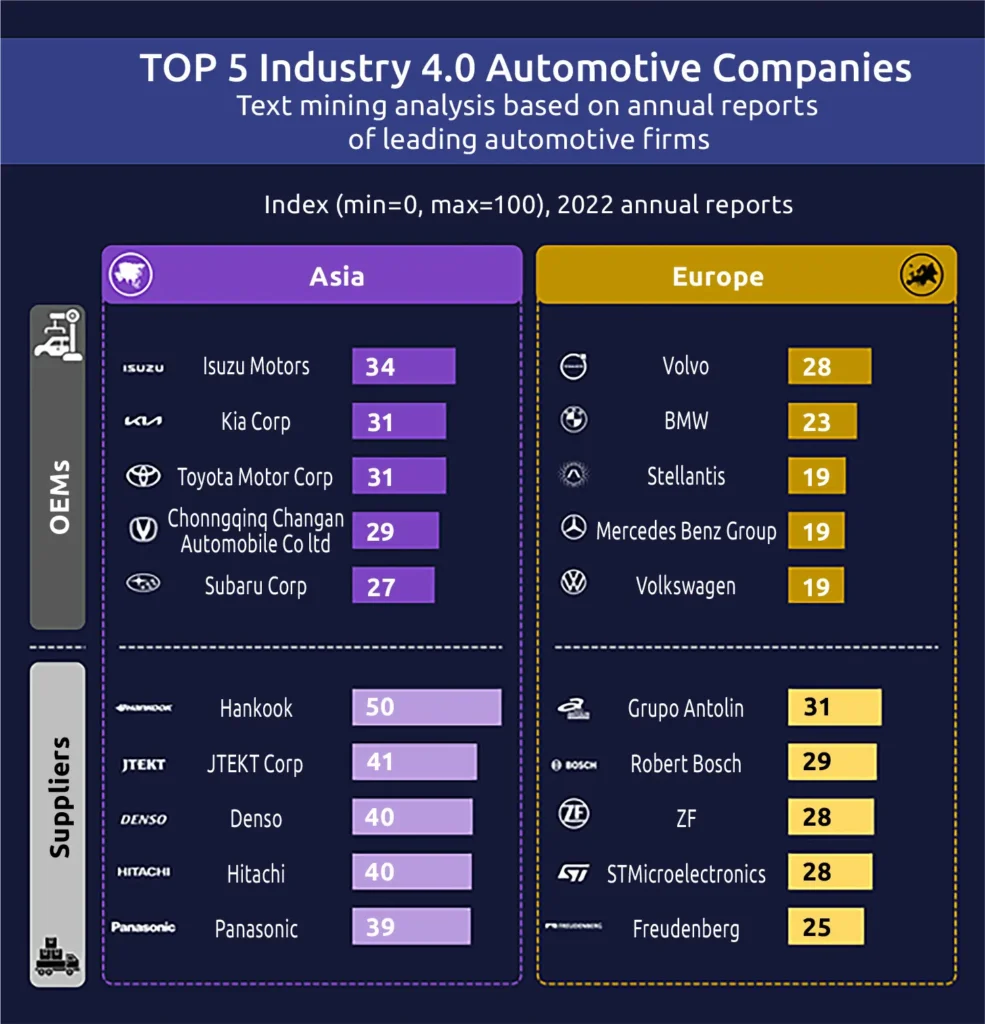
Suppliers were found to be more advanced in digitalization compared to car manufacturers, with Asian companies leading the charge. The top five most digitalized automotive companies globally are all Asian suppliers, with tire maker Hankook securing the top position.
In Europe, Grupo Antolin, a supplier of interior components, ranks first; however, none of the top five European suppliers match the digitalization levels of their Asian counterparts. Among automakers, Isuzu leads globally, while Volvo heads the European ranking, standing approximately on a par with Subaru, Asia’s fifth-best.
The study’s 10-year analysis highlighted a steady increase in both traditional and cutting-edge Industry 4.0 technologies within the automotive sector. Conventional technologies, such as robotics, radio-frequency identification (RFID), and algorithms, have grown by 15%, reaching a score of 54 on the researchers’ 0-100 digitalization scale.
Meanwhile, advanced Industry 4.0 solutions, including the Internet of Things (IoT), smart machinery, artificial intelligence, and simulations, surged by 24%, attaining a score of 26.
“While Industry 4.0 solutions are advancing dynamically, traditional technologies remain widely used,” explains Krisztina Demeter, a professor at Corvinus University and a member of the research team. “Their prevalence reminds us that Industry 4.0 innovations are built on established technologies.”
The study’s findings underscore a pressing need for European automotive companies to accelerate their digital transformation efforts. As the industry grapples with challenges such as electrification and the shift towards autonomous driving, enhancing efficiency through digital readiness is becoming increasingly critical.
Accordingly, share prices of Europe’s “big five” automakers, Volkswagen, Mercedes, BMW, Stellantis and Renault, have mostly struggled throughout 2024. For instance, Stellantis dropped 37%, VW 23% and BMW 21%, respectively. High interest rates and rising vehicle prices have held back consumer demand. The EV segment, where affordability remains a primary concern, along with range anxiety due to the charging infrastructure not developing fast enough, was particularly badly hit.
That is where the price advantage of dynamic Asian manufacturers kicks in. As a result, perception is shifting even in Germany: a recent Adac survey found that 80% of respondents could imagine buying a Chinese brand. The price tag was mentioned as the main reason for such a preference.
Although the market share of Chinese cars is still just 3% in Germany, the process seems to be accelerating and unstoppable. Big Four consultancy PwC estimates that 2024 may have seen 440,000 vehicles exported to Europe. This would mean that, for the first time, the number of cars shipped in from the Asian powerhouse would exceed related European exports to China.
All that has implications for the Hungarian economy, which is largely dependent on the sector’s performance. Orders were down 23% year-on-year as of the end of October, and stakeholders don’t see the end of the tunnel just yet.
Pressure comes partly from the 2035 deadline set by the European Union, beyond which only zero-emission cars can be produced and sold new. Many are questioning whether that date should be set in stone; indeed, BMW chief executive Oliver Zipse said it was “no longer realistic” at the Paris Motor Show in October 2024.
Another issue is tariffs. The EU, the United States, and Canada have all announced plans to limit the sale of Chinese EVs, although European OEMs fear that this could have a cannibalistic effect that could lead to plant closures.
As Stellantis boss Carlos Tavares noted earlier, Chinese car manufacturers such as BYD have been stepping up plans to build their vehicles in Europe to circumvent the tariffs. Tavares predicted that Chinese brands would not be going to Germany, France or Italy, the home of Europe’s oldest carmakers, but would seek cheaper options in countries in eastern Europe, such as Hungary, where labor costs are lower.
This, the Stellantis CEO added, would mean “accelerating the need to shut down plants” elsewhere in Europe, thereby defeating the object of protectionist tariffs.
Indeed, BYD’s multibillion-euro factory project in Szeged (175 km southeast of Budapest by road) is progressing according to plan. The leading EV manufacturer’s first European plant is scheduled to be up and running by the second half of this year.
Development is also progressing well at the other ongoing flagship investment for Hungarian automotive, BMW’s iFactory in Debrecen (233 km east of the capital). According to the head of the new plant, Hans-Peter Kemse, construction is “in full swing.” Pre-production is ongoing, and serial production of the fully electric Neue Klasse X model Sports Activity Vehicle is set to start at the end of 2025.
Kemser noted that the Debrecen plant was planned with a maximum annual capacity of 150,000 vehicles, though it will be ramped up gradually. That is another glimmer of hope for the sector and the Hungarian economy as a whole.
This article was first published in the Budapest Business Journal print issue of January 10, 2025.


