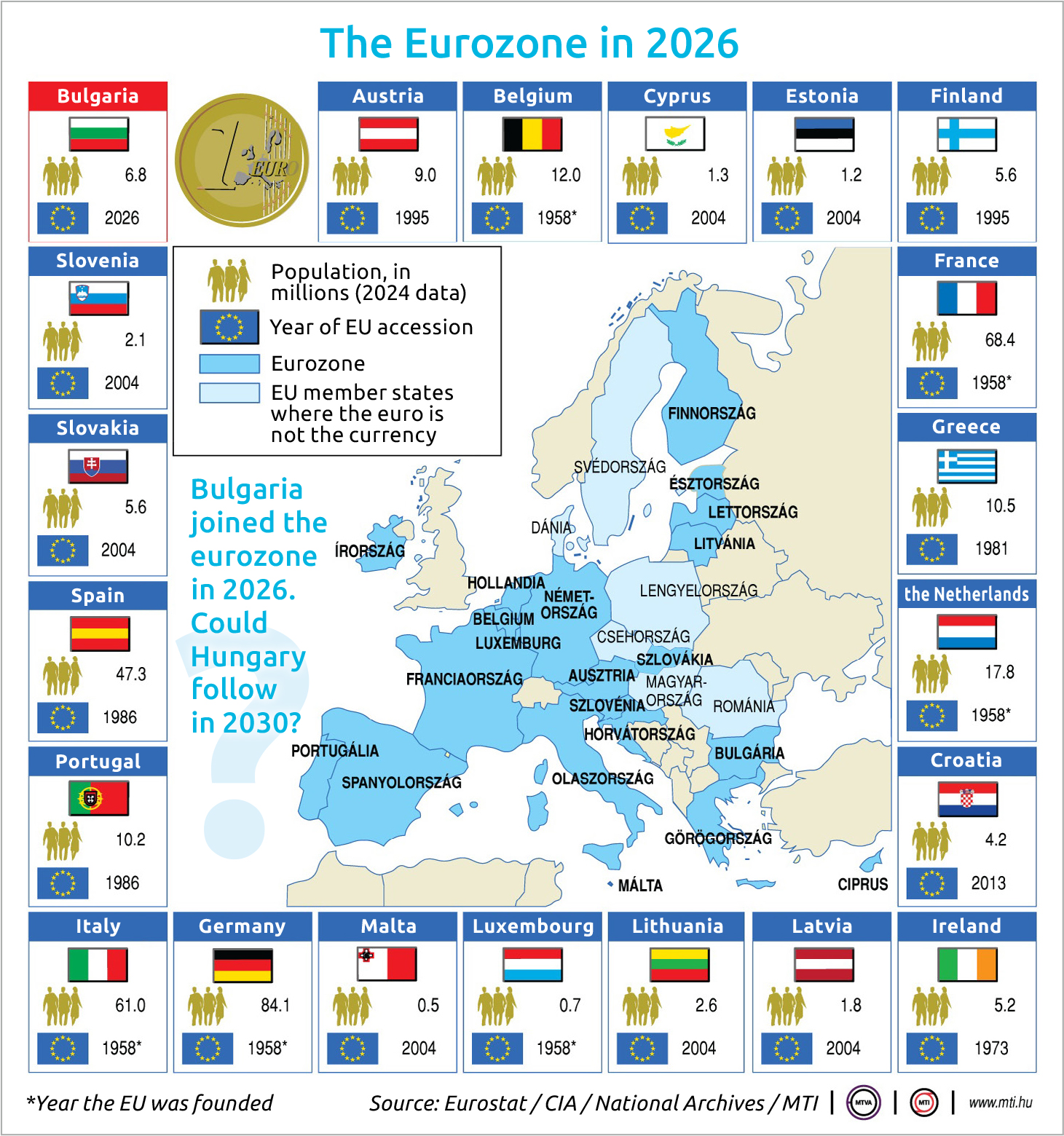
After years of political resistance and economic ambivalence, Hungary’s euro debate is back. The new Tisza Party government led by Prime Minister Péter Magyar has signaled that euro adoption is once again a strategic objective, marking a sharp departure from the Orbán era, when joining the eurozone was repeatedly delayed and often dismissed as unnecessary or premature.
The government is not promising a rapid switch from the forint, but officials are openly discussing a path to meet the conditions for membership by the end of the decade. For investors, companies and policymakers, the renewed discussion raises a fundamental question: is Hungary finally preparing to enter the euro area, or is this another long-term aspiration constrained by economic realities?
The new administration’s position is cautiously ambitious. Minister of Finance András Kármán has framed euro adoption not as a symbolic political project but as part of a broader effort to restore economic credibility after years of fiscal volatility, unpredictable policymaking and strained relations with Brussels.
The government aims to place public finances on a sustainable path, cutting the budget deficit toward the European Union’s 3% threshold and reducing debt levels over a multi-year horizon. Officials say these steps would also move Hungary closer to fulfilling the Maastricht convergence criteria required for joining the eurozone.
Government officials have repeatedly referred to 2030 as a possible milestone; not necessarily the date of euro entry itself, but a target for putting Hungary in a position where accession becomes feasible. The administration has linked the issue to a broader economic reorientation focused on productivity, innovation, higher value-added production and stronger institutional predictability.
Under Viktor Orbán, Hungary remained outside the euro area even as several Central and Eastern European neighbors moved closer to the common currency. Orbán argued that retaining the forint preserved economic sovereignty and policy flexibility. His government never established a formal target date for euro adoption, while criticism of Brussels and tensions with EU institutions made deeper monetary integration politically unattractive.
The new government’s approach reflects a broader recalibration of Hungary’s relationship with the European Union. Unlocking frozen EU funds, rebuilding policy credibility and improving investor confidence are central priorities. In that context, discussion of euro adoption functions as both an economic and a geopolitical signal: Hungary is presenting itself as more closely aligned with mainstream European integration.
Yet the National Bank of Hungary (MNB) is striking a more measured tone. Central bank Governor Mihály Varga, a former Fidesz finance minister, has indicated that the MNB will work constructively with the government’s plans, emphasizing that meeting eurozone entry criteria, particularly low inflation, fiscal discipline and sustainable debt dynamics, would be beneficial in its own right.
At the same time, the MNB has warned against rushing the process. According to Varga, euro adoption is ultimately a political decision, but economic preparedness remains essential. That caution echoes long-standing arguments from Hungarian monetary policymakers.
Former MNB Governor György Matolcsy repeatedly argued that joining the euro before Hungary’s economy had sufficiently converged with Western European living standards could be counterproductive. He described euro membership as a “club of the rich,” suggesting that Hungary should consider entry only after reaching a substantially higher level of development, potentially around or after 2030. Analysts broadly agree with the MNB’s underlying assessment: the political conversation may have changed, but the economics remain demanding.
Hungary still faces substantial obstacles before it could realistically join the eurozone. Inflation, though moderating from earlier peaks, remains a sensitive issue. Fiscal deficits have widened after years of expansive spending, while public debt levels remain elevated by regional standards. In addition, Hungary would eventually need to enter the Exchange Rate Mechanism II, the eurozone’s waiting room, and maintain exchange-rate stability for at least two years before adoption. Currency dynamics will be a critical part of that equation.
“Looking at the forint’s real effective exchange rate, we are now at roughly the same level as in 2008, when the currency was too strong for the economy,” said Dávid Németh, analyst at K&H Bank. In his view, an exchange rate around 360 forints per euro represents the upper limit of what remains tolerable for economic actors in the short term. Over the longer run, however, a credible euro-adoption path could itself generate further real appreciation of the Hungarian currency.
Németh expects the euro-forint exchange rate to fluctuate between 360 and 370 during the second half of this year, before renewed forint strengthening could resume in early 2027. Under such a scenario, Hungary could potentially lock in the conversion rate for euro adoption at below 350 forints per euro.
The K&H analyst argues that the MNB would also have tools to prevent excessive currency strengthening: two 25-basis-point interest-rate cuts remain plausible this year, and that Hungary’s benchmark rate, currently 6.25%, could fall below 5% by the end of 2027.
Economists see advantages in joining. The euro would lower transaction costs, reduce currency risk for exporters and investors, and potentially lower borrowing costs over time. Hungary’s highly open, export-oriented economy, deeply integrated into European manufacturing supply chains, may be structurally well suited to monetary integration. For multinational companies operating in Hungary, the elimination of exchange-rate volatility would be a meaningful benefit.
But analysts also warn that euro membership carries trade-offs. Surrendering monetary policy autonomy means giving up an independent currency, a potentially valuable tool for responding to external shocks. Countries outside the eurozone, including Poland and the Czech Republic, have sometimes argued that retaining national currencies offers greater flexibility during crises. Critics of rapid accession warn that entering too early could expose Hungary to painful adjustment pressures if competitiveness and fiscal resilience are not firmly established.
This article was first published in the Budapest Business Journal print issue of May 22, 2026.
Producing journalism that is worthy of the name is a costly business. For over 30 years, the publishers, editors and reporters of the Budapest Business Journal have striven to bring you business news that works, information that you can trust, that is factual, accurate and presented without fear or favor.Newspaper organizations across the globe have struggled to find a business model that allows them to continue to excel, without compromising their ability to perform. Most recently, some have experimented with the idea of involving their most important stakeholders, their readers.
We would like to offer that same opportunity to our readers. We would like to invite you to help us deliver the quality business journalism you require. Hit our Support the BBJ button and you can choose the how much and how often you send us your contributions.