


Here she reflects on what taking that step up has been like, the growth in numbers and individuals in Budapest, creating a pipeline and supportive career pathways for talents, solving the “and equation,” and leading by example.
BBJ: You have been in Hungary for two years, but in this post since July. Given you were already based within the organization here, what has surprised you most about taking the step up?
Nicole Biser: Before stepping into the role of lead country manager and finance manager, I was leading our planning and stewardship organization here in Budapest. In this capacity, I worked closely with colleagues across the finance function; however, until taking on this new role, I did not fully appreciate the breadth and complexity of activities within the Global Business Center, particularly in the commercial and IT space.
Our teams are responsible for a mix of global and regional activities across all three of our value chains: Upstream, Product Solutions and Low Carbon Solutions. They are heavily engaged in our ongoing business transformation and passionate about the role that they play, which both energizes and inspires me to lead with the same commitment.
From an external perspective, I am equally impressed by the strength of Hungary’s business services ecosystem. The scale and maturity of the sector create a dynamic environment that attracts investment through training, innovation, and career development opportunities.
BBJ: The Budapest Affiliate was established in 2004 as a business support center. In 2019, it was renamed a global business center (GBC) to reflect its work better. How important is it to the international business today?
NB: All of our GBCs play a key role in enabling ExxonMobil to deliver on our strategy, and the Budapest Global Business Center is no exception. Initially, each GBC mainly supported its local region; however, as our business has evolved, work now spans regions and time zones. This allows us to group similar skills and knowledge in one place, creating hubs of expertise that better support our global operations.
We are working to solve the “and equation,” providing the energy and products that make modern living possible and reducing emissions. For this, we use our competitive advantages: technology, scale, integration, execution excellence and people. The Budapest GBC team plays an essential role in advancing this mission by leveraging our expertise and capabilities to help deliver on this dual challenge.
BBJ: The head count at the GBC has ramped up almost continuously since 2004. What are the development plans for your office?
NB: Similar to many business services sector players in Hungary and the region, we are a mature organization with a highly talented and experienced workforce. Our portfolio of activities reflects the skills and capabilities across the organization, leveraging automation and technology to shift away from transactional work to value-added activities that drive insights, enable strategic decision-making and create measurable impact for the business. As part of this, we measure growth in terms of job content and opportunities for skill and career development versus solely the number of positions. Many of our colleagues are responsible for global portfolios, and we have centers of expertise and global hubs here for certain activities.
To drive this transformation, we continuously invest in skill development across the GBC. Our latest initiative, “Future Ready,” outlines the key competencies we believe our employees need to be successful, such as digital literacy, adaptability and analytical thinking, so they can thrive in a fast-changing environment, embrace technology and take on more complex, value-driven roles. The program then connects employees to programs available here at the Budapest GBC that help them develop these skills through a combination of theoretical practice and real-world application.
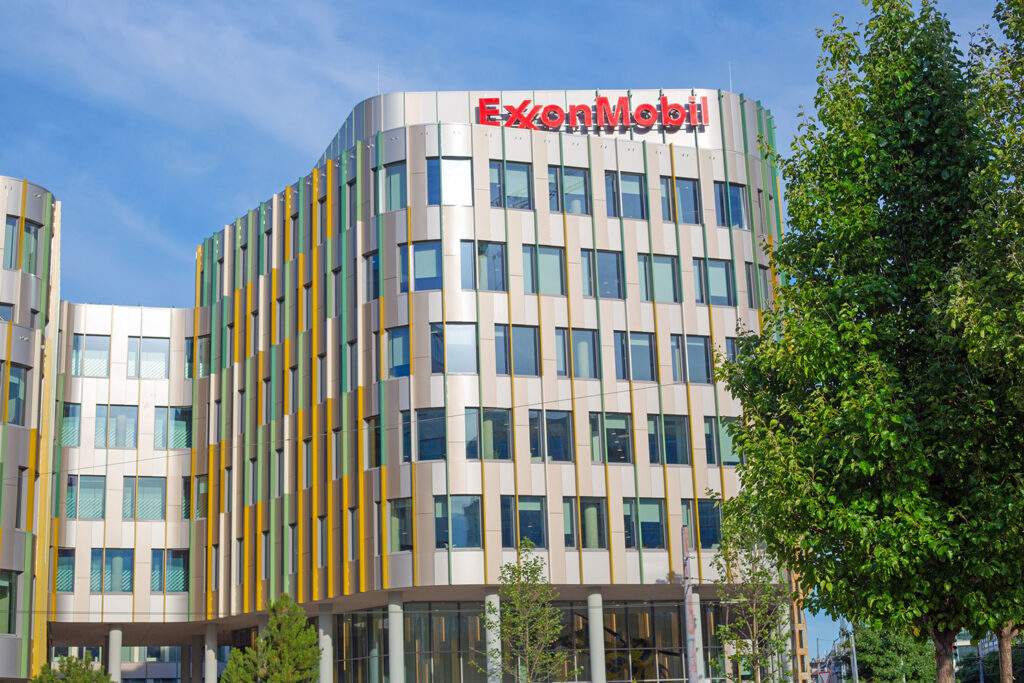
BBJ: Allied to that, you are the sole tenant of the Pillar building in the Váci út Office Corridor. When you moved into the new HQ in July 2022, it was ExxonMobil’s biggest office in Europe. Is that still the case, and how many people could you safely accommodate if everyone were in at once?
NB: ExxonMobil Hungary remains our largest European affiliate. Our Pillar office is more than “just a building.” With more than 1,800 professionals from over 80 nationalities in our offices, we enjoy a collaborative, open work environment where we deliver innovative commercial, digital, and financial solutions to power ExxonMobil’s global business.
Flexibility is embedded into the design of our building, and we have tripled the number of collaboration spaces compared to our previous location. We have large areas for informal collaboration, think tanks, lounge areas, and an auditorium for more than 200 people, so there are more opportunities for colleagues to collaborate, depending on their needs.
Our Budapest office regularly welcomes senior leaders and hosts global workshops, creating valuable opportunities for collaboration and knowledge sharing. These events strengthen connections with colleagues worldwide, provide insights into different areas of the business and foster networking across regions.
BBJ: Vital to maintaining current staffing levels, much less raising headcount, is access to talent in adequate numbers. With Hungary at virtually full employment, do you have any concerns on that front, and what are you doing to shape the curriculum and make sure the educational system produces graduates you can use?
NB: Hungary has a broad business services ecosystem that provides a strong foundation for talent development and meaningful careers for more than 120,000 people. With that said, it is important for us to continue supporting the pipeline for talent development, particularly as it relates to both STEM and language skills. We currently do this through a couple of means.
• The Sci-Tech Challenge is a joint initiative with Junior Achievement to promote STEM education. Aimed at high school students, the annual competition encourages teams across Europe to tackle real-world issues such as energy, the circular economy, plastic waste, and sustainability using STEM skills. Over one or two days, teams develop innovative solutions with mentorship from ExxonMobil professionals. Company leaders, policymakers and industry experts then evaluate these ideas. We are proud to have organized the local competition for four years and to have hosted the local winning teams at the European final.
• We also develop strategic partnerships with universities, leveraging our leaders and university ambassadors to enrich academic learning through real-world projects, internships and mentorship. In addition, ExxonMobil’s senior leaders deliver regular lectures and seminars to students. This collaboration supports talent development, elevates corporate branding and fosters cooperation and innovation within the local higher education ecosystem.
ExxonMobil Hungary places a strong emphasis on collaboration with critical stakeholders to ensure the country’s workforce remains competitive in a rapidly evolving economy. We maintain ongoing dialogue with policymakers, government agencies and trade associations, such as the American Chamber of Commerce in Hungary, to align on educational priorities and ensure a highly skilled, continuous talent pipeline. These partnerships aim to keep curricula relevant, foster continuous skill development and prepare future professionals for high-value roles in the energy sector and beyond.
BBJ: In the past years, I have interviewed all of your predecessors: Byung Kim, Jeroen Kirschbaum, and Romke Noordhuis. All either came to Budapest from the Texas HQ or went from Budapest there (and sometimes both). You also came to Hungary from Houston two years ago. Is that an inevitable pathway, or does it say something about you and your predecessors?
NB: Even though we have all transitioned to or from our headquarters, my predecessors and I have all had different backgrounds and career paths, reflecting the company’s approach to personalized development. We focus on individualized development plans, prioritize targeted skill and capability development and ensure employees get the right assignments and experiences at the right time. Because the approach is unique to each individual, it requires deliberate career planning, formalized skill development and training.
We invest in long-term careers that can span the full breadth of ExxonMobil, with career paths that allow employees to build skills through specific work assignments, projects, on-the-job experiences and through focused technical and leadership learning. Many employees transition into new roles approximately every three years, often in different parts of the company or even in another country. This approach ensures that over the course of their career, employees can explore a wide range of roles and build a rich portfolio of skills and experiences.
BBJ: Finally, your immediate predecessors were all men. Do you see yourself as a role model for women in ExxonMobil and the wider community?
NB: Being the first female lead country manager is something I take pride in; more importantly, I see this as an opportunity to create visibility and inspire others. Representation matters; when people see someone who looks like them or shares similar experiences in leadership roles, it helps them believe that those opportunities are possible for them too.
Inclusion and diversity are foundational to what we do and the culture to which we aspire at ExxonMobil. When employees can thrive, reach their full potential and deliver their best, it enhances our competitive advantage. For me, it’s about paving the way, showing what’s achievable and encouraging others to pursue leadership positions.
This article was first published in the Budapest Business Journal print issue of December 12, 2025.


