


Storing and making sense of this much information is a monumental task, calling for computerization at ever higher levels. Not too long ago, mainframe-type supercomputers were indisputably the rock stars of high-performance computing. The tech world closely followed each new (and named) contender and its edge over the competition.
Such systems still offer unrivaled processing power, essential in handling bulk data or high-volume input, like bank transactions. However, powerful as they are, supercomputers cannot effectively serve the entire research ecosystem. Efficient scientific research, particularly in fields such as medical research, is made possible by a dedicated, robust, accessible and advanced information infrastructure. Increasingly, demand for computing clusters turns them into the backbone of scientific research.
These clusters are multi-computer units built from components at the top of the high-end but still mass-produced. Distributed systems built from commodity components are more cost-effective, redundant, and easier to maintain and upgrade. They can be in places where investment-hungry supercomputers are unreasonable. Above all, they are perfect for tackling complex problems that require data analysis or running simulations.
In other words, it is perfect for bioinformatics- and medical informatics-heavy research the Hungarian Center of Excellence for Molecular Medicine (HCEMM) engages in. Whether profiling tumors based on blood samples or linking gut microbes to harmful mutations, scientists at HCEMM who seek to understand age-related disease must often call on advanced computing capabilities.
Advanced Core Facilities, dedicated research infrastructure integrated with research groups at an institutional level, are central to the operations of HCEMM. When it comes to its palette of imaging devices, microscopes, CT scanners, cell sorting machines or spectrometers, the institute already offers a unique combination of tools to its research groups.
Adding computing to the list was a natural next step. The computing cluster currently being configured at HCEMM brings easy access, safe data storage, and expert assistance to the institute that would otherwise be far outside the budget of individual research groups. However, HCEMM goes beyond securing computing power for domestic purposes.
By joining the Hungarian Elixir Node, it strengthens national and regional research. Elixir is a Europe-wide intergovernmental organization helping scientists take advantage of the vast amounts of data produced by life sciences. Upon joining the member states (of which there are currently 23), each country established a “node,” an organization that coordinates local activities and links them to the hub at the Wellcome Genome Campus in Cambridge in the United Kingdom. The Elixir cooperative helps scientists who turn to any of the nodes in two important ways. First, it offers access to hardware systems that make advanced analysis or modeling possible. Second, it provides expert technical guidance so scientists can make the most of the information infrastructure they access.
While a dedicated high-performance computing infrastructure is especially essential for hosting the biomedical data in a controlled manner, which allows full control over patient-related information, HCEMM also cooperates with the high-performance computing centers in Hungary coordinated by Bay Zoltán Nonprofit Ltd. for Applied Research in Miskolc. Under the MOU signed between the Knowledge Management Center and HCEMM, the research groups can access additional computing capacity, which is particularly important for processing large-scale raw data, such as that generated by high-throughput DNA sequencing experiments.

Sharing access is also a cornerstone of education: HCEMM aims to participate in the training of future scientists and information technology experts to make sure the rapidly growing infrastructure for high-performance computing is matched both by the number of people capable of supporting the system on a technical level and those who understand what the technology may be used for with regards to their research. With the speed at which technology develops, it is essential to ensure scientists are fully aware of their options.
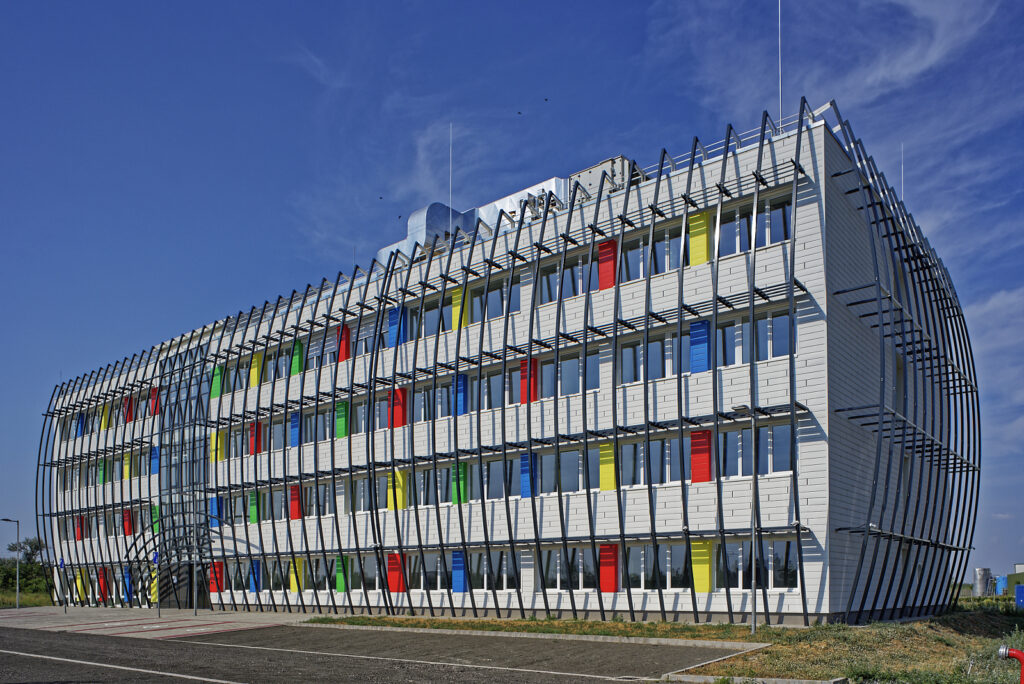
The computing cluster of the Advanced Computing ACF is located at the HCEMM headquarters in Szeged, as are the laboratories of the institute’s core groups. While digital data travels at the speed of light, the physical distance between the host facility and the users can make cooperation difficult, a pitfall that a locally hosted system avoids.
Besides advanced electronics, the most valuable component of the ACF is indisputably the knowledge of bioinformaticians, biostatisticians and mathematicians who assist scientists. Data collection and analysis is best planned as an integral part of any research project right from the get-go, but not every research group has access to dedicated bioinformaticians who can see clearly in the deluge of options, and certainly not to a whole group of experts. But the Advanced Computing ACF is all about having that group, and lending its expertise throughout the design, execution and handling of scientific research.
Hardware is, of course, no less necessary. The computing cluster is 15 interlinked computers in a dedicated, temperature-controlled server chamber. The system sports 30 processors, each a 24-core, 2.65 GHz, dual-thread CPU. This processing power is complemented by seven Terabytes of DDR4 RAM and 300 Terabytes of storage. While impressive, CPUs are not the real workhorses of the setup: GPUs, or Graphics Processing Units, are.
GPUs started out as specialized display co-processors for video games. In early computer displays, computing was handled more cost-effectively than storage, so video chips made high-quality graphics possible by compositing data on the fly, as an image frame was created, instead of buffering image frames and computing how they should change. As computer graphics evolved, video chips became increasingly specialized at handling massive amounts of information in parallel, much more so than the CPUs at the heart of the computer. Modern high-end processors used in desktop computers usually manage two parallel computation threads per core, somewhere around 128 threads in total. High-end desktop GPUs handle orders of magnitudes of calculations more (tens and often hundreds of thousands) simultaneously. Individually, these calculations may be less complex than those juggled by a CPU, but, as the adage goes, quantity has a quality all its own.
As it turns out, some practical problems, from blockchain building to machine learning or protein simulation, need precisely that, rather than the sophisticated number-crunching ability of a high-end CPU. A protein, for example, is a chain of simple molecules interacting in relatively straightforward ways but in such great numbers that simulating how they are folded is better handled by a GPU than a CPU. HCEMM’s computing cluster has a specialized subunit with two 48 GB GPU components.
With all the specifications of various components, it’s difficult to get a feel of just how much computing power a cluster packs. The go-to number is usually Flops (FLoating-point Operations Per Second); think of it as horsepower for computers. In essence, Flops measures how many mathematical calculations a computer performs in a second. Most desktop computers are in the Giga-Flops range: billions of calculations per second.
With all components acting in concert, HCEMM’s cluster packs over a hundred Tera-Flops: a hundred thousand trillion operations per second. This is for most scientific calculations, which require higher precision. Modern high-end GPUs are geared towards supporting machine learning, which relies on lower precision and higher data throughput. When it comes to such specialized calculations, the system is capable of nearly 10 times more: a mind-boggling one million trillion calculations. For some perspective, 14 operations per second was what flew humans to the moon.
Covering the needs of its research groups and placing HCEMM on the map of regional computing assets are not the only factors at play, though. Information has always been a valuable commodity but has never been procured, traded, and abused at a greater scale than today. Security has become a lynchpin of modern information technology, and a domestic computer cluster is a statement in that field as well. This means that crucial software solutions can be locally hosted, and all the information the institute’s scientists generate or obtain during their work, some of which may be highly sensitive health-related data, is locally stored. Local hosting and storage mean information is safer from security risks that often plague external services: policy changes and differences between legal environments, vendor lock-in, or privacy beaches.
Beyond providing the means for handling a great deal of information, HCEMM’s new Advanced Core Facility for Scientific Computing ensures that this information is used for the benefit of society.
HCEMM is a distributed institute whose scientists develop advanced diagnostics and treatment options supporting healthy aging. The HCEMM program is currently funded by an H2020 Teaming Grant (where Semmelweis University, the University of Szeged and the HUN-REN Biological Research Center in Szeged cooperate with their advanced partner, the European Molecular Biology Laboratory, headquartered in Heidelberg, Germany) and a Thematic Excellence award, as well as a National Laboratory award from the Hungarian Government. The various activities are coordinated by HCEMM Kft., headquartered in Szeged, Hungary. HCEMM works at the interface of academic and industrial research on topics related to translational medicine. The goal is to improve the quality of life for an aging Hungarian population while at the same time lowering the cost of healthcare provision through novel applications in the field of molecular medicine.

This article was first published in Invented in Hungary 2024-2025 on September 20, 2024.


