


The award program, launched for the 34th time by the Hungarian Innovation Association (MISZ), is being run in cooperation with the Hungarian Chamber of Commerce and Industry, the National Chamber of Agriculture, and the National Innovation Agency, with main support from the Ministry of Culture and Innovation and the National Research, Development and Innovation Office (NKFIH). The 34th Hungarian Innovation Grand Prize was announced on November 6, 2025.
Sector breakdown of this year’s entries shows industry leading the field with 25 submissions, followed by IT with 19. Agriculture contributed 10 applications, while energy and environmental protection each accounted for eight. Healthcare projects made up six of the submissions. The competition also saw a record number of startups entering, with 15 early-stage companies submitting projects.
Beyond overall volume, organizers point to a growing spread of innovation outcomes that are already tangible in the real economy. Eligible entries were required to be implemented in practice and to have delivered measurable business or social benefits during 2025. MISZ says the aim is to identify and recognize the strongest Hungarian innovation results and to highlight best practices in innovative products and technologies that also meet environmental and sustainability considerations.
A notable addition this year was a nomination pathway that allowed organizations involved with domestic innovation to recommend companies for the applicant pool. The nominating bodies included the partner and co-organizing institutions involved in the award program, as well as the Entrepreneurship Club of Corvinus, the Hungarian Business Angel Network, the National Bank of Hungary, Startup Hungary and STRT Holding.
These nominating organizations had recommended more than 230 Hungarian companies with standout innovation results by the end of November. The wider funnel, combined with the record number of formal applications, suggests a higher level of engagement across company sizes and sectors, and an effort to draw attention achievements that might otherwise remain less visible outside their immediate markets.
Since its foundation in 1991, more than 1,500 entries have been submitted for the Hungarian Innovation Grand Prize. Of those, 255 have received various prizes, a group the MISZ describes as forming the domestic innovation elite.
The organizers also noted that the Innovation Trademark, granted by the Innovation Coalition (established recently at the initiative of the National Bank of Hungary and the Hungarian Chamber of Commerce and Industry, with MISZ also participating) has awarded to nine companies that had previously won one of MISZ’s innovation prizes. A further 16 of the new trademark holders are competing for the Innovation Grand Prize this year.
“The Hungarian Innovation Grand Prize and the nine related sector-specific innovation awards have recognized the most outstanding innovation achievements for more than three decades. These innovations move the Hungarian economy forward, and the more there are, the greater the chance of sustained, well-founded economic growth in Hungary,” said Csaba Bőthe, managing director of MISZ.
He added that increasing the number of successful innovations is a shared interest and cited MISZ’s role in establishing the Innovation Coalition and the Hungarian Innovator trademark. “We are pleased that this year, more innovative companies than ever before were able to demonstrate a 2025 innovation result that qualifies them to take part in the competition,” Bőthe said.
The judging panel has begun evaluating the entries. The results are set to be published on the evening of March 18, with the winners to be introduced the following day at the InnoSummit2026 innovation conference.
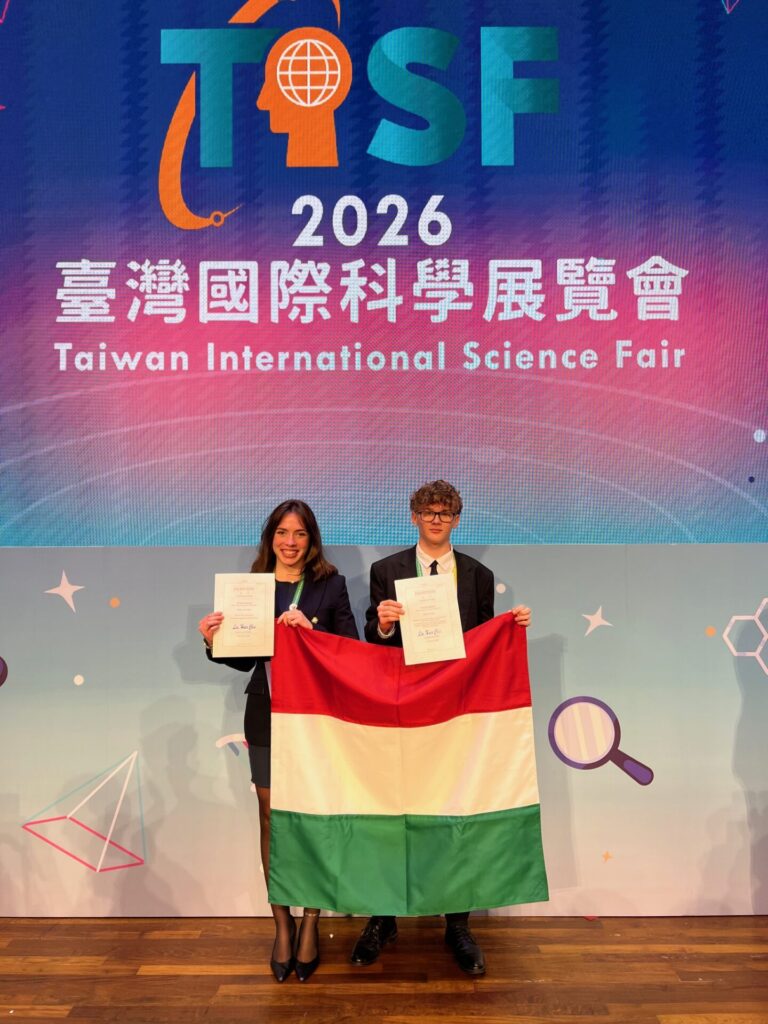
Hungarian secondary school students again performed strongly at one of the most prominent international student science competitions, the Taiwan International Science Fair, where both Hungarian entrants achieved fourth-place finishes from a field that brought together 700 students representing 32 countries.
The two students were delegated by the Hungarian Innovation Association (MISZ) after first proving themselves at the National Science and Innovation Olympiad.
The Taiwan International Science Fair, established in 2002 by Taiwan’s Ministry of Education, is one of the best-known platforms for high school-level scientific and technical research. Since 2010, the event has included participants delegated by international partner organizations.
This year, secondary school students presented more than 500 research projects across 13 scientific and technical categories, with the competition taking place at the National Taiwan Science Education Center from Feb. 2-6.
Natali Júlia Hajsz, from the Deutsche Schule Budapest Thomas Mann Gymnasium, entered the competition with a 3D-printed, customizable wound dressing that is partially absorbable and designed to support more effective healing while also reducing the amount of medical waste generated.
The other Hungarian student, Dániel Czapák, of the Ferenc Medgyessy Secondary School of Arts, developed a wireless system based on flexible sensors that can help predict failures in industrial machinery. By enabling earlier detection of potential malfunctions, the system is designed to support more reliable operation and maintenance planning.
The Hungarian delegation was headed by Zsófia Pazsák, competition director of the National Science and Innovation Olympiad, who accompanied the students and supported them during their preparation for the international event.
Both students have participated in the Hungarian innovation competition system for years. Their development reflects one of MISZ’s core missions: to encourage innovation-mindedness and creative problem-solving among younger generations.
MISZ has delegated top-performing students from the national innovation olympiad to major international events for many years. As well as the Taiwan competition, Hungarian students have represented the country at the EU Contest for Young Scientists, the world championship of science competitions held in the United States, and the Swiss Talent Forum.
Hungarian participants have consistently achieved success, most recently returning from a 2025 world championship event with a silver medal and from a European-level competition with a bronze medal.
This article was first published in the Budapest Business Journal print issue of March 13, 2026.


