


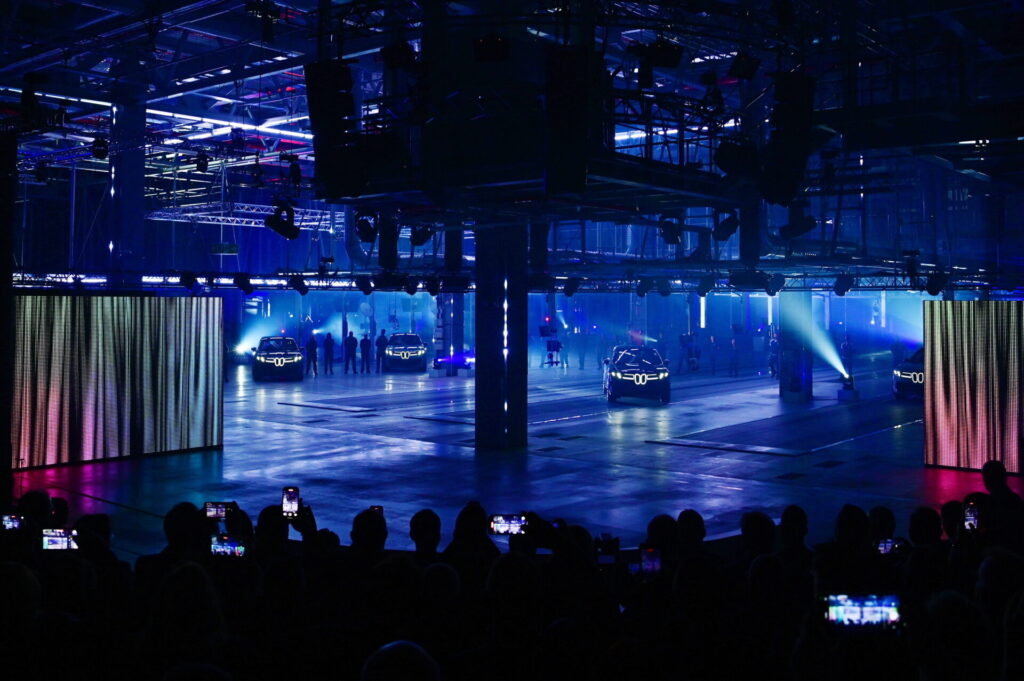
One stream involves continued FDI, the most recent example of which was the opening of the BMW plant at Debrecen on Sep. 26. The other strand has been unease about slowing sales globally. But there are signs the pessimism over the latter may be lifting.
Róbert Ésik was, for almost eight years, CEO of the Hungarian Investment Promotion Agency. Since September 2022, he has been a partner at EY, advising clients on location selection and incentives, covering the EMEIA region. It makes him an ideal person to provide an overview of German investment in Hungary, in general, and in the automotive sector, in particular.
“Despite the recent challenges and headwinds in the global automotive sector, I think there are signs of recovery that are emerging, and, ultimately, there will be a significant expansion in EV-related sales. The question is the timing,” he tells the Budapest Business Journal in an exclusive interview.
“July and August of this year actually do show a recovery of the automotive market in Europe, with a growth of 7.4% and 5.3% respectively in terms of new car registrations,” he says. But what underlies that growth?
“Firstly, battery and vehicle prices are declining, so the cost position of the manufacturers is improving. Secondly, slowly but surely, the charging infrastructure is also improving, which, let’s be frank, is one of the main concerns of buyers of electric vehicles when going on a long journey. Third, from a policy point of view, there is still a clear focus on moving towards EVs; the ban on internal combustion engine vehicles from 2035 is still valid,” Ésik says.
“And last but not least, the OEMs are definitely accelerating EV model rollouts. We saw several new models presented at the Munich automotive show, and governments also have in place incentives for private individuals to purchase cars.”
Hungary remains well-placed to benefit from any global recovery. BMW’s greenfield factory in Debrecen, which will create more than 3,000 new jobs, is three major milestones rolled into one, Ésik says.
“First of all, it’s a brand new plant. Secondly, it will produce a completely new model. This is the first time BMW has opened a new plant starting with a new model. And number three, it’s the first of this new generation of vehicles that will prepare the company for the decades to come,” the EY partner notes.
“The land was purchased seven years ago. But, importantly, the chairman of the board of BMW, Oliver Zipse, said at the opening ceremony on Sep. 26 that he would make the same decision again. I think it’s a strong message about the investment environment, but in any case, it is a large investment creating lots of jobs and defining the future of this specific company,” Ésik argues.
Nor is it in isolation. The Mercedes-Benz plant in Kecskemét is doubling its capacity to 400,000 vehicles, with an investment of more than EUR 1 million, creating another 3,000 new jobs.
“If you look at the production network of major European OEMs, there aren’t many, not to say any, places where significant funds are being spent on such greenfield investments or huge expansions. We should add Audi to this list, as it has become a multi-brand factory that also produces Cupra vehicles, meaning it is now producing five models on a single production line with the various powertrain solutions.”
Ésik believes Hungary will continue to»be a highly competitive and productive location for these companies, and be able to capture a growing share of potential high value-added activities, such as engineering, R&D or complex business services, not just for Hungarian businesses, but also for other locations at the group level. The health of the German economy, then, is a good indicator of Hungary’s well-being.
“As we used to say, Germany is the backbone of the European economy, and Hungary is the backyard of the German industry. There’s a tight correlation visible in the numbers: Germany is the largest trading partner and represents around 25% of total exports,” Ésik says.
“There is a slight increase in Germany’s industrial output. The latest data was from July, and it’s the first expansion registered since March, exceeding analyst expectations. So, there are some signs of growth again.” For now, the expected GDP growth is only slightly above stagnation: 0.4% this year and 1.2% next year.
“But at least what we can say is that there is relative stability despite everything that’s happening in terms of the war in Ukraine, and global trade tensions. Also on the positive side, Germany has a much more active fiscal policy than previously. It has decided on a EUR 500 bln infrastructure stimulus program, which will benefit the German economy and, by the way, might even give opportunities to Hungarian companies.”
Most Hungarian exports to Germany are of electrical equipment, vehicles, and machinery. What other sectors are worth watching? Ésik makes the point that Hungary continues to punch above its weight in attracting foreign direct investment. Global FDI is declining; in 2024, there was an 11 percentage point decline in FDI globally. 2025 looks likely to be another challenging year.
“There are 2,400 German companies, and they continue to spend significant amounts of money on investments on an annual basis. Mostly these are expansion projects or additions of certain functional areas,” he says.
“In addition to automotive, I would highlight two categories. One would be R&D in general, high value-added service activities, such as evosoft, part of the Siemens group, opening a center in Miskolc and strengthening its presence in Budapest,” the EY partner says.
“Deutsche Telekom IT solutions Hungary continues to grow as one of the largest IT and business services employers in the country. Kostal Group, a German family-owned, automotive-related business, doesn’t have manufacturing facilities here, but it opened a complex business services center last year, which has finance, HR, procurement, and IT functions, he continues.
He points out that R&D is a key focus from an investment promotion perspective, with incentive schemes aimed at making Hungary more attractive and supporting these activities. The second sector Ésik mentions as becoming increasingly important is the defense industry, where spending is increasing significantly on the back of heightened security concerns and geopolitical tensions.
“Spending on defense in the EU grew by roughly 20% in 2024, and defense R&D spending also rose by 20% last year. We have prime examples in Hungary of that. We have FDI investors like Rheinmetall, but we also have Hungarian SMEs, even family-owned businesses, diversifying away from the automotive sector and strengthening their presence in the defense industry to increase the resilience of their businesses,” he notes.
“One opportunity for Hungary here is to attract new FDI in this domain, but a second opportunity is to get a deeper integration into the European defense supply chain by helping Hungarian companies to become tier two or three suppliers initially.”
Ésik argues that this is the best way for SMEs to work their way up the value chain: start by supplying the suppliers, learn how to navigate the industry, its quality and service expectations, and build from there. Hungary still has much to offer, he says. The Case for Investment
“I think Hungary – and Central and Eastern Europe, by the way – continues to present an attractive and strong case for German investments. This part of Europe has well-developed infrastructure and a skilled labor force at a competitive price point. Hungary has maintained its policy of focusing on supporting foreign investors, so the cost advantage for Hungary remains, and it continues to be a key strength. And despite wage inflation, which, of course, we have seen over the years, I think it’s worth pointing out that we continue to be the most competitive among the V4 countries,” Ésik points out.
If the economic fundamentals remain strong, what about the political landscape, with elections due next spring?
“I have not seen any evidence in the market that companies would delay investment projects because of the upcoming election. I believe these decisions are driven by market needs and the company’s requirements. Stability of the regulatory environment, taxation and so on are important for any investor, but I have not seen any change in behavior.”
To return to where we started, even before its Debrecen factory opened, BMW considered Hungary an “invisible factory” due to the substantial volume of purchases it made from suppliers here.
“I think having capable local suppliers, the infrastructure in place, the policies in terms of competitive taxation and the incentive schemes, and within this a willingness to go the extra mile to work together with these companies remains. All these should give us a positive outlook overall.”
A German Business Forum will be organized in Debrecen on Nov. 5 for the first time by the German-Hungarian Chamber of Industry and Commerce (DUIHK) and the city of Debrecen. The event will bring together German businesses from across the country, alongside representatives of German ministries and economic development agencies. “I believe that if you look at different industry associations and chambers in Hungary, the DUIHK is one of the most professional and best organized. It’s a good vehicle to use for companies that are interested in cooperating with German businesses,” says Ésik.
This article was first published in the Budapest Business Journal print issue of October 3, 2025.


