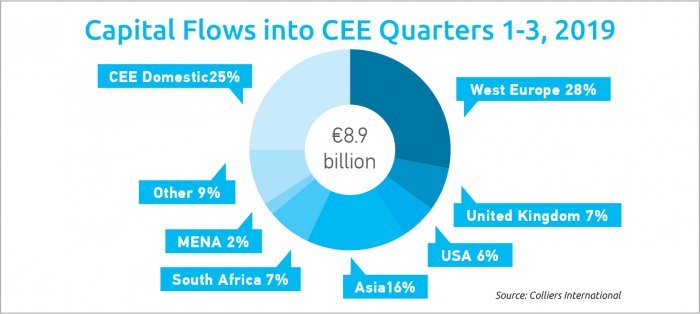
“We expect the region to maintain a similar momentum to the previous three years and forecast a full year investment volume of EUR 12.5 bln-EUR 13.5 bln,” said Kevin Turpin, regional director of CEE research at Colliers. The consultancy recorded a market total of EUR 13.8 bln in 2018 and EUR 13 bln for 2017.
Office will easily take the largest share as it is the preferred asset class for many investors, according to Turpin. Indeed, it has a 58% share of deal flows, followed by retail at 18%, industrial and logistics at 9% and hotel with 8%. Retail is 30% down on the same period of last year, while the hotel sector is up.
Western European funds dominated, closely followed by domestic CEE funds; Asian capital, particularly from South Korea has also been increasingly active.
“The appetite from investors for all asset classes in CEE remains positive, particularly as a vast amount of capital is seeking allocation and the market fundamentals in the region remain compelling,” Turpin explained.
“A shortage of core and core plus product can be found in some markets and sectors, as many such properties are in the hands of long-term holders, portfolios and platforms. In addition, some owners may be hesitant to sell without the opportunity for redeploying their capital,” added Turpin.
With regard to the longer-term prospects for the region, Benjamin Perez-Ellischewitz, head of capital markets at JLL Hungary argues that the current cycle is more favorable than the previous one.
“The banks are more discerning, there is no oversupply as the office supply is 10% of stock and investors have a better knowledge of the market,” he commented at the Portfolio Property Investment Forum 2019. However, big-ticket items are lacking in the Hungarian market, which has a low supply of investment stock in the retail and industrial markets.
The lack of available stock is seen as a particular problem for the industrial and logistics sector according to Marin Polák, managing director and regional head of CEE at Prologis.
Analysts also stressed that the region-wide labor shortage is acting as a brake on development in all sectors, and therefore oversupply is avoided.
Producing journalism that is worthy of the name is a costly business. For over 30 years, the publishers, editors and reporters of the Budapest Business Journal have striven to bring you business news that works, information that you can trust, that is factual, accurate and presented without fear or favor.Newspaper organizations across the globe have struggled to find a business model that allows them to continue to excel, without compromising their ability to perform. Most recently, some have experimented with the idea of involving their most important stakeholders, their readers.
We would like to offer that same opportunity to our readers. We would like to invite you to help us deliver the quality business journalism you require. Hit our Support the BBJ button and you can choose the how much and how often you send us your contributions.